
Translated material
Session of the Neva Battle
In early May, the pirated DVD with the film "Alexander. Battle of the Neva" was not yet on sale. I had to spend money on a movie ticket. About what was on the screen below, first about the atmosphere in the hall, especially since a later analysis of responses on the Internet and print media confirmed the initial impression. Director Igor Kalenov undoubtedly has some kind of magical gift, with the help of which he literally hypnotizes the (admittedly small) audience. After all, in any cinema, literally at every screening, someone loudly explains to their neighbor what is happening, someone clears their throat for a long time, choking on Coca-Cola, someone’s phone rings at a key moment, and this scoundrel answers the call and begins to explain how to get from Lesnaya to Butyrsky Val, and then there is silence. The silence is almost frightening. No laughing, no crying, no snoring, no sobbing. They sat down, looked, got up, and left. However, it seems that director Kalenov’s professional skills (it’s somehow completely inconvenient to talk about talents) are exhausted by the ability to create silence in the hall.
True, one cannot help but admit that the historical spy action film “Alexander. Battle of the Neva” continues the already established trend of the current Russian “educational” cinema. The direction set by such films as, for example, “1612” and “The Servant of the Sovereigns”, on the one hand, supposedly allows you to be imbued with the greatness of Russian history, exclusively by visiting cinemas and making no further effort, and on the other hand, provokes wide discussions of what you saw, for the most part conducted under the now popular slogan “Learn the materiel!”
This trend is convenient for everyone.
Filmmakers who have the opportunity, choosing iconic figures of Russian history, using (including) state money, make films whose action will revolve around a specific event. That is, we should fully expect the appearance of the film "Alexander. Battle on the Ice." With the same actors. Built on the same techniques, also shamelessly using borrowings from other, relatively speaking, historical films, both domestic and foreign.
Viewers, at a minimum, receive a charge of emotions (positive, negative - it doesn’t matter), as well as the opportunity, if they have at least a little experience, to compare domestic film products of this kind with, again, domestic and foreign films of past years.
Those who, like the author of these lines, are trying to understand, analyze what they saw on the screen and share the results with those who have not seen such epoch-making paintings, are not going to watch, but still want to be in the know.
And, of course, to those who are involved in the distribution of public funds and who have the right to put another tick in the “paid” column opposite the next item.
The circle of people is thus closed. Quite a circle, by the way. Everyone is happy. Everyone gets up. In one impulse.
But no! The picture of general pleasure is spoiled by individual self-willed characters.
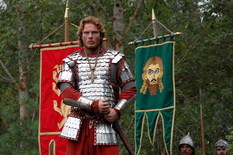
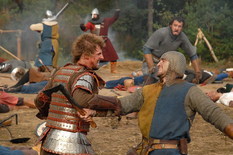
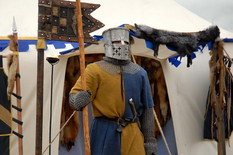
Some, as was the case with Khotinenkov’s “1612,” lament the “failure of the state order.” Someone regrets the rubles spent on a ticket. Someone is beginning to seriously discuss the cinematic merits and demerits of works created within the framework of the “historical” trend. Someone spends time looking for historical absurdities in what they see, as if one of the creators really cares whether they fought in the right armor in the indicated times, why the main Swedish knight in his hands is not a spear, but a poorly planed pine stick, why, when Alexander, the future Nevsky, with his future wife rides along the high bank of a wide river, on the other bank you can see the roof of a modern building, no less than a country villa producer.
It's all empty. Such creations should be accepted with a calm heart. They are not worth the nerves, nor the heated debates, nor the desire filled with patriotic fervor to get an explanation of why the money was given to the wrong people, spent in the wrong way, or for the wrong thing.
Films a la "Alexander. Battle of the Neva" will be created until such an outwardly simple, but at the same time complex thought prevails: "The cinema of Big Ideas is always doomed to failure."
No, no, it’s the cinema of Big Ideas that is always interesting and important for the viewer, even if he is far from both ideas in general and Big Ideas in particular. It’s just that everything turns out like Nabokov, who dreamed of a time when someone would crush the plaster of big ideas in literature with a hammer. Despite all the fundamental differences between cinema and literature, in both cases, Big ideas can only be promoted in the presence of human characters, human conflicts, and, in the end, even if artistically transformed everyday human life. Characters, not masks, genuine experiences, not imitation - only they are able to revive, as Nabokov would say, soulless celluloid. Just like soulless paper, however.
And the “tension” we have is not with the failure or fulfillment of a government order, not with the suitability of the armor on the leading actor for the duration of the action, but with the Man on the screen. Even such brilliant actors as Stupka (he was also used in “Alexander”) cannot, due to some inexplicable reasons, just as the director’s ability to create silence is inexplicable, jump above the image of a doll. Talking heads. Walking manifestos. Nothing natural, breathable. Only artificial respiration of “big ideas”, introduced into the characters as if through a tracheal dilator and launched into the deflating lungs with a special medical device.
The list of films in which Big Ideas coexist harmoniously (one might even say - are produced) with human life is long. The only trouble is that, with rare exceptions, these are foreign films. It is not possible to make a Russian "Braveheart" not because there are no actors comparable to Mel Gibson (although lately it seems that this is the case), and not because our cinematic process technology is hopelessly behind, but because complete devastation reigns in the minds of the creators. However, here the circle closes again...
Therefore, there is no point in writing specifically about the film “Alexander. Battle of the Neva”. The creators should forgive direct borrowings from Tarkovsky’s “Andrei Rublev”, and the melancholy of stage filming, and the ideological stiltedness that is more likely befitting a political agitator.
They can't do better. I think they do. Otherwise it would be completely sad.
P. S. "Alexander. Battle of the Neva" tells about the early years of Grand Duke Alexander Yaroslavich, later called Nevsky, about his first term of reign in Novgorod, from where he was expelled (not shown in the film) after the battle he won on the banks of the Neva (shown in the film). Alexander himself (artist Pampushny) is shown to be wise beyond his years, strong, kind and, in the right cases, tough, even cruel. Maneuvering between the West and the East (the scene in which Alexander resolves the situation with Batu’s envoy, who is literally “protecting” the young prince, is surprisingly consonant with modern times), the prince finds love, defeats his enemies, and builds a vector of historical development. A vector whose direction is still relevant today.