
Translated material
Food instead of bombs
The White Helmets volunteers - the Syrian humanitarian organization - told The New Times about how civilian citizens live in Syria and what it is - what it is - to help people under constant bombing
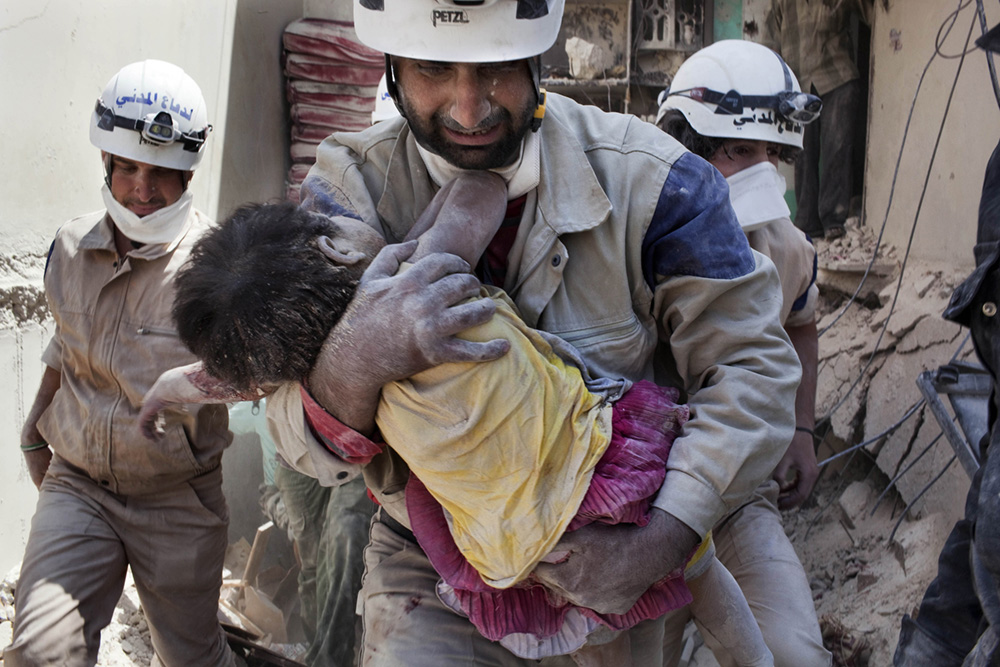
The White Helmets volunteer carries a girl pulled out from under the rubble
Reference
The White Helmets is the Syria Civil Defense (SCD) project, an organization created by a group of Syrians engaged in humanitarian aid to people in fired areas. The network has 114 centers in different provinces and about 2850 volunteers, the center is located in the city of Idlib. The project is financed through the Non -Profit Organization of the MayDay Rescue, based in Dubai, the governments of Great Britain, Japan, Germany and the Netherlands. The head of the organization and the creator (together with SCD) The White Helmets Project is ex-officer of the British army James Le Mesurier.

Ola Suliman, 29 years old
I come from Homs, and when the revolution began, I worked in Damascus an engineer of electrical communities. In 2011-2012 she took part in peaceful protests, as a result of which I had to leave Syria in November 2013. I don’t know how important this information is, but I am an Orthodox Christian, I bring up my son. Now I have to stay in Turkey, I work in The White Helmets Project by the head of the public relations department. Of course, I maintain contact with all volunteers on the spot. Among them there are doctors, and engineers, and students, and workers, and housewives who have never worked before. For example, in the province of Idlib, the richest man of one of the villages sold everything that he had, bought an ambulance carriage and joined SCD.
Our volunteers are those who turned to us for help. So we know well how people live, including in regions, uncontrolled Syrian authorities. They are conditionally divided into three groups. The first is the province constantly besieged by government troops, along which the main front, such as Damascus and Homs. It is almost impossible to live here: there is no food, constant bombing.
The second group of territories is under the control of the Syrian opposition - Aleppo and Idlib, part of the provinces of Homs and Ham. It is better with food here, but it is difficult to find a job, and the prices are high. Services providing public services, of course, are not, and it is impossible to get some official documents. But the tips of the regions keep, for example, unofficial accounting of those born, dead, married, etc.
The third group - regions that have concluded, so to speak, a “truce” with a regime. They are not subjected to bombing, but they have big problems with the supply of food and medication. At the same time, they are densely populated - people flee here from the surrounding regions in the hope of escape from air strikes.
Our volunteer Khaled from Aleppo says that in principle, people can find work in local companies or receive help from their friends and relatives in Turkey. You can work only in two areas - agriculture and services. There are still shops in the cities, there are those who receive income from the sale of fuel. By the way, the power supply is carried out by the residents themselves, buying one diesel generators by one. People in the provinces are engaged in farming, in cities you can work, for example, repairing buildings and establishing electricity. What is natural, because it is necessary to eliminate the consequences of bombing. During 2015, 50 barrels per day were dumped at Aleppo (barrel bombs - homemade shells, for example, made of metal containers filled with explosives, gasoline, nails, shrapnel, etc. - NT). Now Russian bombing are added to this - one blow of Russian aviation led to the death of 36 people in the shelter in Homs. Plus the desire of Daish* expand their territory north.

Jihad, 46 years old
My life, like the life of many Syrians before the start of the war, was completely ordinary. At the end of the university, he worked at the Commercial Bank of Syria, traveled a little-he visited France-and did not have any particularly unusual activities, except, perhaps, fascination with music. By religion, I am a Muslim-Sunni.
In March 2011, I protested in the Daraa Center, because they arrested teenagers who wrote on the wall “The regime should fall”. We demanded punishment for those who tortured these children in the police. I do not regret that I opposed the regime, although I spent two days in prison in May 2012. Friends tried to rescue me, but as a result, I was released only in exchange for one of the law enforcement officers-I don’t know the details for sure. But in prison I was beaten so that then I went to the hospital.
Then I had to leave for Jordan. There I learned about the existence of Syria Civil Defense, which I joined with my friend Gardenia. She is 33 years old, she graduated from the Faculty of Arts of the University of Damascus, worked in medical insurance, was a volunteer at Syrian Red Cross. She participated in a peaceful protest, and when the revolution began, she began to help in the hospital. In the end, Gardenia had to run to Lebanon. I returned to Daraa, and in April 2013 my five friends and I began to work as SCD volunteers, and then - The White Helmets Project.
When the regime leaves the region, there is no infrastructure left - no hospitals, no schools, no utilities. Since I once received an education in crisis management, I deal with organizational issues in Syria Civil Defense, I participate in the evacuation of people. The most important problem for us remains medical care - people who have suffered from air strikes often receive injuries that we cannot cure on the spot. Then we will organize their transfer to treatment to other countries - for example, to Jordan. Another direction of our work is clearing streets and houses from blockages after bombing. Usually, three groups who work within eight hours go to their places - by the way, despite my “managerial” position, I also leave them. We are looking and burying the dead - in fact we try to replace almost all social services as possible.
* Daish or “Islamic State” (ISIS, IG) - a terrorist organization banned in Russia
Photo: JM López