
Translated material
The name of Faradei
The text continues the project on the Ecology "Variable" .
Interior combustion engines, the main motor of progress in the last 100 years, is losing ground. State regulation and responsible consumption force manufacturers to introduce low -carbon technologies that less affect the climate of the Earth. According to one of the forecasts , by 2030, electric cars will be occupied by 58% of the market of cars. At the same time, the final transition to electric motors is still interfering with objective problems: buyers are disturbed by the run range, prices, battery charging and the availability of charging stations. All these calls are associated with one element of electric vehicles - their batteries.
In fact, the range of electric vehicles is already comparable with a distance that an ordinary machine can drive on one tank of gasoline. The standard version of Tesla Model 3 passes on one charge of 350 kilometers, and the car in the Long Range configuration has a range of 500 kilometers. But this is not the limit.
The authors of the British Sunrise project are developing advanced batteries with silicon anodes and designed for electric transport. One of the goals of the project is to increase the range of cars of cars to at least 640 kilometers (400 miles). To do this, developers want to replace carbon in silicon anodes, while increasing the capacity of each battery cell. Silicon anodes should reduce costs, increase the performance of batteries and accelerate charging time.
In fact, Great Britain creates a model that can be relatively easily transferred to Russian soil, there would be political will.
Meanwhile, Redt Energy received a grant of the British government to develop vanadium running batteries - technology that allows you to store energy for a long time without losing charge. One of the largest British energy accumulation projects is the center for the development and production of batteries in Coventry worth 80 million pounds (approximately 6.45 billion rubles). The center open to all British companies will be responsible for the scaling of developments in the early stages.
Sunrise , Redt Energy and the Center in Coventry are only some participants in the UK State Program for Supporting Innovative Development. In order to motivate entrepreneurs and researchers to develop new batteries, the British government launched in 2017 the initiative of Faraday Challenge , a four -year -old innovation development program with a budget of 246 million pounds (about 19.5 billion rubles; the Russian Scientific Fund in 2018 plans to issue grants in all areas of 22 billion rubles. - Ed. ).
The task of Farady Challenge is to commercialize the development of British scientists and make the country one of the leaders of the electric batteries market, Colta.ru was told by the head of the energy direction of the Scientific Council on Engineering and Physical Sciences (EPSRC) Catherine Magnei during the press tour organized by the British Embassy in Russia and Thomson Reuters Foundation .
Machine owners will be able to sell electricity in peak hours and charge batteries at night when energy is cheaper.
Faraday Challenge is divided into three flows: research, applied innovations and scaling. Each direction has a separate budget and its own operators responsible for organizing contests for researchers, developers and business. The mentioned Scientific Council on Engineering and Physical Sciences, for example, is responsible for a research flow with a budget of 45 million pounds, or approximately 3.63 billion rubles. As part of this area, the Faradei Institute is being created , uniting scientists from different universities.
The British Innovate UK British Innovate UK is engaged in applied developments within the framework of Challenge. Among his projects are the development of technology "car-net" ( Vehicle-to-Grid , V2G ). This concept provides for the use of electric vehicles and hybrid cars to transfer excess energy to the network. Machine owners will be able to sell electricity in peak hours and charge batteries at night when energy is cheaper.
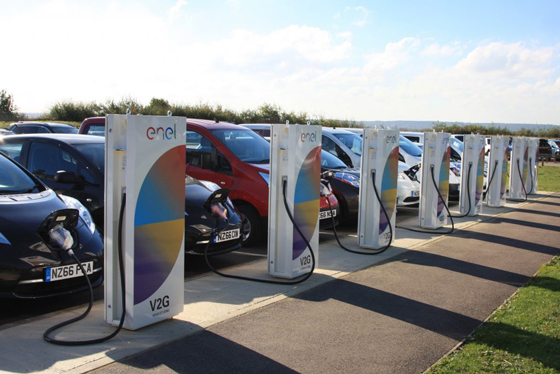 © Nissan Gas station "Motor-network"
The division of the initiative into thematic flows seems very logical: so everyone is engaged in the fact that they do better. Some organizations focus on breakthrough research, others think about the implementation of development in production, and others work on the scale of the industry, turning scientific work and experimental developments into everyday technologies.
Investments in the "batteries" should bring the country a tangible effect. In 2017, the Imperial College of London and Carbon Trust, the study showed that a combination of solutions in the field of energy storage and demand management will help the UK save from 17 to 40 billion pounds by 2050.
In fact, Great Britain creates a model that can be relatively easily transferred to Russian soil, there would be political will. Take the best world experience, create the conditions for the interaction of scientists, engineers and entrepreneurs, invest state money in applied interdisciplinary research and do not interfere - at the exit you will receive a competitive industry.