
Translated material
Syrian gambit
What is the year of the media, as programmed information brigades, under the guise of the main, important news, reports from Syria. We are flickering - where do our taxes go? In an insatiable desert? She surrendered to us with her endless groups and ophthalmologist. How much money is swollen, people are ruined, it would be better if the salaries were raised by teachers, as, by the way, the “May decrees” are doing? The other day the next “reports” appeared - Russian travel agencies resumed sales of tours to Syria. The rhetoric of the "irradiators" is ready to contrast the rotting edges of Hamon and Parmesan of friendly Syria, which looks tragicomic and helpless.
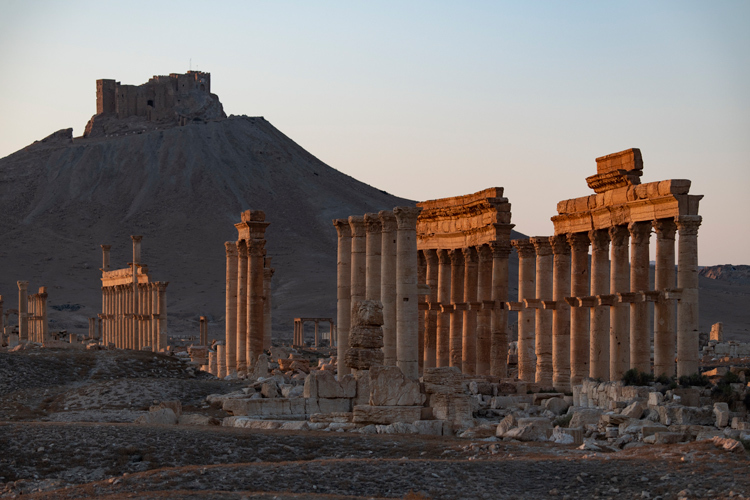
Meanwhile, in the St. Petersburg agenda, news about "Restoring Palmyra by the Hermitage forces" has been flashing for several years. What does the Hermitage have to do with it? For us, Palmyra is part of the television propaganda myth, the culmination of which was the concert of the Symphony Orchestra of the Mariinsky Theater under the direction of Valery Gergiev in the amphithera of the liberated Palmyra (II century AD) in the spring of 2016 (after which the militants again captured the city). But in addition to the shameful latest mythology of Palmir, it is woven into other cultural layers. The city is called "sacred", but over the years of "irradiation" this word was boring and ceased to impress. So let's try to find out again what is so valuable and unique in the dead city. Is there something in the Middle East except for oil and militants who disperse the desert, or all the people standing cultural values compactly and prudently placed in Europe?
Many people see it, and Italy often go to Greece and Italy with the sight to see ancient monuments. Europe in this sense is untwisted to disgrace. A step to the side - north of Africa or the Middle East - and even other former provinces of the Roman Empire are seen native, suitable for habitat within the All Inclusive . What is there, Türkiye seems to many as a country dangerous for a “white man”, to which exceptions of adventure seekers are sent without a thorough. It is possible to watch cultural and historical values not only in Europe, you can watch for a long time and stubbornly, but this is ungrateful. All the same, Italy and Greece will remain in the mass consciousness of open-air museums, and, say, Syria and Lebanon-terrible places where, firstly, it is dangerous, and secondly, there is certainly nothing to watch.
 © Maxim Atantz
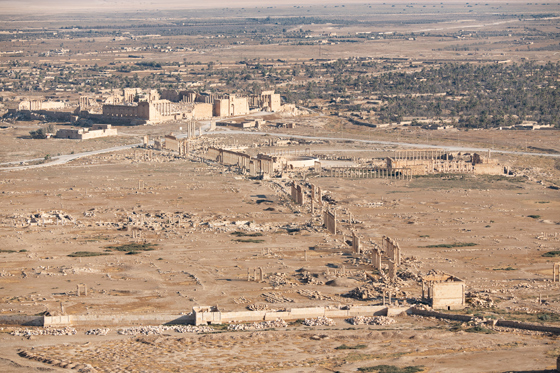
To move away from tourist marketing and geopolitical prejudices, we will divert from modern geography. “As a result of a very large defeat of Emperor Valerian near Edessa in 260 AD The Odenat, the ruler of Palmyra, took a campaign against the Persians and won over them, thereby contributing to the restoration of the strength of Roman weapons. This success allowed him to accept the title of the king. Somewhat later, his widow Zenobia and his son Wahballat also appropriated the royal title. But this demarche was regarded in Rome as a usurpation of power. Emperor Aurelian opposed the Palmyr, defeated them, and the city captured and plundered. After this disaster, Palmyra could no longer rise ... ” - writes Daniel Shlumberge in the book" Hellenized East. " The relationship of Palmyra with Rome resembles Venice and Byzantium - however, with a nasty outcome. “This greatness (Palmyra. - A.S. ) can already be felt by her magnificent ruins, according to its large and unusually rich sculpture <...> at the end of the Hellenistic era, the Palmieris managed to accumulate wealth and organize a caravan trade that combined the Mediterranean from the Partyan Mesopotamia, which, in turn, has access to Persian Gulf - to the country of pearls, in India - the country of spices and aromatic potions and even China - the country of silk. The inhabitants of the Mediterranean dreamed of these objects of luxury, and their resale was supposed to bring large incomes. Thanks to the profitable trade, Palmyra turned into a very large city, which has become a kind of ancient Venice, Venice on solid land. ” So, in a certain period of the history of Palmyra was a rich independent city-state, which had an extremely advantageous geographical position. The exquisite prosperous oasis in the desert between the Roman Empire and the Parthian kingdom. It is logical to assume that at the place of interweaving of cultures under the patronage of wealthy customers, thin, eclectic, not similar monuments appeared to anything.
 © Maxim Atantz
“A traveler who came to Palmyra from Roman Syria would not have felt in a foreign country,” we continue to explore the Shlumberge. “True, with a more careful analysis, the characteristic features of the Palmyr monuments, especially the cults, can be found.” So, the main temple of the city, the Bel sanctuary, “the magnificent building-periper, even more ancient than the courtyard, amazes the unusualness of its plan, with its majestic portal, bizarrely inserted into the colonnade, and the peculiarity of numerous elements of the decor. In another large sanctuary, the temple of Baalhamin <...> there is an opposite phenomenon. There the temple is built later than the peribol surrounding it. He dates back to the time of the reign of the Roman emperor Adrian, both according to his plan and decor, could be considered a Greco-Roman building. But the sanctuary, in the center of which this temple towered, which was gradually created in separate stages during the 1st century. AD, is in the eastern manner of the pile of yards and various premises. There were found archaic capitals with powerful volts and Abaka, displaced from a separate block. The feast of the hall was identified ... It is assumed that the ancient, freely developed palmira, the decor of which was distinguished by the independence of the style and repertoire from the art of the Roman Mediterranean, during the I and especially the II century. N.E. The Greco-Roman Palmyra followed ... In the sanctuaries and along the streets, console porticoes on which statues were placed on the streets-a custom, apparently preserved in the architecture of Palmyra until the last period; If we try to mentally imagine these ranks of the bronze statues standing on the consoles, at an equal height between the Earth and Architrav, just above the head of passers -by, it will be obvious that they should give the city landscape a special, by no means classic, shade. ”
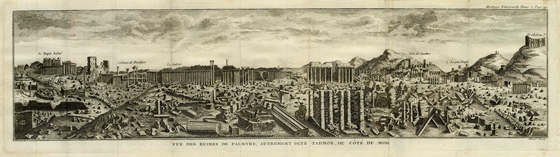 Panorama Palmyra. Etching. According to the original by J. H. Van Essen 1693 from the collection of M. Atantz
The sculpture of Palmyra is particularly distinctive: “In the sculpture of the images of characters, which are whole hundreds, are always given strictly in the FAS ... In this case, we are not talking about any chance, but, on the contrary, about the most important feature of the art of Palmyra, which is sharply distinguished by this last from the art of the rest of the Roman Syria and, in general, the Greco-Roman world. <...> The main feature of the fine art of Palmyra, as we have already said, is the convention of the image in which all the figures are strictly given in the FAS ... The same feature is also characteristic of the painting of a fool, the reliefs of Hatra and the casual sculpture of Elimaida. " After studying costumes, fabrics, jewelry, funeral reliefs, it became clear that two types of costumes were worn in Palmyra - Greek and Iranian, despite the fact that in neighboring Roman Syria, the Iranian costume did not wear a costume at all. And some ornamental motifs noticed in Palmyra were not known in the Greco-Roman world, but they were discovered, for example, in India. The gods here were also their own - local Semitic cults.
Obviously, in the case of Palmyra, it is not just about the province of the empire, albeit rich, but about the bizarre layering of self -sufficient cultures, which gave rise to a brilliant stylistic hybrid. The city is recognized as a UNESCO World Heritage Monument. In a word, the fate of Palmyra should worry not only Russian television.
At the press approach in the Palmyra Hall in the Hermitage in August 2019, Mikhail Piotrovsky asked not to replicate the news about the “restoration of palmiers”. Russian specialists really created the 3D model of the current city, withdrew and processed information about twenty square kilometers of the monument. Simply put, we know where which stone fell from. But the idea of recovery contradicts the Venetian Charter. Now, in the restoration community, it is considered a bad tone to build antiquity again; For clarity, the director of the Hermitage gave an example of Peterhof (and other suburban palaces of St. Petersburg), who was rebuilt after the war. It is this that is not consistent with world restoration trends, even if we are glad that there is Peterhof. Piotrovsky recalled that there is still a war in Syria, "people are starving, and when they begin to restore some luxury nearby, the reaction to this may not be very good."
One of the main reasons why our experts do not intend to build Peterhof 2.0 in Palmyra is UNESCO. However, according to Mikhail Piotrovsky, now the international organization does not conduct any work in Syria, since ... the country is under sanctions. The World Heritage is not lucky to be in Syria, where UNESCO, as they say, “paws”. The general director of the organization Odra Azule, in an interview with the last spring, answered the question of Syria quite streamlined: “What is happening today in Syria is a tragedy. The tragedy, first of all, for the Syrians <...>. And, of course, it was a tragedy for a cultural heritage, which was often intended in front of his eyes. They became the goal as historical symbols <...>. Today in Syria, the International Community with the support of the UN has not yet completely begun to work on Earth, but we are already acting <...>. For example, we are working on the preparation of Syrian technicians in our foreign representative offices. <...> I think about what to do in the old city of Aleppo. " It is hoped that the international community will someday be untied the “paws”, because Syria-a region saturated with world heritage-deserves the entire possible concentration of specialists.
 Panorama Palmyra. Etching. I.S. Müller on the original J.B. Borra of 1753 from the collection of M. Atantz
But if the restoration is a question for the future, then the problem of predatory excavations in Palmyra is what you had to think about the day before yesterday. “There are pits where the caliphate was really actively digging during the existence of the caliphate,” said Piotrovsky . “There were many robberies,” Natalya Solovyova, deputy director of the Institute of Material Culture of the Russian Academy of Sciences, confirmed , regularly participating in Russian expeditions to Syria. - When we transmitted information about their number of Syrian colleagues, even they were surprised. What pops up is isolated cases. Many monuments may never come up, settle in private collections. ” It seems that if the country is under sanctions, and even at war, the World Heritage on its territory can be robbed, sold to private collections - but what will be more purpose! How did it happen that a large civilized community with the principles (!) Does not seem to notice a uniform, requiring an operational “field” work, if not upon the return of the lost, then at least to fix the damage?
In May 2015, the ancient city was captured by ISIS militants (the organization is prohibited in the Russian Federation. - Ed. ). The exhibits of the museum, which was in a small town near the architectural monument, was saved with great difficulty by employees. The ancient city itself was looted, many monuments were destroyed. In the spring of 2016, the Syrian army and the Russian VKS repelled Palmyra, but by the end of the year the city was again captured. In early March 2017, Palmyra was again returned to the control of government troops. The militants destroyed the temples of Bel and Baalhamin, tombs in the form of towers, amphitheater, a monumental arch. In the fall of 2019, the head of the Department of Antiquities and Museums of Syria, Mahmud Hamud, said in an interview that in total, about 1 million monuments have been plundered or damaged in Syria since 2011. About 25 thousand things managed to return with the help of the military, something is controlled by the "unofficial" ways. By the way, Khamud said that there were no replicas from the Russian side so far: that our experts will help to implement a pilot project of restoration - to restore the triumphal arch.
Trying to figure out what happened and clarify the future of Palmyra, I meet with the architect Maxim Atayan. He studied in detail the antique monuments of the Middle East and North Africa even before the aggravation of the geopolitical and military situation in the regions, several times in Palmyra and after the destruction of the city.
- The eastern Mediterranean and the coast of North Africa during the Roman Empire were prosperous provinces with a rich life of large and small cities, where there were a huge number of monuments. There would be no less in Spain and south of France, but due to the specifics of the further development of civilizations, the safety in the Middle East and north of Africa is much better, ”says the architect. -I am talking about Morocco, Algeria, Tunisia, Libya, Israel, Jordan, Syria and Lebanon-I visited these regions intensively from the two thousandth years, until it ceased to be possible because of, let’s say, the mistakes of large world players. In Syria, I was the first time in 2005, I saw Palmyra even before destruction, in Lebanon and Jordan was more often. When the news sounded that the militants blew up two temples in Palmyra, I reacted painfully painfully on this and, on my own initiative, began a draft digital reconstruction of the Bel Temple - one of the two blown up. Then many in the wake of the rising hype rushed to do this, but there were a lot of PR and hacks: I remember, there were proposals to collect some kind of arch on Trafalgar Square and all that spirit. Serious specialists were silent. When Palmyra was freed, a group of archaeologists from the Institute of History of Material Culture of the Russian Academy of Sciences went there on an expedition. In a difficult environment, with the help of our military, they worked on professional shooting of palmira in high resolution. It was necessary to remove the entire area of the archaeological monument, where, in addition to conscious destruction, there are many traces of black diggers. At some point, ISIS again took Palmyra. Now they have been repelled from them - let's hope, finally.
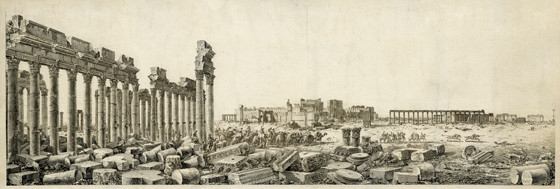 Panorama Palmyra. Etching. J. Malbest and R. Dode according to the original L.F. Kassas 1799 from the collection of M. Atantz
In Russia, to oversee issues related to Palmyra, they entrusted the Hermitage. In the second half of November, Mikhail Piotrovsky visited Damascus, a Russian-Syrian agreement was signed on cooperation in the field of preserving the cultural heritage.
“Now not only an archaeological monument is ruined, but also an adjacent residential town who worked for tourists who visited Palmyra,” the architect continues to share reports. -It arose when in the thirties the French colonial administration carried out research work and relocated the Bedouins who lived in the fence of the Bel Temple for several hundred meters. Then hotels, infrastructure appeared in the city, there was a museum. The city and the museum were ruined, now two or three hundred people live there, but so far this is still a very difficult place. The museum was, among other things, deliberately destroyed - exhibits were broken, face were knocked down.
- That is, it is not looted in order to sell?
- There was part of the “PR” - demonstrative destruction on the camera, but there were also attempts to trade for benefit. I have considerations about why it was all breaking it all. In this case, you can’t write off everything on religious motifs, even if you keep in mind the fundamentalist Islam. So it would be possible to substantiate the destruction of sculpture, but arches, theater? So, it's not about religion, there is something else. Why did these things have been there for so long and well? They were part of a geological landscape - stones, which, by and large, were not needed by anyone. From this and high safety. Since the 18th century, local residents realized that for some reason, these stones have great value to European tourists. And the terrorists, it seems to me, took them “in hostages” - as something that has a value to the enemy, but not for you. And they began to demonstratively destroy-how they record a video with the torture of hostages-people. Only in fact it turned out that Palmyra for the so -called Western civilization is not such a value. For some reason, we need it only.
Answering the question of predatory excavations, the architect mentioned that the Department of Antiquities of Syria banned the export of antiques from the country - but again we are only talking about territories subject to official Damascus. Now this is already a majority of the country, but how much it was exported before is difficult to calculate. If the architecture is difficult to “take away”, then the scale of the plunder of bronze and jewelry has yet to be evaluated.
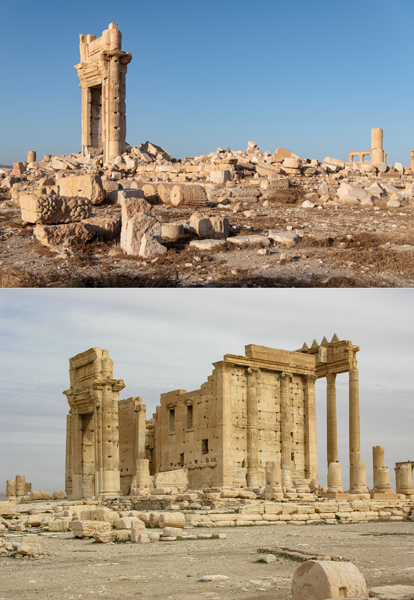 Palmyra. The view of the temple of Bela from the southwest. Photo by M. Atants 2019 and 2005.
- What is the catastrophic of losses suffered in Palmyra? Most of these architectural monuments of museumified antiquity that we see in Turkey, for example, or Athens, are the result of anastilosis, that is, recovery, when archaeologists, having a collapse from blocks, restore the monument to which it looked exactly what it looked. When we see ancient ruins, very often this is the fruit of the great work of archaeologists. In Palmyra, the temples of Bela and Baalhamin were preserved from antiquity indestructible. На гравюрах XVII—XVIII веков они точно такие же, как были до 2016 года. Поэтому утрата колоссальная, их архитектурная и художественная ценность очень велика.
Архитектура Пальмиры вообще очень рафинированная, высококлассная. Храм Бэла интересен также тем, что по форме является обычным периптером, которых много в Греции и Риме, но был приспособлен под другой культ — семитский, там даже вход сбоку. Получился такой «монстр Франкенштейна», явление очень интересное. А храм Баалшамина до того, как был взорван, оставался единственным античным храмом с уцелевшей алтарной частью. И все это сейчас в руинах, хоть и узнаваемо. Помимо храмов там взорвали триумфальную арку, тетрапилон и сцену античного театра. Но эти три памятника уже были восстановлены в 30-е годы. Ужасно, что взорваны также монументальные башенные гробницы на северо-западе города, и пока сложно понять масштаб бедствия — возле них еще не все разминировано. До разрушения там были в сохранности интерьеры, бюсты, следы раскраски.
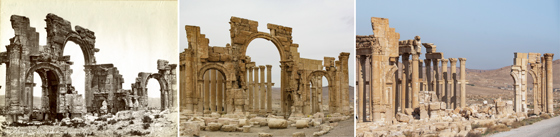 © Институт истории материальной культуры Российской академии наук Пальмира. Триумфальная арка. Вид с юга. Фото конца XIX в. из научного архива. Фото М. Атаянца 2005 г. Фото М. Атаянца 2019 г.
Максим Атаянц вслед за Михаилом Пиотровским замечает, что ни финансовой, ни научной либо организационной помощи Сирии со стороны ЮНЕСКО нет, — архитектор тоже полагает, что дело в «неприятии официальной сирийской власти западным сообществом во главе с США». Хотя Соединенные Штаты и вышли из ЮНЕСКО в 2018 году, очевидно, влиять на курс организации это не мешает.
— Хорошо, что российская традиция изучения Пальмиры берет начало с середины XIX века, то есть у нас приличная собственная исследовательская база, — продолжает Атаянц. — А прекрасные специалисты из Швейцарии, Италии и Франции вынуждены проявлять интерес в обход своих правительств. Например, насколько я знаю, храм Баалшамина на предмет возможного восстановления исследует итало-французская группа. Некий интерес есть со стороны Китая, но в чем конкретно он выражается, я не знаю.
Итак, во-первых, мы выяснили, что сирийские памятники — явление тонкое, неординарное. Во-вторых, эти красоты на наших глазах демонстративно разрушают и грабят, и противостоит этому аду суховатое и пассивное «выражение озабоченности», которым политики прикрывают бездействие. Отношение мирового сообщества к «нетуристической» античности мы обсуждаем со старшим преподавателем кафедры истории и теории искусства СПбГУПТД Марией Назаровой.
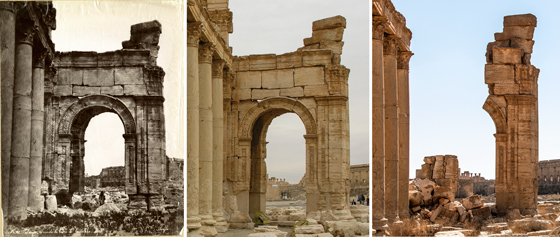 © Институт истории материальной культуры Российской академии наук Пальмира. Триумфальная арка. Южный пролет. Вид с запада. Фото конца XIX в. из научного архива. Фото М. Атаянца 2005 г. Фото М. Атаянца 2019 г.
— У меня сложилось впечатление, что не только Пальмира, но и другие античные памятники Ближнего Востока и Северной Африки не особо нужны т.н. западной цивилизации, хотя свою европейскую античность она любит. Почему, на ваш взгляд, так происходит?
— С памятниками Ближнего Востока существующие сложности, связанные с изучением, сохранением и популяризацией, можно попробовать объяснить стечением нескольких обстоятельств. Здесь и удаленность их от «европейского центра» — ведь каждое отдельное современное государство, территория которого была прежде частью Римской империи, заботится именно что о своих античных древностях. По сложившейся в науке практике сравнивает свои древние памятники с аналогами, как правило, опираясь на столицу и «центр», в качестве которого выступает современная Италия. На Ближнем Востоке меж тем отмечается крайне неспокойная политическая ситуация: Ливия, Сирия, Ирак, Алжир (до 2011–2012 годов). В условиях войн, восстаний само собой разумеется, что о древностях, как и о прочих памятниках, особо думать и заботиться местные власти не будут. Для западного мира эти самые древние монументы из-за их отдаленности (а отсюда и малоизвестности) часто остаются «вне поля зрения». Итальянская и греческая античность — вещи очевидные. Отсюда и желание всяких Испаний, Франций, Германий и прочих, кого затронул Рим, показать, что «и мы, и мы тоже могём, и у нас, смотрите, все есть». В Хорватии, например, отличная античность, но про нее в мире вспомнили только после развала Варшавского договора и распада Югославии. И дали денег в двухтысячные.
Говоря об «инстаграмной» популярности памятников Италии и Греции, Мария поминает неочевидное: «Кто нынче поедет, например, в Алжир? И даже крайне опытный организатор поездок деятелей культуры и искусства не знал про археологический музей в Рабате».
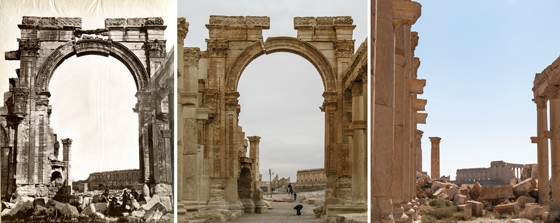 © Институт истории материальной культуры Российской академии наук Пальмира. Триумфальная арка. Центральный пролет. Вид с запада. Фото конца XIX в. из научного архива. Фото М. Атаянца 2005 г. Фото М. Атаянца 2019 г.
Так что инициатива российской стороны говорит в том числе о политических имперских мечтах. Обработан огромный массив данных, создана 3D-модель Пальмиры в ее нынешнем состоянии. Запущен сайт, куда каждый побывавший в Пальмире до разрушений турист может загрузить свои фото, тем самым помогая уточнить модель. На этой базе специалисты со всего мира смогут работать сообща, предлагать решения по реставрации и сохранению. Помимо острого чувства прекрасного и невозможности вынести пытку уничтожением цивилизационно значимых вещей, желания помочь такому беззащитному «заложнику», как археологический памятник, и горячего научного энтузиазма (возможность поработать с такими объектами!) тут ощущается патетика высокого государственного интереса. Своеобразная надстройка российской истории в глубину и ширину, каковой было, например, и государственное медиасопровождение крымских событий с тезисами про сакральность полуострова. По-настоящему своей, домашней, античности у нас не было; наверное, поэтому мы так настойчиво ищем точки опоры на ее восточных рубежах, там, где к греко-римской ясности примешивается византийская пышность или парфянская причудливая утонченность. Пальмира отлично вписывается в ландшафт нашей вымышленной ментальной родины. В то время как другие страны, нагруженные античным наследием, являют осознанное лицемерие, российские специалисты трудятся «в полях». Это может казаться политическим расчетом верхов или наивным рвением конкретных людей, но речь о сложной работе в регионе, разоренном войной. То есть о деле важном, нужном и своевременном — независимо от мотивов и того, насколько вам по душе его медиасопровождение.