
Translated material
Poetry of powerlessness
In society
 Poetry of powerlessness
September 9, 2013 Sergey Gogin
But it was not for nothing that the Duma “furious printer” was called the furious. Obviously, this definition applies not only to the speed with which our so-called legislative power gives an anti-constitutional acts to the mental state, but also to the mental state of the authorities (if we assume that the power elite as a sociological group has a collective psyche). The thought may not be new, but I recently read the decryption of the lecture by the famous American psychotherapist Michael Miller and realized that the motives of the Russian authorities are surprisingly similar to the motives of paranoid. However, this is not a Russian exclusive, paranoid features have any authoritarian regime.
Miller quotes another smart American, anthropologist Ernest Bekker, who writes in his book “Angel in Armor” that Paranoya is a person’s poetry who stands on a fragile pedestal and feels terribly small and unprotected: “With his shatter, the paranoic support looks at the world that seems to him incredibly large, and tries to somehow understand his own in his own A painful position, applying the creative capabilities of human imagination. As a result, dramatic, sometimes brilliantly built plots appear, including themes of danger, threats, conspiracy and betrayal. In other words, paranoia is a poetry of powerlessness. ” In fact, it is impossible to call the laws all this Milovshchina and Mizulischina-these are songs, not laws, but minters-mudflies, however, not folk, but bureaucratic ones.
Poetry of powerlessness is also creativity: paranoid, as you know, are active artists of life. Paranoia is a creative way out for a person (power elite or even society), who feels the gap among themselves and others, especially when others persistently invite to join or when there is an inner desire to become part of the community. But paranoid with his own hands is digging the abyss that separates him from others: afraid to show weakness or inferiority, he must stay away from the team in order to maintain his individuality (we love to call it “national sovereignty” and “special path of Russia”). Power-paranoid grows the abyss and says: we have, Soviet (options: Russian, Russian, Orthodox, heterosexual), our own pride, we are on bourgeois (options: “Americans” and the West, “liberals”, atheists, “homiks”) we look down on the way.
Paranoid, in particular, the paranoid power is a mental disabled person who is unable to join the group, but passionately wants to do it. He feels at the same time both next to the group and outside of it. To be near the group (for example, with a group of world powers, to be a member of PACE, the WTO, the UN Security Council, the “twenties”, formally recognize the priority of international law) and at the same time far from it (insisting on its unique “Eurasianity”, “sovereign democracy” and “special mission of Russia”) - it is impossible to withstand such a breakdown of consciousness without justifying his position and not explaining to itself without explaining to itself. In it. Which with brilliance and does the gifted paranoid gifted with the creative imagination. He ascribes to others his thoughts and feelings (in psychology this is called projection). For him, his own fantasy is the reality of the environment.
Fantasies are needed in order to fill the abyss between themselves and others. “The paranoid personality uses projecting in an attempt to invent an alternative way to be involved in the group, at the same time avoiding it,” says Miller. “In fact, Paranoik writes a novel or play, in which he is the main character, and everything that happens in the group has an attitude to him.” If someone is talking on the sidelines, then "they are building a conspiracy against me." If they are invited to joint activities, "they want to use me." They don’t invite anywhere, which means they “want to get rid” because they are “afraid” or “envy”. For Paranoic power, the whole country is teeming with “foreign agents” and opposition, who want to arrange a coup on Western money, and power is a collective James Bond, which prevents this.
The main consolation of paranoid is to make an elephant from a fly. For him, everything that others do is a conspiracy to drive him into a corner. Thanks to his conspiracy fantasies, he begins to experience a sense of his own significance - he is associated with everything that happens, albeit negatively. This is a miserable, unenviable, flawed state, but now paranoid has an illusion that he threw the bridge through the abyss and now his nightmare will receive an explanation, Miller explains.
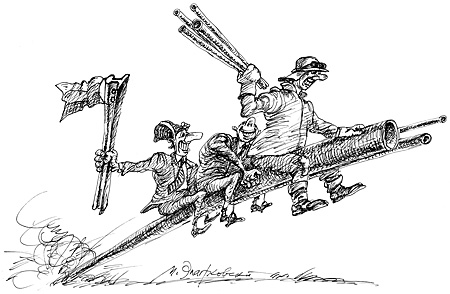
Even if the described analogy is conditional or not quite accurate, it explains something. The fragile pedestal of our power is oil and gas. This is a shaky support, because the price of energy resources depends on the state of the global economy, the influence of Russia on which is not too large, and is prone to fluctuations. At least a couple of times in domestic history, a drop in oil prices led to serious cataclysms in the country. There are no other supports: there is no diversified high -tech economy and strong civil society, but there is a dilapidating infrastructure of the Soviet era, an aging and not very healthy population, a large, ineffective, corrupt state (our power - hydrocephalus) with its monopoly. Scary, uncomfortable. The loose, vulnerable Russian giant (or, conversely, an evil dwarf?) Sits a pipe thrown over the abyss, and "looks at the world that seems incredibly large to him." In fact, the abysses are two, and both man -made. Accordingly, there is a double paranoia - in the external arena and within the country.
One pit separates the country from the so -called civilized West. Work is underway to expand this pit by strengthening authoritarian trends in the country and mass violations of the European Convention on Human Rights. I would like to be with Europe and at the same time I want to avoid this contact, because I will have to communicate with people who do not accept authoritarianism, but consider gays ordinary citizens. The splitting of collective consciousness occurs. Therefore, a creative device is turned on: we launch a militant about the conspiracy of the world backstage in the media, which, it seems, seems only to the author of the militant and his loyal readers and spectators, we suspect that in Borjomi and Georgian wine, we give a refuge Snowden. The Law of Dima Yakovlev is a head of this detective with Russia in the title role, and it does not matter that this law has harmed mainly by this law, but there is an illusion of influence in the international arena. As for large international image projects - the Universiade in Kazan, the Olympics in Sochi, the World Cup - they can be considered as an attempt to contact (but on its territory), and as an illusion of influence, projection, fantasy about their significance, and fantasy, which costs real and big money.
The second abyss is between the authorities and the people within the country. Its tangible manifestation is corruption, social stratification, increasing rupture in income between the poor and the rich. Power, this hump-bolt on the pipe, seems to want to be with the people, and does not want to not mix with him and not lose his “power identity”, which ensures income and privileges. Civil life seems to her too large and complicated, moreover, dangerous, because civil processes lead to a change of power. This abyss is also the work of the authorities: it destroys democratic institutions by emasculation, breaking off the threads of feedback with society. The illusion of the “unity of the party and the people” is supported with the help of a heroic play about the stood from the knees. As it moves to hospitalism, the class struggle is growing, isn't it? Therefore, internal enemies appear in the play, and instead of contact with society, he is given repressive laws. Hence the “frantic printer” as a product of a sick fantasy on the topic of lawmaking. For paranoid power, fantasy (projection) that Khodorkovsky stole all oil, Navalny - forest, and demonstrators were beaten by riot police on Bolotnaya, and becomes a legal reality. Falsification of elections is also a projection, embodied in numbers, the illusion that the people love and support the party in power.
The basis of any fears is the original fear of death, the inability to reconcile with the limb of their own being. Obviously, this applies to the despotic power of the Byzantine type, leading its origin from God. But the power consists of living people. The same Ernest Becker in his work “Deny of Death” writes that the individual, protecting himself from the world, acts “animals” - limits his vision of the world, dismembering it into pieces, so that it is easier to cheat: “Most people only look at the fact that they have under their feet, but if a person thinks about the eternal problems of life and death, he will cause a disorder.” Maybe this is simplification, this bad dichotomy, that is, the division of citizens into patriots and “jackals” among embassies, division of NPOs into worthy grants and “foreign agents”, and so on - this is not “not upset”? Then frantic norm -making is a vulgarized decartion: “I write, like, laws, which means I exist.” This is a special pagan ritual of faceless frightened people in power, which helps them get rid of the idea of death, because before the same Orthodoxy you still have to grow up the soul, there is little one Easter standing. This is a reminder to the world in the style of the Gogol's “auditor”: “Yes, if this and the sovereign has to, then tell the sovereign that, they say, your imperial majesty, Peter Ivanovich Bobchinsky lives in such a city.”
The paranoia described, as well as the fear of death, is treated only with contact - both with the international community and with society within the country. To just live and enjoy life, you will have to get rid of the messianism and the Eurasian mania of greatness.
Graphics of Mikhail Zlatkovsky / Zlatkovsky.ru