
Translated material
To the issues of reclamation
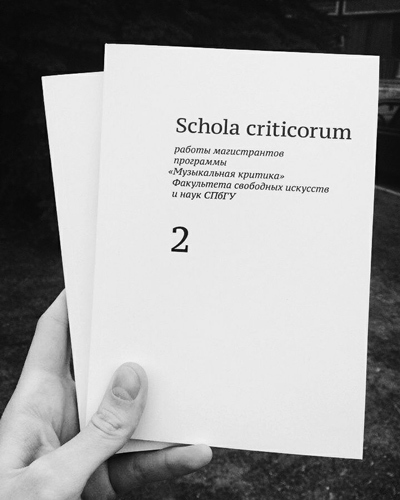
On July 20, the acceptance of documents for the master's program of the Faculty of Free Arts and Sciences of St. Petersburg State University in the direction of musical criticism ended , and in early June online the second release of the Schola Criticorum almanac, which appeared in the spring in the spring of 2017. This almanac is a collection of texts of undergraduates and graduates of this program, called, as reported in the annotation, "to refute the most common opinion that professional musical criticism in Russia is dead or speaks in a dead language." The text of the texts consists of essays, reviews, announcements and materials in some other genres, one way or another related to the sphere of academic music and the opera theater. In order to finally refute (or, conversely, strengthen) the aforementioned considerable opinion, Viktor Vilisov asked six authors of the second release of the almanac to answer eight questions about musical criticism, its current state and functions, about its isolation or offset, about the media, on the sites of which this criticism exists, about its relations with art and some art producers and some art and some manufacturers and some friend. The resulting monologues in an unexplored form is given below.
Polina Dorozkova
Alexander Ryabin
Ekaterina Baburina
Ilya Popov
Aya Makarova
Bogdan Korolek
Polina Dorozkova

It seems to me that the question of the need for musical criticism may arise due to the feeling of loss and ignorance-and to test it completely naturally. Say, if earlier the article Criticism N appeared in the newspaper every Thursday on the sixth page, now there is no pattern and stability-but this does not exclude the fact that some texts are still interesting to someone. The mechanism of interaction has changed, which everyone only learned to use: the imposition method works weaker and weaker - everything that is uninteresting is gradually washed out of the information field. An inventive critic will be able to react to these changes to these changes - so this is a question not of temporary prospects, but rather skill and technology.
I would not deny the isolation of musical critics from a wider cultural field - there are vivid exceptions, a lot of nuances, and probably correctly switch to private examples (which is tiring and inexpensive). As a reader, it is more interesting for me to see the texts that diverge in different directions, absorb different cultural associations - and therefore seems boring and meaningless, often encountered one -dimensional reviews of opera performances and concerts. This can be fixed with a good educational program, focused on interdisciplinaryness, even before the critic of various professional cliches is assimilated.
The boundaries between musicology, musical criticism and musical journalism are indicated quite expressively - the scientific field and a small range of events and publications associated with it are assigned to musicians. I got the impression that they have no special desire to contact the general public - therefore, in the conditional “poster” or even on the Colt, you rarely hear their direct speech (and, it seems, they do not really strive for this - due to internal inertia or self -sufficiency, I do not know). Musical criticism and journalism live according to more democratic laws - they will not work without expansion into public space.
It seems to me that the most important of the functions performed by criticism are educational and curatorial, their optimal ratio. Criticism in a modern edition should rather be like orientation of society/readers - for it you need to create a simple and accessible to a large number of people who can be used to explain more complex things (if you agree that there is a certain level of distrust, misunderstanding between the audience and the professional community).
The overwhelming part of the critical community now maneuvers between lacket and clake.
In the sense of media, now you have to choose between two extremes, quite uncomfortable and far from always attractive. On the one hand, these are small and little -known specialized publications (such as “musical life” or “Bolshoi Magazine”), on the other hand, constantly decreasing islands of activity in large editions, in which a small number of writing authors were fixed. Phenomena such as the section of academic music on Colta.ru or the Paper Magazine “Theater.” - exceptional cases, and they are clearly not enough for a full -fledged review of musical events. In addition, in the work in the editorial office there is one burdensome circumstance - the need to smooth out their author’s, subjective statement. Now this problem is solved by new media, for example, T Elegram channels. It turns out that the figure of a newspaper columnist can be easily replaced by the author of such a channel - for me it is a very important and promising circumstance.
The fees for critical texts make up a very insignificant part of my income - I do not think that in the near future the financial management of the Russian media will change a lot, and I do not really like it to adapt to existing options. The critic, by and large, has two scenarios: to collect a collection of small (if not miserable) fees every month or strive for the position of lifelong luminaries in a respected publication in order to guarantee a high income. Both paths are not very interesting to me - in this case, it seems to me, it takes more strength to financial manipulations or self -defense than creative work.
I can note some things only in relation to academic music-I will not take the judgment of the whole immense field of musical criticism. Outwardly, everything looks quite dynamic: they write more, the critics workshop is growing quantitatively - after the program of musical criticism at the faculty of free arts and sciences of St. Petersburg State University, a similar program appeared in GITIS. Maybe something like a bright surge in activity in the 1990s begins-but I am afraid to overestimate the scale of all these changes, and it is quite possible that this is a storm in a glass that only people who are involved in this are noticed. Ask me in a couple of years!
If we talk about the relationship of criticism with art producers - it seems to me that the vast majority of the critical community now maneuverates between lacase and chatting, and since this is all - the personal choice of each individual person, it is worth thinking whether to make all his professional life to the triad “shake your hand, get a ticket, roll your eyes with delight”. This has nothing to do with professional modesty and sensible attitude to his work that the critic must have - this is precisely a conscious descent to the level below the art producers and the desire that arises from it to focus on creative whims. I think that today you should get rid of the amyconscence as hard as possible - and not to tie a critical assessment of personal acquaintances.
Alexander Ryabin
As today, yesterday and tomorrow, musical criticism needs the reader. The reader as it was and will be an unknown person. Not everyone comments on the message in social networks, not everyone makes it known that he has read something. The viewer of views says something, but, except for numbers, it is not entirely known what exactly. Who reads Ganshlik or Stasov today? One who needs; It is not entirely clear why, but it is necessary. Who reads today's critics? Apparently, for exactly the same reasons. So in the future in this sense I do not think that something will change. I am a reader, and I need her. Here I have a friend, he loves Formula 1. But he does not look at the races, only reads reports and selflessly talks about engines, pilots, difficult sections of the tracks. As I did not understand, I don’t understand: why does he need this?
Criticism retains, tells, asks questions, answers, enlightens and so on. I do not think that there is a “critic” that performs some functions. There are critics who write what they consider necessary, according to their ideas about criticism. There is no criticism at all , but in particular there is - this particular person. And someone does not fulfill the educational function, someone does not think, and someone on the contrary, and so on.
I have the feeling that the environment of people from the hydrometeorological center is much more sealed than even ballet critics. This is just a sensation.
On the corner of Nevsky and the sink there is a Vertu salon. It seems to me that visitors to this store are a very closed environment, and I do not really understand why I should go into this salon, but I think if I decide to go there and find out what and how, then a lot of interesting things will be clarified. If you go in the lack of money, you can make money. This is one conversation: you need efforts, as with an opera, or ballet, or generally a theater, or a Skid Row group. If it’s not clear to me why this store is another question. And it's not a special high status. You just need to do something. And the environment will open.
I have the feeling that the environment of people from the hydrometeorological center is much more sealed than even ballet critics.
With regard to academic music, it seems to me that the matter is bad with the media, but the problem is not in articles and the level of skill-there are still fewer enthusiasts, although there are enough low-grade srachs-but just a lot of things and who have a lot of things where. Brave people in courageous publications, whose leadership understands that this is a necessary business, wrote and continue to write, speak and tell, but ... Here the trees in Moscow will illuminate billions of rubles. Well, it will be beautiful to walk Muscovites.
To earn in our prosperous country, you need to write every day. Here someone complained about translators-to earn money, you need to steadily translate in a month by book. To be a freelance critic, then receiving one and a half to two thousand rubles per text-it means to write at least one per day to get 45-60 thousand rubles in thirty days. No one needs such a conveyor. If it’s regular - I don’t know, I was not like that. But I am on another conveyor - I sit down and shamelessly a hundred announcements in the night I write.
In Moscow, they have just opened a reception to the magistracy in the direction of “Musical Criticism”. In St. Petersburg for the fifth year is a magnificent program. Something is happening. Dear people continue to write, new people appear, they also seem to listen to them.
Critics with everyone in warm, friendly relations. The audience is friendly and rightly believes that the critic is necessary, and his thoughts are balanced and accurate. Art manufacturers come to discuss production. It is only necessary to strengthen these ties. Then all critics will become musicians, musicians - critics, philosophers - kings, kings - philosophers, proletariat - officials, officials - proletariat, men - women, and women - men.
Ekaterina Baburina

The reader needs criticism to navigate the content offered to him. I don’t think that she ceased to be needed in this capacity: you still won’t see all the performances, and one head is good, but two are better. It is impossible to talk about the institutional need for opera criticism, it seems to me that either I need to talk not to me - I believe that criticism is written for people, and in this sense it was, is and will be necessary for everyone. Because the experience gained in the opera theater is able to enrich anyone.
I would like criticism to perform the function of attracting people who have no habit of going there, but the format that has developed in the domestic critical industry does not imply this. And in order to develop a more suitable one, completely new sites are needed, apparently with a different approach to the presentation of materials.
Any environment where specialized issues are discussed may seem airtight. What do we consider to be open? The ability to write about the opera, and about ballet, and about drama? I believe that there are such multi -malls, but I’m not sure that such omnivorousness is necessary. Specialization of topics is valuable, which allows the expert himself not to choke in the sea of information.
The question about the appropriateness of the word "industry" is not the first of the terminology related to the terminology. I do not mind, let's call this word the environment of professionals creating a professional product - if for us it is insignificant that our production is not conveyor and is not connected with the generation of cash flows.
It is clear that it is impossible to determine where the dance ends and the dancer begins, but criticism should not be a field of accounting.
As I see, today we have formed a certain musical and critical format, and it is designed as a whole for readers, since it requires a demonstration of very special knowledge-in particular, you need to professionally analyze music and give context. Everything that is written outside this format is usually impossible to read: it is an average of an unstructured stream of “beautiful” words. And barely the muscritic begins to focus on the uninitiated, it switches to a condescending tone. And no one has yet developed the golden mean. Perhaps this will be able to do our generation when reputed reputed more strongly - so far you still have to write under the format.
The fees in the media, even if they are provided, are either funny, or delay, or both. It is impossible to make money with obviousness. For my short career, only one edition paid me money. However, I mainly write free.
Relations criticism with art producers are not related to the work of criticism. Criticism is more productive to express their attitude to the work, and not their personal claims to its creators or enthusiasm against their address - both looks usually equally sorry and does not bear values for the reader. It is clear that it is impossible to determine where the dance ends and the dancer begins, but criticism should not be a field of accounting. It is also clear that the attitude towards the authors still affects: the credit of trust/distrust of one or another director/conductor makes him justify his work or find fault with it. But this is precisely that it is not a matter of relations C , but the question of relations to - that is, again we have a problem with terminology. Naturally, the critic must be subjective - because the critic must be not indifferent.
Relations with a wide audience in the critic is one -sided, and they should be like that. We must imagine our audience, but the audience is completely unable to know our kitchen. In many ways, we decide for the public what to read, because this is our competence. In this sense, the only valid feedback from the public is if someone bought a ticket for the event by reading your material, or downloaded an entry, or a book of villages to read.
Ilya Popov

If you represent musical criticism as a public institution, then, of course, I want to load this institution with a number of useful functions. This is, first of all, an educational, educational function: the critic acts as a guide, an intermediary between the listener and the work, finds the points through which the modern listener can establish contact with one or another music, or creates the conditions for its more saturated perception; Sometimes the critic becomes a preacher (if you like, an agitator), talking about the works or the performers who are outside the field of the public attention.
Another function (it is it that is traditionally associated with us with the concept of “criticism”) - control. This is ensuring an expert assessment of what is happening in music and the musical theater, a judgment about the phenomena, supported by knowledge of the subject and context; This includes an assessment of execution, as well as new works and productions. Ideally, within the framework of this function, the critic should put a reliable barrier to mediocrities and hack workers and stimulate everyone who brings something to the public court to do their work as qualitatively as possible. Unfortunately, this does not always happen in practice due to the engagement of publications and authors.
Finally, another function is associated with a deeper understanding of the works (both new and old) and events, with the search for relationships, identifying patterns, trends, with the creation of a more coherent system of ideas about art. Here, in fact, the line between criticism and science is erased - musical criticism flows into musicology and theater studies. Only criticism is more mobile, free in choosing a topic and, in theory, should speak a more human language.
A conversation about these functions and in general about a certain of the defined task of criticism, I repeat, is possible only if we understand it as a public institution, in other words, as a field of social activity, as a territory to which a person (author) goes out, having ambitions to change the world for the better. On the other hand, a view of criticism as a field of creativity is possible (and for me is more natural for me. In this prospect, writing about music is the natural need of a certain kind of people, and the question "Why do you need criticism?" It also does not make sense, like the question “why do you need poetry?”.
Almost any novice critic, having passed the first (let's call it graphomaniac) stage, is trying to write under Kommersant.
This is not an excuse for graphomania in social networks. Речь как раз о том, чтобы оговорить право на существование для критики как художественной практики, дать в авторитетных изданиях место критическому высказыванию, которое будет, прежде всего, поэтическим, а не функциональным (что автоматически подразумевает серьезный отбор, единственным критерием которого должен быть художественный уровень текста). Непревзойденным примером такого высказывания для меня служат критические статьи Осипа Мандельштама (например, «Слово и культура») — я не очень могу себе представить их напечатанными сегодня даже в «продвинутых» изданиях. Форматы и стили, принятые в лучших сегодняшних СМИ, обеспечивают, прежде всего, легкоусвояемость (тогда как художественный текст часто встает читателю поперек горла). Помимо установки на функциональность (против которой, подчеркну, я ничего не имею, каждая из функций представляется мне важной, и я радуюсь, например, что просветительских материалов в последнее время становится больше, их уровень растет) это связано с еще одним взглядом на критику, который часто является определяющим, — как на коммерческое производство.
Я имею в виду отношение к критическому тексту как к предназначенному для потребления читателем. Исходя из этого издания устанавливают форматы-обертки, которые удобно разворачивать (например, ставший классикой иерархический формат «Коммерсанта»: заголовок, подзаголовок, вводка и лаконичный текст на пять-шесть тысяч знаков, где каждый абзац жестко ограничен одной мыслью и теоретически может быть без потерь вынут), а авторы вырабатывают стиль, который будет приятно щекотать чувство юмора и собственной образованности высокоинтеллектуального читателя (например, почти обязательная игра с фразеологизмами — а лучше с прецедентными текстами — в заголовке и после), и выносят суждения, резонирующие с принятыми в «приличном обществе» оценочными моделями. В конечном счете все это направлено на то, чтобы сделать более продаваемой газету или увеличить посещаемость сайта, — так критика входит в цепочку коммерческого производства-потребления.
Для меня очевидно, что, строго говоря, такое понимание критики несовместимо с первыми двумя подходами. Мысль о том, что общественная деятельность должна быть отделена от бизнеса, общепринята (см. ограничения на деятельность депутатов Госдумы). В отношении творчества на этот счет консенсуса нет, и я опираюсь на свое скромное мнение: искусство должно не продаваться, а финансироваться (государем или государством, меценатами или обществом), и это в полной мере относится к критике, понятой как художественная практика.
Важно сказать, что форматы и стили коммерческих изданий (разработанные с достойной восхищения изобретательностью) оказывают огромное влияние на всех авторов, пишущих о музыке, независимо от того, как те понимают свою задачу. Почти любой начинающий критик, пройдя первую (назовем ее графоманской) стадию, пытается писать под «Коммерсантъ». Думаю, что изменить ситуацию может инициатива редакторов некоммерческих СМИ, если они осознают проблему и будут пропускать и даже привлекать материалы, написанные в более экспериментальных жанрах.
Aya Makarova

Музыкальная критика нужна мне как критику. У меня есть потребность высказаться, и я хочу это делать; у меня есть желание рассказать о том, что для меня важно, и я хочу быть услышанной; мне интересна тема — и я хочу ее обсудить с теми, кто этой темой владеет (и с теми, кто не владеет, кстати, тоже).
Функция критики — помогать понять и помогать узнать, помогать сформулировать для того, чтобы лучше понять и точнее узнать. Такую функцию она и выполняет для тех, кто ее читает/слушает, а для остальных, очевидно, никакой не выполняет.
Музыковедение как литературный субжанр по-русски в основном ориентировано на коллег-музыковедов, с public musicology до совсем недавнего времени не шло, пресловутая музлитературщина часто означает набор фраз, которые читателю понять, на самом деле, невозможно (иногда еще и потому, что они ничего не значат), лошади кушают овес и сено. Что такое музыкальная журналистика, кстати, я не знаю. Интервью — журналистика, рецензия — критика? А анонс — что из этого? А ликбез? А публичная лекция? Это, видимо, означает ответ: по-моему, границы размыты.
У меня нет такого ощущения, что среда музыкальных критиков герметична. На этом можно было бы закончить, но я займусь немножечко чтением мыслей. Я помню твой пост , где ты говорил о герметичности музыкальной критики — на том основании, что музыкальные критики не любят постдраму и слишком ценят нарративные спектакли. По-моему, ты путаешь здесь причину и следствие. Во-первых, мне не кажется, что постдраматический театр (даже если мы верим Ханс-Тису Леману, что он есть и обладает именно выделенными Леманом признаками) — это некоторая высшая форма театра, в которую неизбежно должно все развиться и неизбежно развивается. Такого рода наивный прогрессизм в истории оперы тоже был: достаточно вспомнить, как романтики фыркали на барокко за недостаточный психологизм.
Опера как выделенная форма существует, продолжает существовать без всякой междисциплинарности и трансформации в новые роды искусства — Джордж Бенджамин, Кайя Саариахо, Томас Адес или, скажем, всеобщий нелюбимец Филип Гласс прекрасно себе пишут оперы. Форма продолжает жить, быть востребованной в том числе как форма современная — и, соответственно, почему бы ей в таком виде не интересоваться?
Во-вторых, у классико-романтической и барочной оперы есть сейчас мощная традиция сценических реинтерпретаций. Вот этот пресловутый режиссерский театр в опере — такая особенная штука. В драме она дала толчок к созданию других сценических жанров, а в опере она-то и фиксирует ригидные конвенции театра, она специально, а не по ошибке это делает. Значит, нужна и оптика, позволяющая видеть здесь не ошибки, а сознательно выбранные и поставленные задачи.
Не факт, что стоит так уж горевать об этих переменах: социальные сети, мессенджеры, вообще открытый интернет — иные блоги интереснее и точнее многих рецензий.
В-третьих, наконец, и о проектах Электротеатра, и о спектаклях Хайнера Гёббельса (чтобы далеко не ходить за примерами) пишут те же люди, что и о несомненно нарративном Чернякове или сомнительно нарративном Варликовском. И в твою видеотеку они же приходят. Не вижу здесь ни отторжения, ни замкнутости.
С другой стороны, да, есть такая проблема — оперная публика (а в нее входят зачастую и критики) не ходит в немузыкальный театр. Но — сюрприз! — наоборот тоже. И когда более чем искушенные зрители драмы и постдрамы начинают делиться своими впечатлениями об опере, часто становится заметно, что они не так чтобы очень хорошо поняли, с чем имеют дело. И в этом я не вижу ничего чудовищного: специализация на то и специализация. Знатоки кино зачастую пасуют перед драмой, эксперты в области балета не всегда умеют смотреть кино. Словом, я не вижу никакого оперно-критического гетто.
Наконец, о критиках, которые занимаются академической музыкой (но не оперой). Страшная правда обо мне: я с ходу никого не могу вспомнить. Точнее, все, кого я вспоминаю, еще так или иначе занимаются синтетическими, междисциплинарными и постжанровыми проектами. Наверное, это отвечает на вопрос о капсульности.
Кстати, а художественные критики — гетто? А кинокритики?
Чтобы немножко оживить беседу, сошлюсь на эссе Саши Воробьевой во втором томе сборника Schola criticorum . Думаю, что то, о чем Саша пишет, так и не так. С одной стороны: да, сейчас нельзя прийти музыкальным обозревателем в ежедневную газету; вряд ли получится вести действительно удачный раздел «Музыка» или там «Театр» в глянце. С другой стороны: это из сегодняшнего дня всегда кажется, что «раньше» все было стабильнее и проще. А между тем ведь и та карта, на разрушение которой сетует Саша, создавалась не при царе Горохе, а примерно тогда, когда я оканчивала школу. То есть, в общем, только что.
Ландшафт меняется — так он всегда меняется. На фоне меняющегося ландшафта есть еще колоссальная стагнация и ригидность — и она тоже всегда есть. А еще меняется социальный и политический ландшафт. И в 90-е он менялся. Ну и, понятно, не факт, что стоит так уж горевать об этих переменах: социальные сети, мессенджеры, вообще открытый интернет — иные блоги интереснее и точнее многих рецензий. Тут я опять ничего нового не скажу.
Кстати, интересный случай — Вилисов. Ты сам себя называешь критиком (это неверно. — В.В. ), а едва ли не всякий раз, как о тебе говорят другие критики, ты оказываешься «блогером». Подозреваю, это говорит как раз о том, что русскоязычные критики в основном различают формат блога и как бы настоящего критического СМИ. Говорит ли это о ригидности критиков более старшего поколения или о чем-нибудь еще — не знаю. Бывает, что текст, опубликованный в блоге, потом попадал «в прессу», то есть в какое-то конвенциональное СМИ. Повышает ли это статус текста и его доступность для читателя? Don't know.
Заработать на жизнь написанием текстов у меня не получается. Судя по тому, что я вижу, чтобы заработать на жизнь, нужно делать что-то еще — в той же сфере (работать в литчасти, переводить, заниматься супертитрами, организовывать трансляции, преподавать...) или, как я, еще и в совсем другой. Мне известно несколько контрпримеров, но как им это удается — не знаю.
Что такое отношения с аудиторией? Выше я говорила о растущей роли интерактивных площадок. Мне кажется, сейчас есть большое пространство для диалога с критиками и со знатоками, в том числе из числа не-критиков и принципиально-не-критиков; если хочется обсуждать, а не вещать, — это отлично. Но насколько в таком формате сохраняется именно критическое высказывание — не знаю. Если говорить о критическом тексте, то это дистиллят, результат работы над словом: совсем не формат живого разговора.
Богдан Королек
В некотором смысле музыкальная критика всегда — вещь в себе. Философствование вслух, попытка установить связи происходящего здесь и сейчас с культурной традицией, с социальной и политической повесткой и, что важнее, с собственным мировоззрением, настроением и погодой за окном. В идеале — попытка сформулировать этические и эстетические начала искусства (конечно, если не понимать под критикой пересказ сценического действия и содержания буклетов, а также вынесение приговоров). Разрыхление почвы. Поленья в общекультурный камин. Никакой ощутимой практической пользы. Зачем нужна философия?
Вопрос не в том, кому нужна критика, а в том, кто желает ее плодами воспользоваться. Наивно думать, что критика способна кардинально влиять на художественную политику театров/фестивалей/филармоний или на вкусы и воззрения художников — хотя в России 1990-х такое влияние ощущалось (но были и театры, которые в те же годы на ту же самую критику плевать хотели). К тому же я всерьез думаю, что не существует отдельной специальности «музыкальный критик». Можно быть облаком знаний, компетенций и талантов, из которого вытяни клок в эту сторону — получится критик, разверни другим боком — будет куратор, сценарист, режиссер, педагог. Можно назвать десяток блестящих российских критиков, которые сегодня ушли в практику, преподавание или вообще в художественную литературу. Можно указать на прекрасную программу в Санкт-Петербургском университете (сейчас открывается вторая — в ГИТИСе), где таких универсальных людей готовят. Я не могу называть себя музыкальным критиком — и, честно говоря, эти вопросы не совсем по адресу. В моей трудовой книжке написано «помощник руководителя труппы» — и объяснить двумя словами, чем я там занимаюсь, трудно. Подкидываю поленья.
Ровно поэтому не хочу давать никаких прогнозов по поводу нужности музыкальной критики. Если угодно, она нужна для вечности. Хорошая критика навязывать и продавать себя не будет: захочешь — возьмешь. Если иметь в виду необходимость «официальной» критики в крупных изданиях, сегодня каждый обладатель блога в Телеграме и страницы на Фейсбуке — сам себе критик, который не нуждается в некой «официальной» критике в больших изданиях, — и поди убеди такого блогера, что его знаний бывает недостаточно, суждения подчас эффектны, но опрометчивы, а ораторский (литературный) дар, пардон, неубедителен. Здесь встает вопрос о критериях оценки произведения.
Состояние российских СМИ с точки зрения критика оцениваю так: декорация представляет небольшой парк в английском стиле.
Полей экспертного высказывания несколько. Есть академическое поле — достаточно замкнутое научное сообщество со специальными изданиями. Если речь идет о поле «общедоступных» высказываний о музыке, размытие границ произошло как раз в начале 1990-х — и принесло свое благо. Хорошая критика подразумевает и журналистские навыки, и солидную музыковедческую базу. Между ними нет противоречия. Самые важные высказывания по поводу философии и законов композиции балета и оперы делались в 1990-е — 2000-е годы как раз на страницах ежедневных изданий.
Предлагаю не измерять степени герметичности критических сред. Балетных критиков меньше, театральных — гораздо больше просто потому, что драматический театр как сфера гораздо обширнее и включает больше видов и подвидов (и это не значит, что балет и опера — недоразвитые и отсталые: их в силу специфики никогда не будет столь же много). Критика всегда в определенной степени замкнута. Что понимать под герметичностью? Малый кругозор, нежелание оглядываться на соседние области знаний — когда, условно говоря, оперная критика не ходит в драматический театр, а балетная не читает трудов по философии и не интересуется кино? В этом я вижу проблему.
Проблема и в том, что единой среды критиков сегодня нет. Есть сумма одиночек в «серьезных» изданиях и блогеров/комментаторов в сетевой пучине. Отсюда — крайняя размытость критериев оценки спектаклей. Смешно, конечно, желать единого свода правил, которые нам разъяснят, что такое хорошо и что такое плохо. Речь идет о неких базовых, я бы сказал — ремесленных понятиях, которые позволяли бы делать первичные выводы: этот балет плох как хореографический текст, этот режиссер чуток к музыкальной драматургии оперы etc .
Состояние российских СМИ с точки зрения критика оцениваю так: декорация представляет небольшой парк в английском стиле. В глубине живописные руины (отделы культуры и журналы, созданные 15—20 лет назад). Направо качели (части больших просветительских проектов, например, Arzamas ). Во всем заметны отсутствие заботливой руки садовника и необходимость в деятельном его участии.
Написанием критических текстов в России никогда не заработаешь, если не умеешь с равной скоростью писать об опере, кино, биржевых новостях и вопросах мелиорации. Это вынуждает искать применения в других жанрах (анонсах чаще всего), книгоиздании, просвещении, внутри театров (например, в литературных частях, что, кстати, тут же тебя от критической деятельности отсекает) или вообще в других сферах. Например, в мелиорации.