
Translated material
There is nowhere else
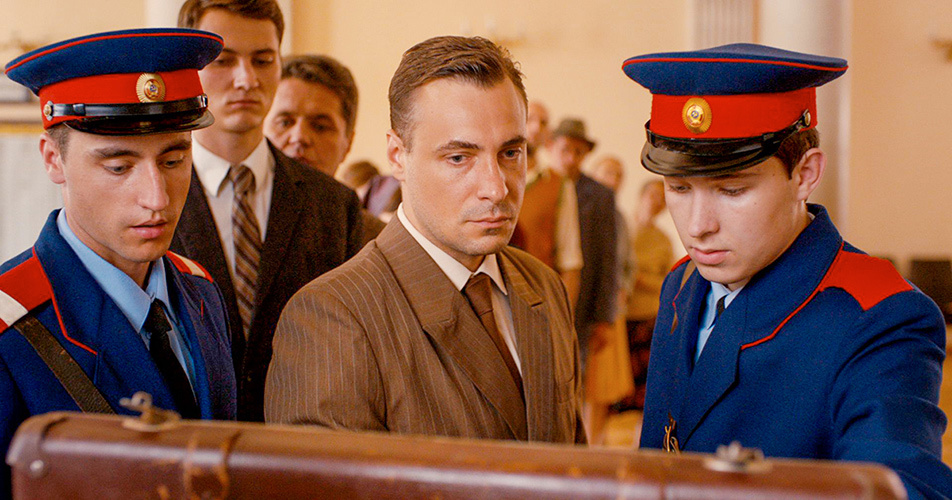
I watched Russian TV shows for a month here-they somehow had a particularly many: “Homeland”, “Orlova and Alexandrov”, “Farz”, “Leningrad-46”, “Once in Rostov”. In addition to stated topics and plots, the series always translate a certain system of values, offer a picture of the world. This is the nature of seriality - since we are not just watching them, but are forced to “live” in one way or another there. Our series in this sense are extremely slurred - they rather do not speak, but speak. But still: even through the thickness of slurred, besides the will of the authors-they tell us something.
What? What is this picture of the world? What is the value system? What kind of meanings?
Their sluggishness, incredible, by the way, is the most important feature. All TV shows are noticeably disintegrated in rhythm. The most integral series are the first, about five; Then the red tape begins (the Russian series is famous for the unmotivated number of “personal connections”, according to the principle of “everything with all”). Why in any Russian series there are so many “love” - which is used to plug semi -laying holes for “maintaining a conversation”? Probably such a complex of the 1990s: it seems to the producers that you can’t spoil the porridge with oil. There is no excess love in the frame. And let's the heroine will accidentally fall in love with the passerby. And let the district police officer fall in love with it. So that everything is full.
Finally, the finale, where, most likely, the channel management requires something to add or remove-to protect itself or, for example, to balance the excessive core (or conservatism) of the previous series. Therefore, the series can change the theme or optics on the move - as in “Farce”, which begins as a story about farmers, and ends as a confrontation between two power structures. Or the long "Leningrad-46"-32 episodes. Somewhere in the middle, the authors seem to be caught: it is clear what we are and for whom, but it is also impossible without “Stalin's repressions”. And so they appear, some ridiculous, as in an episode with the “writer Averbach” or sister of the head of the Internal Affairs Directorate, who returns from Paris home after 20 years.
There is no excess love in the frame. And let's the heroine will accidentally fall in love with the passerby. And let the district police officer fall in love with it.
The general theme, a messenger of any “series about the homeland” - a historical, detective, Bayopic, even a gangster saga - is the presence of strong power. You cannot imagine a series without power - about ordinary people, about their life, suffering and love. Moreover, it is quite acceptable to scold power (Soviet, naturally), you can laugh at it, be horrified to it - but in any case it should be a lot of space. The post -war crime is also a certain Ersatz of the authorities: the criminal hierarchy fills the space where the state did not reach. Power is bad, kind, humane or anti-, it doesn’t matter-in the series it will never leave a person alone. She is always there. All our series are actually one continuous leviathan.
Relations with the past
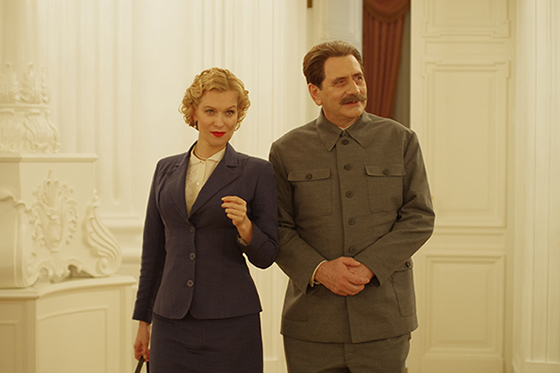 © Channel One Frame from the series "Orlova and Alexandrov"
Along the way, the authors broadcast their own ideas about the world. All this, together with the general line, forms a rather bizarre synthesis: the series can be more conservative than an official point of view or a little more liberal - this does not change the essence. As the hero of the series “The Reverse side of the Moon” (2012) cannot offer anything “from himself” to the past - so the creators of the series are really sure that people and life in the past, in the USSR, were tougher, but “more interesting”. Therefore, the space of historical series is not just the past, but as if extended - or the present frozen in the past. The time in which most residents of the country would like to live forever.
Serious TV shows are not shot about today, and in general, everyone is used to it. "Today" does not exist on the screen. It is customary to guess about “today” in historical series: viewers are more educational look for these hints, and the authors arrange them there - although in lesser than us, quantities.
We have any discussion about Stalin into a toast for Stalin.
The effect of the media (“tell me anything, the main thing is to say”) in the case of Stalin worked perfectly. This became clear even during the series of TV shows by the novels of Rybakov or Solzhenitsyn. It turned out that even anti -Stalinist material turns into the "series about Stalin." All the threads of the narrative converge to him, he resolves all conflicts, sweetly and punish him. Here is “Orlova and Aleksandrov”: Stalin is terrible, cunning and Kovaren, but we see that Beria and his henchmen are even worse, and it is Stalin’s accidental call that saves Orlov from direct literally violence. The episode with poisoning Orlova is a typical city legend, but again Stalin saves Orlov from death. Even when Aleksandrov (Anatoly Bely) reads the famous “We live, under us without sensing the country ...” and sparkles with his eyes - it still turns out “about Stalin”. This is a well -known paradox: we have any discussion about Stalin into a toast for Stalin. Even as an evil, but decisive, supreme-he is invariably the main character of the series about the 30s-50s. All these Bayopics about the Orlovs, Alexander, Zhukov, Furtsevs are actually series about Stalin. And this gives great pleasure to his apologists. Let him scold him, but he is still the main one.
The rivalry of law enforcement agencies
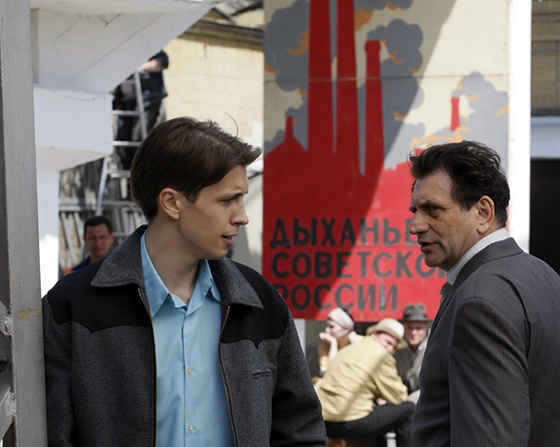 © Channel One Frame from the series "Once upon a time in Rostov"
If the series about the 30-50s is about Stalin, then the series about the 60-70s are about the rivalry/cooperation of the law enforcement agencies, the Ministry of Internal Affairs and the KGB. Even “Once in Rostov,” which, it would seem, in the first episodes - about the Novocherkassk execution and in general about anti -Soviet sentiments. By the way, why did the Tolstopyatov brothers have turned the criminal history into anti -Soviet? The Novocherkassk execution was in 1962, and the gang of Tolstopyatov began active activity in 1968.
I have a version. The story of Soviet gangsters, which with machine guns go to savings banks, is from the point of view of the current ideology of more sunk than the version, that the brothers had some kind of motive that they were “offended”, that they were influenced by the execution in Novocherkassk and they took revenge on the Soviet regime. Any of these versions is more convenient than the recognition of the fact that such a gang could appear without any occasion in the fiftieth year of Soviet power, in an ordinary Soviet city. This is just the most difficult to explain. It is better about the struggle of power with anti-criminals anti-Soviet-whatever the power is unfair. The authors choose less from two evils - plus the moral failure of the "anti -Soviet".
The story of the two departments - about local KGB and the Ministry of Internal Affairs - occupies a large place in the gangster saga, and the images of special services are as deep and human: here work, love, treason, family squabbles, and informal connections. The producer “Once in Rostov” Sergey Zhigunov personally embodied a deep, complex image of the Chekist (the series was shot back in 2012). His colleague, senior lieutenant, comes to God. Another colleague begins to smoke grass ... In places, the authors seem to bring it to the point of absurdity, but in any case, about half of the serial time is devoted to the law enforcement agencies.
The space of historical series is not just the past, but as if extended - or the present frozen in the past. The time in which most residents of the country would like to live forever.
In Leningrad-46, the employees of the Ministry of Internal Affairs (they are the main characters here) were instructed to “restore the honor of the MGB”-when it turns out that under the guise of Chekists, dressed scammers burst into people's apartments (that is, someone in addition to the Chekists takes people at night, violating a monopoly on horror). Here you have the topic of the nobility of special services workers-both in Rostov and in Farce, the Chekist/operative goes to the official crime, helping the victim-criminal.
In "Farce" is somewhat more complicated. The KGB controls Farza for its purposes (supervision of foreigners) and in fact is forced to come into conflict with the Ministry of Internal Affairs, which is hunting for the farmers. It would be possible to develop this thought deeper - for example, that the KGB got acquainted with the private -owned relationship before other layers of society - but the series did not dare to go so far. Another thing is important. Without the participation of special services in the series, nothing can happen at all - neither bad nor good. What seemed to be a natural human conflict, emotion, ambition - in fact, explain to us, only the result of the rivalry of powerful organizations. Everything fundamental, turning point that happened with the country happened only as a result of a conflict of departments. Nothing depends on the will of an ordinary person.
Attitude to wealth
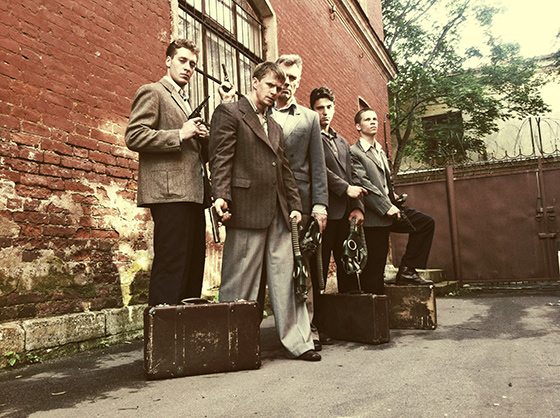 © NTV FRARE from the series "Leningrad 46"
In principle, we have no series about wealth and financial success. But the series "Leningrad-46" manages to get scores with the "rich" even in the conditional 1946. A constantly suggestible thought - wealth is acquired only by dishonest way. The money is not brought to good. A variety of “suppliers” and “rear rats” play for the rich - images emphasized negative. The bandits rob them, but they are not very sorry - we know that they "profit from the blockade." The suppliers are fattening, buying a ball, black and red caviar and pronounce cynical monologues: “I honestly think that the idea of equality is nonsense. What is it-I will have the same as a representative of the proletariat? .. I work ten times more than some kind of worker. ”
The series was laid down by the busts of Stalin - but at the same time he breathes hostility towards the very conformal class of the Conservatives, thereby “suppliers”. And also to Bohemia, which can afford a service car and a housekeeper. Bohemia also becomes a victim of bandits, but also “to blame”, because she leads to himself “anyone”. That is, in the series - in addition to chasing and shooting - there is a powerful anti -bourgeois charge; It was removed from the truly proletarian, Marxist-Leninist positions.
But the Farz, it would seem, is the time to talk about the formation of private -owned morality in the USSR. Acquaintance with Western goods greatly changed the Soviet man. However, the authors move away from this dangerous conversation. They narrow the phenomenon of the stuffing to the framework of a narrow group. In the middle, the series suddenly changes optics: at first we looked at the world through the eyes of young farts, and then-suddenly-the eyes of the “fathers”. The father of the farmer at the end of the series says: "We fought for these guys to have the right to make a mistake." This wording is filigree. This is not just a replica - this is a Brecht zong, going beyond the ramp. This is a “right”, ideologically verified attitude towards Farce for today.
The series does not forget to "disappoint" the farmers. The heroine makes it clear to the hero that the more money, the less talent. Finally, in the episode where the Soviet girl is deprived of innocence, who took her as a prostitute, dollars fly up - symbolizing that they are not worth it. The “bad foreigner” in the frame is a kind of compensation for excessive liberalism in choosing a topic.
The series about the nature of wealth turns into a Soviet detective: the couple refueled, from which the strings lead to two or three dishonest trade workers-that’s all the farce. This story is not about how socialism contradicts the thirst for consumption-but that it is impossible to take in a large way, like a currency of the Rokotov.
Intelligentsia and transformation
 © Channel One Hard from the series "Homeland"
The intelligentsia is an obligatory and important hero of these series. Most often, this is an eternal type: he speaks specifically like that, he has such a special beard or pince -nez. But Leningrad expands the line. A “journalist” appears, who turns out to be an ideological accomplice of a German spy. He makes recognizable liberal speeches: “I distributed anti-Soviet leaflets ... I wanted the Germans to be here ... Tired of surviving. There will never be anything here ... This car is done in Germany, and here no one will ever do the like ... In the West they are used to appreciate smart people. ” He wants to run to Estonia (what Estonia in 1946? There is Estonian SSR. But the authors put Estonia in the hero’s mouth, and the Target Group of the series accurately reads this signal). Estonia is generally a place of “evil”: in the series “Homeland”, an accomplice of terrorists is an Estonian citizen.
There are good intellectuals - they help organs. There are a pair of innocently injured from the regime - for balance. But the main motive is the transformation of the intellectual. The main line in Leningrad-46 was built on this: "Danilov became hardened and exchanged the life of a respectable person for the life of a criminal." Toward the end, he pronounces the famous phrase - "when power becomes ours." That is-a bridge to the future, in the damned 1990s, when the dream of bandits materialized.
The literature teacher turns into a mother killer. Another hero is from the writer's hopefulness to the farmer (“Faritsa”). The doctor is in the voluntary assistant of the special services ("Rostov"). The musician from the orchestra plays during the day, and kills at night. A friend of the writer, a secular lioness, betrays ("Leningrad"). A bespectacled instigator of riots in Novocherkassk also passes his comrade (Rostov). Teachers dismiss their colleagues by calling from the city committee (Leningrad).
This is clearly a pleasure to the authors of the series, there is something personal-to talk about a rotten essence again and again. But if it is wider - that there are no “decent people”, there is no difference between a thief and an intellectual. The same motive was in the "Apostle" and in Pepley. This, by the way, is about the recent rental film "Battalion" - that you can turn anyone into a killer. No ethics mean anything: if everyone is in terrible conditions, everyone will behave equally terribly. Hence the manic desire - to finally put everyone in these conditions.
All this does not cancel any talented finds, interesting words and scenes-in these and other series. You can praise the authors - in the end, they could not do this, but did. However, any liberty still remains only a scratch on granite. None of the authors, actors or screenwriters can break out of the closed circle, even if he wanted to, as the Soviet writer could not say more than the language of socialist realism allowed him. All our series ultimately that a person is powerless, and power is omnipotent.
The trouble of these series is not that they play poorly (there is nothing to play there, in essence) or such scenarios, and not that there is no "resistance culture to the producer." And in the fact that a fundamentally “different” series to shoot in today's Russia is impossible. It is therefore pointless to discuss the degree of their courage or freedom: it will still be another series about Stalin or about the KGB/Ministry of Internal Affairs. Only two options. For people of creative professions, this is, in principle, a tragedy. But they either learned not to feel anything, or simply do not understand this. I don't even know what is sadder.