
Translated material
The rails are buzzing
New theater Kirill Serebrennikov
Director Kirill Serebrennikov paved a new railway from the destroyed Gogol Theater to the sparkling Gogol Center
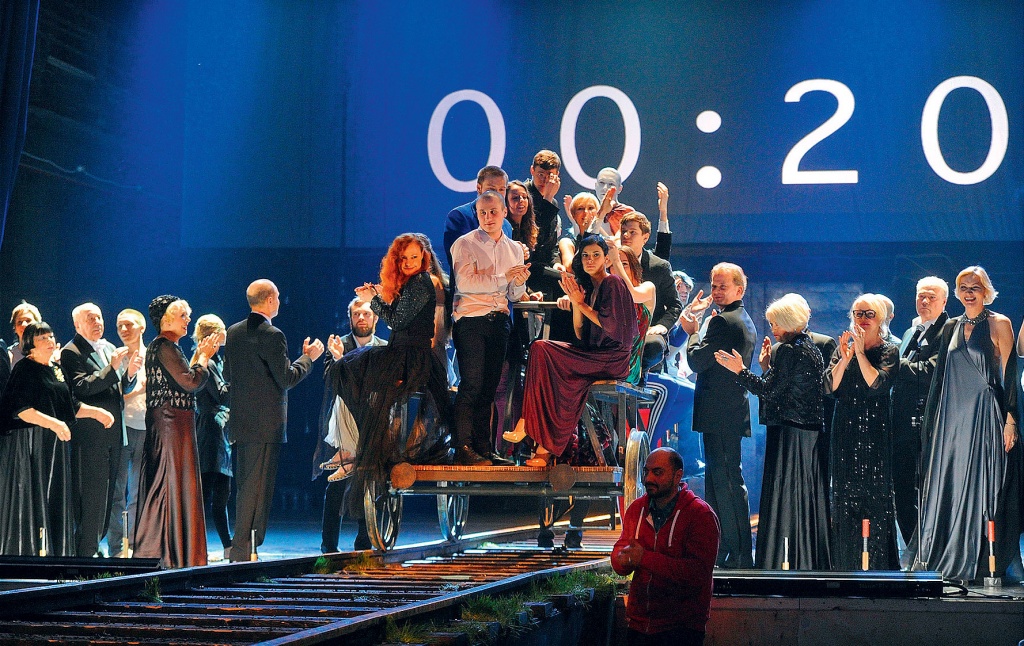 | 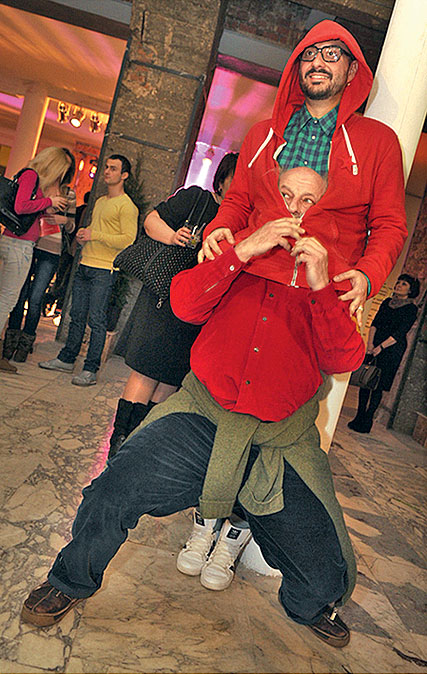 |
| The Gogol Center was opened by the performance “00:00” by Kirill Serebrennikov (in the picture on the right he is with Vyacheslav Polunin). The clock of the former Gogol Theater began to count the new time |
During the fight against pests, the film “Rails buzz” based on the play of Kirshon in the Soviet rental. The protagonist of the locksmith Novikov is put forward to the post of director of the steam locomotive factory, but a group of pests, led by the former dismissed director, is preparing an insidious plan to discredit it. The selfless locksmith Novikov enters an open battle with enemies, most of whom stands to his side, and all together with honest workers put a new composition on the rails. The film ended with a triumphant locomotive beep.
In the final of the solemn opening of the Gogol Center over the agricultural road, laid through the hall on the stage, the white pigeons were soared under the dome of the theater, and then on a huge railway scoreboard the countdown began, from the new time-from four zeros.
Serebrennikov won, and even his enemies cannot deny this victory.
In a whole embankment
The dramatic fate of the Gogol Drama Theater, the former Transport Theater, was predetermined by the proximity of the Kursk station and a terrible, smelly, endlessly long underground passage leading from the metro to Kazakov Street. Deciding to change the leadership and change of the aesthetic appearance of the theater, Sergey Kapkov, the Minister of Moscow Culture, decided to save the theater from the birth curse - to be forever in outsiders, on the side of the road, "under the mileage in the ditch of the non -nakedness." Kirill Serebrennikov, having a successful experience in mastering the industrial zone behind his back (the Platform project arose and blossomed at the Winzavod), with excitement and enthusiasm took up the risky business, without even suspecting what difficulties would have to be encountered. Sabotage and undisguised hatred from the part of the troupe, heated by the "patriots" from all the cracks from culture and from politics. Hooligan attack on the director of the theater Alexei Malobrodsky. Inhibitory threats to today. Hysterical calls to stop the “destruction of the Russian theater”, letters-similarities similar to anonymous from Stalin's times.
At the opening of the Gogol Center, it seems, was all of Moscow. Where, in what performances can all the leading theater figures of the capital from Kalyagin to Katalin Lyubimova can meet? The Serebrennikovsky landing tore the old plastic panels from the walls, like an old wrinkled skin, the Donaga section is both halls, a scene, and a foyer. The space turned out to be a grandiose, even though start the airship under the dome, even put the steam locomotive on the rails.
"
The directorial landing tore off the old plastic panels from the walls, like an old wrinkled skin, the Donaga section is both halls, a scene, and a foyer. The space turned out to be a grandiose
"
Action time
“Night”, “Morning”, “Day”, “Evening”-four presentations of the four artistic programs of Gogol Center.
Night is a connection with yesterday’s day, black and white stylization under the cinema on close-ups of the artists of the old troupe of the theater, its main performers, devastated by timelessness and desperate struggle for survival. The text, written by love, is a shelter specifically for the evening-opening, after some time ceases to be important. The main thing here is intonation and emotion. "Do you remember?" - sounded a refrain. “Ah, these old walls! - exploded with the curse of Svetlana Bragarnik. - I'm not sentenced to them! " Moscow seemed to have first examined these amazing beauty of the face, broken female figures, draped with black and white silk, perfumes and fogs. The smoke of cigarettes, a mixture of male gray hair and blond female curls, shining eyes with tears of pain and fear, stubborn, like otherworldly voices, a mixture of cigarettes and fear - everything was fascinating - everything fascinated - everything was fascinating. Everything aroused some unbearable feeling of compassion and joy at the same time.
Morning is a presentation of the theater dance concept. Dialogue Dance was invited by Serebrennikov from Kostroma, along with young firm dancers and a bathroom filled with water, in which either a girl in a white coat, then a solid young man with a naked torso. The morning was the weakest, uncertain, timid, tongue -tied. Unimaginated for now.
The day is graduates of the Serebrennikov course, the basis of his “Platform”, “Seventh Studio”. Young, bright, selfless, not afraid of either public or time that have already managed to taste the glory, ready as a pool (and not a bathtub with water!) To rush into any dramatic scam, a trace of the trace of their commander and teacher. The theatrical stans played by them on the topic of love and death were similar to the Blokovskiy "Balaganchik", in which the heroes "expired with cranberry juice."
Evening - an application of another resident of the theater Vladimir Pankov, his studio of Soundrama, headliner of modern Russian theatrical art. The orchestra, by clicking on the conductor, getting from his cases not a violin and pipes, but huge hammers, with which the "musicians" immediately begin to peel on iron rails. The deafening cacophony of destruction before our eyes turns into the triumphant music of victory, into a grand hymn of the Renaissance. They are peeing with their hammers in such a way that, it seems, they will smash the entire theater to the damn mother, and this metaphor becomes perhaps the main metaphor of the evening: this is the only way to win, defeating everything without fear and to the last brick.
Silbrennikov Square
Of all the possible ways to self -realization, Serebrennikov chose the most win -win - work, a plow. He does not hide his contempt for power, but does not abandon the possibilities that she provides him. His conviction is that they do not ask for money, but demand, causes some mockery of some, others have respect. As Dmitry Muratov once said in response to accusations of campaigns in the Kremlin: "It is not that it is not that a person goes to the Kremlin or not, but it is important that he takes out from there." Serebrennikov makes the right to freedom, which he uses at his discretion. Does how he feels. Its performances are not part of the “protest” culture, in contrast, for example, from the performances of theater.doc. Serebrennikov sequentially distant from all possible political camps. Even in radical "scumbags" he declares the philosophy of the world, not war. He chuckles at the white ribbons, the liberal slogans, over the ever -doubt intelligentsia, over rallies and pickets. Its nature rejects this linear path of resistance, although he himself speaks about the country, about the power, about the laws and decrees, without fear of shouts from the Kremlin. However, it is journalism in his performances, an attempt to respond to the actual and momentary - the most vulnerable, weakest side. The fact that Vladimir Mirzoev, Konstantin Bogomolov, Mikhail Ugarov, succeeds, in the performances of Serebrennikov looks like a concession to the liberal public. And this is not at all because he himself as a person, as a person, did not decide in his civilian priorities. Here everything is said, and he did not give any reason to doubt his civil fearlessness and sequence of actions of silverniks. Sometimes it seems that the scale of his talent and artistic worldview is more dramatic and deeper than momentary reflection. That is why - now we can say - and the scandalous, which dealt a considerable blow to his reputation, the performance of the “Plonol” was an order of magnitude higher, thinner than the literary source. Simply put, his personal creative freedom takes him far beyond the limits of the freedoms for which they go to the square. Square is Serebrennikov is a stage platform that, under adverse circumstances, can turn into a runway. This will be very sorry.
Photos: Vyacheslav Prokofiev/Kommersant, ITAR-TASS