
Translated material
Tuitioner fad
The government seriously discuss the possibility of legalizing Internet piracy. The indulgence can be annual deductions in favor of the Russian Union of copyright holders (RSP), headed by Nikita Mikhalkov: pay - and download calmly
Photo: Shutterstock
RSP proposes to introduce a global license in Russia for almost all types of content (cinema, music, books), except for computer programs. A fixed fee in favor of copyright holders should be paid by telecom operators (presumably $ 2-3 per Internet user per year). The organization on the collective management of copyrights collects a fee - that is, the RSP itself. He wants to conclude licensing agreements with the right to reproduce the work with payers of the contribution on electronic media of the work.
For a new fee with users, the network has already begun to clear the site: on behalf of Deputy Prime Minister Igor Shuvalov, by December 5, 2014, five departments-the Ministry of Complex, the Ministry of Communications, the Ministry of Economic Development, the Ministry of Finance and the Ministry of Justice-must develop appropriate amendments to laws and regulations. Schuvalov himself, by the way, received the task to comprehensively analyze the concept of “anti -pirate fee” personally from President Putin, which was recently acquainted with the head of the RSP Nikita Mikhalkov.
**How does this work**However, one anti-pirate fee in Russia has already been operating since 2011: it is paid by manufacturers and importers of any equipment that can be used to consume content (computer, phone, TV, player, flash card, CD and DVD-disk). Dachshund - 1 % of the price of the sale of goods or its customs value. In 2013, this fee became the fastest growing article of the income of the Russian author’s society (RAO) - growth of 2.9 times, up to 390.7 million rubles, which is almost 9 % of RAO revenues. But in fact, the same RSP collects this money that was created by RAO together with the Union of Cinematographers, and is also headed by Nikita Mikhalkov.
The collection paid from the equipment is growing not so much thanks to its sales, but due to the fact that companies gradually join it, which previously considered it illegal. They disputed him in the courts, but the claims were lost. As a result, according to the RSP, the collection has already paid about 70 % of manufacturers and importers of equipment.
At the same time, the connection with real piracy has a very dubious collection. Firstly, it is charged even from technology, which cannot record video or musical content-from stationary phones, DVD players, cameras, film projectors, etc. It is not taken into account that not every owner of a technical device on which pirate content can be consumed is the possibility of this opportunity: according to a survey of VTsIOM, only 14 % of the country's population is engaged in copying films and music.
According to the Association of manufacturers and importers of equipment (RATEK), the collection creates unequal conditions for competition in the market: its main payers are 50 largest importers of equipment and equipment. Last summer, RATEK - not the first time - turned to the government with a request to either completely cancel this collection or make adjustments to this mechanism. There is no answer yet.
Experts are convinced with the same problem, the collection from Internet users will also face: communication operators are not able to distinguish the work protected by copyright from the user created by the Vimpelcom. If they pay for each subscriber who does not even use paid content, this will be a hidden subsidy in favor of Internet users, add to MTS. In fact, a new fee is a “Internet tax”, only it will not be assembled by a state, but an almost private company.
Default collection
In Russia, it is very profitable to engage in the distribution of money for someone created by someone, as well as to distribute wealth created by someone. In 2013, in favor of the authors of music and songs, RAO raised 4.36 billion rubles. The authors themselves paid 3.2 billion rubles. More than 1 billion rubles. “This is the fee of RAO himself.”
It is with this design that departmental disputes around the Shuvalovsky assignment are associated.
The Ministry of Communications, on the one hand, proposes to extend a new collection to all types of digital content, including software. And on the other hand, he criticizes the system of collecting funds through copyright management societies, rightly considering them opaque. The department considers it important to introduce competition into this system.
The Ministry of Culture, as expected, fully supports Mikhalkov: the gathering de must go through a single organization in order to exclude unfair competition in the struggle for content users.
Many authors are unhappy with the work of collective funds to raise funds and, not receiving sufficient, in their opinion, money, tearing off relations with them. Recently, the services of RAO was abandoned by the poet Ilya Reznik, who wrote to the prime minister that "the current legal norms in the field [...] are the protection of rights in the conditions of an arbitrary interpretation of a small group of people using the declarativeness of these norms for their selfish and far from the original purposes." The monopolization of this activity led, claims Reznik, to the complete insecurity of the authors.
The rights to the protection of rights threatened the work of many concert halls and the Philharmonic. In April, the Moscow Court of Intellectual Rights considered the lawsuit of the St. Petersburg Philharmonic named after Shostakovich to RAO-due to the requirement to pay 10 % of the fees for a concert, which fulfilled at least one product to be protected. In fact, it is a matter of St. Petersburg, about the increased rate of deductions for the execution of modern classical music. The Moscow Philharmonic in a similar situation tried to calculate the reward to the authors, in accordance with the principle of proportionality. But in court, both Philharmonic lost RAO.
However, RAO, although it is the only organization with state -owned credit in the field of collecting remuneration, collects money for the authors only “by default” - until the authors have yet abandoned its services. The author can withdraw his works from RAO catalogs and transfer the right to use another organization. Some authors collect rights on their own, others transfer this right to publishers, producer centers, record-labels, etc.
Earn a lot
At the end of October, the Sverdlovsk Arbitration Court began to consider RAO’s lawsuit against the Uralvagonzavod youth organization, which “on the BIS”, that is, “exceeding one -time use”, lost at the event the songs “The girls did not love me” and “saw the night”. For unauthorized performance, RAO wants to get 60 thousand rubles.
This example is very characteristic - tracking and even video recording of public events in order to collect small payments in the regions from them, thousands of lawyers and agents of RAO are engaged in.
The Society itself and engaged in similar activities of WIS (All-Russian Organization of Intellectual Property) try to earn a lot of money, while often speaking on behalf of the authors who do not even suspect their existence. So, in October, the Moscow Arbitration Court considered the WIS claim against McDonalds-Moscow CJSC for 790.5 thousand rubles. In McDonald's restaurants, you can’t hear domestic music, and foreign was sounded under agreements with Ultivox, which has a contract with Moodia North America, a licensee of copyright holders of the works. The court decided that WIS did not have the right to demand a fee from restaurants, since the copyright holders have no complaints about them, and the WIS - contracts with copyright holders.
The concept of a new collection from Internet users proposed by the RSP involves solving this problem-by creating a publicly accessible register of works. As a result, the payments collector will receive the opportunity to collect money even in favor of the authors with whom he has no contracts.
In July, the Supreme Arbitration Court explained RAO and WIS: the names of copyright holders must be called in their claims, and the recovery should be carried out in his favor, and not in favor of the Rights Management Society. (This is the resolution of the Plenum of you was one of the last - soon the court was abolished). RAO and WIS were categorically protested: they say, things on which the company does not have a contract with copyright holders make up to a third in the total mass, and mainly foreign authors. “It is difficult for societies to notify them,” the Deputy General Director of RAO Ekaterina Ananyeva insisted, “and it is not easy to get their details.”
As a result, some catering leaders decided to go to work with small organizations working directly with copyright holders - simply because it is cheaper. Simultaneously with the Moscow McDonald's, the Coffee House did this, who calculated that the annual payment of music, which sounded in 170 cafes through RAO or WIS, would cost him 25 million rubles, and through alternative organizations-fifthly cheaper.
But the example of these obstinates does not change the overall picture: in Russia, in a matter of years, an industry arose, which allows making money literally from the air. The field of culture was turned into another Gazprom - a machine for pumping rents and its distribution between “their own”.
The fight against the pirates or ...
The RSP of Nikita Mikhalkov could not stay away from this process - the collection from manufacturers and importers of equipment was his first giant victory. Now the second is being prepared. It is not yet clear whether the new collection of Internet users will release from the need to pay additionally for the consumed content: many use devices, the sale of which the “author’s collection” has already been paid, which means, by logic, they can already be watched and listened to them for free. However, this nuance does not take into account the concept of a new fee.
Of course, paying $ 2-3 per year of a new fee invented by RSP is not a problem for most Internet users. But it is possible that the real size of the collection will be several times higher, and in the future it will have to pay “ward”. And if you charge such a collection, it is not clear how they will determine, paid or free content downloaded or viewed by each user. This is an unrealistic task.
So far, the RSP undertaking has not received the highest approval. Mikhalkov periodically meets with Putin, makes films about him and loves him: “I love Putin, and I have a shit for the opinions of others”; "Everything is bad, if not Putin." The president replies Mikhalkov. Recently, he even met with museum workers in the building of the Mikhalkovsky Culture Fund, it was about love for the small homeland. But Putin cannot give Mikhalkov a multi -billion dollar state order, like other friends. So why not consolidate the friendship of two large people with another small gathering in favor of the Mikhalkov RSP headed by Mikhalkov - after all, Nikita Sergeyevich will use income from the collection for a good deed, isn't it?
Instead of the afterword
In parallel with the initiative of Mikhalkov, the power promotes another, much more stringent scenario. On November 14, the State Duma adopted in the second and third readings an anti-Pirate law that allows the Internet sites for 24 hours to remove the content on the statement of the copyright holder, and allowing the court to introduce a constant blocking of the resource if he twice lost the dispute to one copyright holder. Sites are threatened with increased fines, since the countdown of the offense will not go from the moment of filing a lawsuit, but from sending the copyright holder of the application to the site about the violation of its rights, explains the main Duma lobbyist of the project, vice speaker Sergey Zheleznyak.
According to this law, which will enter into force on May 1, 2015, the rights management companies receive powerful pressure tools for sites. “The activities of almost all information intermediaries providing third parties with the opportunity to post content on their sites can be stopped at the request of copyright holders,” the press service of the Rambler & Co. group quoted TASS. The company "Yandex" warns about the same.
A small collection from Internet users and the legalization of all content, as the RSP proposes, is one thing, and it is completely different to harshly pursue sites that place copyright-protected copyright. In fact, we are talking about two different, poorly compatible models of Internet content regulation. It turns out that one strong lobbying group insists on one option, the other on the other. And power simultaneously goes in two mutually exclusive paths.
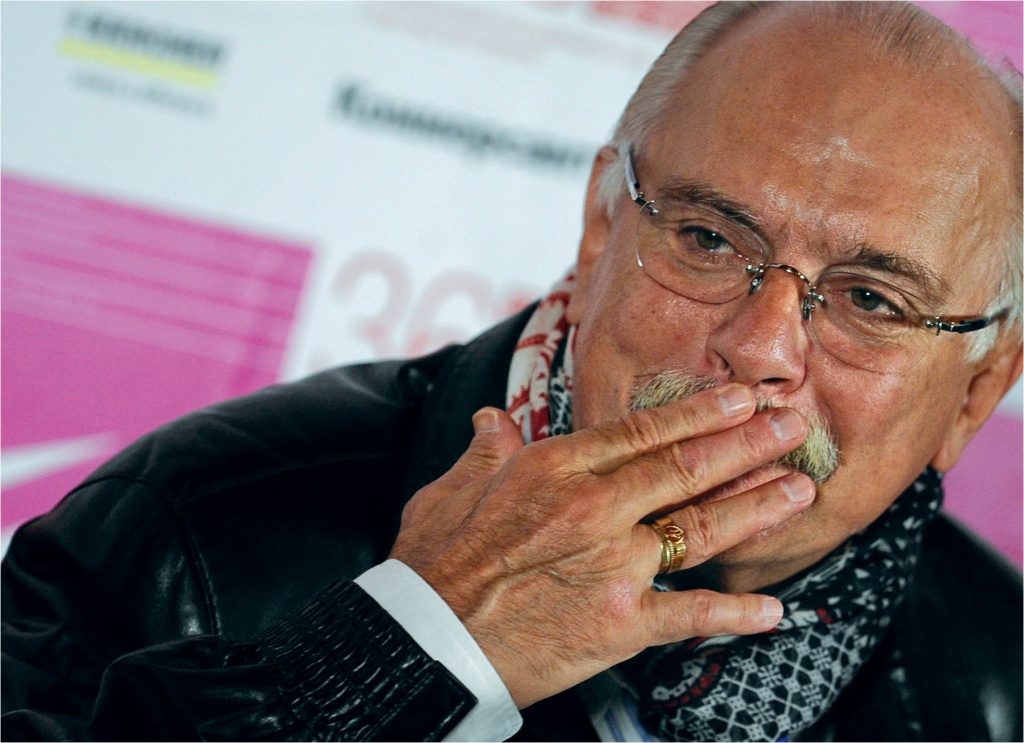
With the concept of a new collection from Internet societies
Nikita Mikhalkov himself introduced President Putin
Photo: Sergey Bobylev/ITAR-TASS