
Translated material
To the machine!
To the machine! “A wooden man”, a hill overgrown with pine trees, and a holey aluminum spoon - all these are samples of simulators, devices, forces invented for training forces, dexterity and quick wit. There are more advanced: treadmills, bicycle ergometers, stepper. How people have been fighting for the perfection of the body for centuries - the New Times recognized
A middle-aged man, interrupting the set of exercises, stretches out on the simulator and, slowly turning his head towards the coach, asks: “When do you feel that your muscles are about to break and you are about to die a slow and painful death, it's time to make a break?” - Yes! - says the coach. - A wonderful feeling, isn't it?! (Joke)
In principle, the simulator is any device or device with which a person trains his muscles, acquires dexterity and some skills. In this sense, even a tablespoon with holes drilled in it can be considered a simulator, which the “grandfathers” slipped to some recruits in the army. You have time to convey it to your mouth until the cabbage soup flowed through the holes - you will be fed, you will not have time - your problems. So the Salag developed a whole complex of qualities considered to be necessary for the fighter - the same dexterity, quick wit, as well as official reverence. 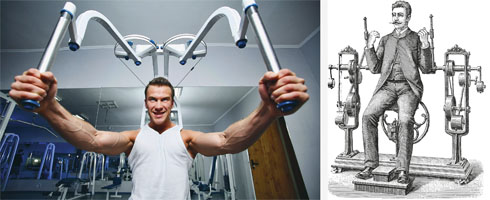
Protection technique
One acquaintance, happy in himself, combining considerable skills of engineer-computer and “master of eastern martial arts”, told how in the late 80s he ended up in South Korea. There he was introduced to one master (already without quotes), who offered to work out on his own master, a simulator. It turned out to be a rather impressive hill, overgrown with spreading, crooked pines. Classes on this natural simulator boiled down to the fact that the trainer rose up the path and, obeying the indication of the master, rushed down. It was necessary, more and more accelerating, reaching the bottom, dodging the knots sticking out in all directions. And then it became clear to our “master” why the newcomers of this school all went smeared with iodine and green, and the finished ones were ready for the release without a single scratch.
However, not all schools of eastern martial arts follow the example of a master from South Korea. The simulator for classes Kung-Fu Mu Jong, a “wooden man”, is used in the preparation of this for more than a thousand years. Different modifications of Mu Jong (for example, fixed motionless, or rotating, or rather, spinning), allow not only to develop the strength and accuracy of the blows, but also to improve the technique of protection, but also to educate insensitivity to pain: try to hit a wooden bar with a fist that spins from the blow and, while you blow on a fist, smiles you on one of the head of a hanging on one of processes of heavy wooden pear! 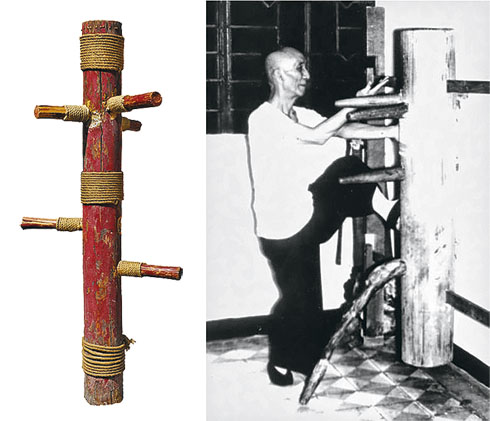
Supporters of the fruitful idea of “Russia is the homeland of elephants”, of course, will not agree that somewhere something was done at least before our vast expanses. Therefore, there is an opinion that long before any “Mu Jongs” simulators for the preparation of invulnerable warriors were developed by the sorcerers of pagan Rus'. Such a simulator (this word is used in this context is nonpatriotic, correctly say “rural”) is a horizontally laid frame, inside which the future warrior is stretched by a belt system, remaining, so to speak, hanging in the air. It is possible that such a stretch itself, in the absence of contraindications, can be very useful. However, she has a background, according to today's interpreters-patriots, some terrible, and it is better to limit yourself to the revelation of one of the apologists of the ruler: “In order to achieve military parity with the West, in Rus' from the time of Ivan the Terrible, an active search for the surviving magicians-rulers began. The true master could go through the most severe test - a triple setting on a stake. But not one of the applicants passed him. ”
Turn the mountain
The current person of Western culture is little overgrown with pine trees of the hill. And the rule does not suit him at all. The modern user of the simulator should be in a state of psychological comfort, and in the consumption society comfort is largely created through the realization that significant funds have been spent to achieve goals. If there were no material investments, if instead of a power simulator are used by great -grandmother, cast -iron irons, then you can’t achieve the goal. But the simulators in the historical perspective were completely “irons”. So, ancient athletes began training with lifting and transferring from place to place of the calf. As the calf grew, and the distance increased, and the loads grew - to a certain limit, until the grown calf was eaten. The legends of outstanding athletes retained the mention of the strong men who can get out of paragraph A and reach the point B with the bull on the shoulders, but these are rather unique cases. There are legends about the strong men who began training on such natural simulators as stones. As if, starting with small stones, the sodes could eventually move the mountains. 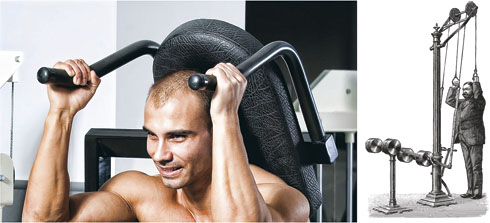
For many centuries, simulators, natural and artificial, were used to train individual, mainly military skills - conducting hand -to -hand, bayonet battle, etc. Only at the end of the XVIII century did the general strengthening effects appear - increasing the general tone, including muscle, contributing to the burning of excess calories. They helped those who led a sedentary lifestyle, and because of origin and place on the social ladder, he could not afford to carry calves on their shoulders. So the first steppes and prototypes of exercises appeared. One of the inventors of the devices for training was the father of modern gymnastics Friedrich Ludwig Yang, a teacher and a politician of extreme right views. At the beginning of the 19th century, Jan began to use gymnastic shells (horse, bars, rings), the exercises on which are now the essence of sports gymnastics. Gustav Zander, a Swedish physiotherapist, made a huge contribution to the development of simulators. Being frail and painful in childhood, Zander devoted the life of mechanical complexes that allowed the muscles with relatively small efforts to heal some of the vices of the spine that were previously considered incurable, and the institute of medical gymnastics opened in Stockholm was essentially a prototype of modern gym halls and fitness centers.
Running in place
Many types of simulators imitate vehicles. For example, exercise bikes that appeared in the 80s of the XIX century after the appearance of the first bicycles with chain gear. The principle of operation of exercise bikes has practically not changed to the present day, although there are “bicycles” for those who, due to medical indications, should not load the back and spine (the so -called horizontal exercise bikes), as well as bicycle ergometers to control the load. The main purpose of bicycle ergometers is to strengthen the cardiovascular system, although they, like ordinary exercise bikes, can be used to “burn” fat or development of the leg muscles. Now exercise bikes with chain gear are practically not produced, and with belt transmission, compared to others, is very noisy. Magnetic and electromagnetic varieties are most popular, and the latter, being connected to the mains, allow you to change the level of load using built -in programs. The only thing that is still attracting consumers in the cycle trains of old models is the moderate price. 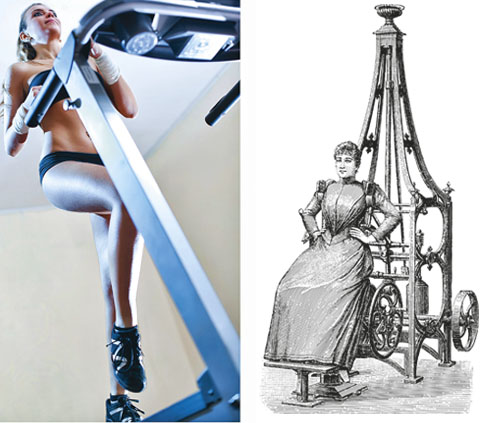
On the same principle, treadmills were also built by visitors to sports halls. They appeared in 1952 thanks to doctors Robert Bruce and Wayne Kinton from the University of Washington and were originally intended for the diagnosis of heart muscle disorders. The simplest and cheap paths are mechanical. Here the walking himself sets the angle of inclination of the track, the speed of movement depends on the width and the frequency of its steps. The most expensive and computerized ones - through the choice of the right programs, they themselves set both the angle and the speed of movement. Some of the most advanced models allow you to accelerate the track to almost Olympic speeds (up to 35 km/h) and even withstand user weight up to 150 kg! And at the same time absolutely - except for the sniffing of the running! - Sunday. These are the rowing simulators and steppers that simulate intensive walking. Universal simulators appeared, combining almost all existing varieties. They are equipped with program complexes and occupy a lot of space. However, one who can fork out a good modern simulator can afford a separate room for classes.
An alternative to a skip
Manufacturers of modern sports simulators have a difficult competition for the wallets of those who want to maintain physical shape and showing care of their health. The relatively short period of strangulation of weak competitors (for example, domestic manufacturers of mechanical exercise bikes) ended in the fact that almost the same models appeared on the market, only at a higher price and - this must be admitted - higher quality. Specialized chain stores have appeared, trying to keep the monopoly on the sale of simulators. However, the Internet contributes to the fight against monopolism. There is no longer any need to go to the sportsmarket - except to see with your own eyes and compare some models among themselves. Everything else-order and delivery-is carried out through online stores, in which the choice is no less, and the prices are sometimes much lower. 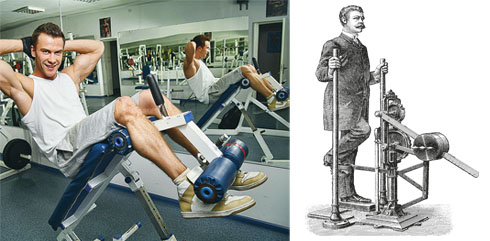
However, how do you know a lot of people who are engaged in the simulators of the house? The author’s personal experience indicates that home simulators quickly turn into hangers: few people have enough self -discipline to train without external coercion, like the need to work out the money paid for classes in the gym. In addition, zealots of traditional training techniques say that for good loads, you do not need to spend a lot of money: just buy an ordinary jump rope, and strength can be developed by digging the garden. But they are most likely wrong. Silers are not just a certain device constructed for pumping money from a desire to maintain physical shape. The simulators connect vast knowledge of medicine, therapeutic gymnastics, physiology, psychology, mechanics, electronics, etc. The simulators allow (and, very importantly, they force) through competently composed exercises in a minimum time to achieve amazing results.
The word "simulator"
It comes from the English train, which translates as “teaching”, “educate”, “train”. That is, the simulator is a mechanical, electrical or combined tool for the development of muscles, building muscle mass, training of flexibility and mobility, general healing of the body.