
Translated material
The fight against ice
After the accident, the operational sequence of the Sayano-Shushenskaya hydroelectric power station assumed the entire load on the water passage and first earned in the winter. What problems had to face the onset of cold weather? How do they fight the formation of ice at the station? This was told to reporters by a specialist in the SSHHSS monitoring service Vadim Zateev.
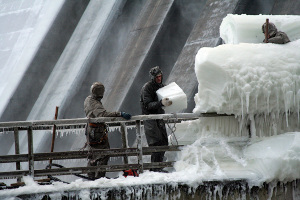
After the accident, the operational sequence of the Sayano-Shushenskaya hydroelectric power station assumed the entire load on the water passage and first earned in the winter. What problems had to face the onset of cold weather? How do they fight the formation of ice at the station? This was told to reporters by a specialist in the SSHHSS monitoring service Vadim Zateev.
- The problem arose unexpectedly. Waterbrow in winter is not obliged to work. It is needed in order to lose excess water. But in winter, as you yourself understand, there is no excess water. In the summer, we accumulate it into the reservoir, and in the winter we slowly dump it - lower it through the hydraulic units. The operational water scope works when the spring flood occurs-usually from the end of May to June-July.
Overfield problems had to be solved immediately. We contacted all scientific organizations that are engaged in water and ice. Experts from the Research Institute of Energy Structures came to us here, there is a powerful hydraulics laboratory. Experts determined at what parameters there is a minimum concentration of water in the cloud (water at the SSHPs falls from a height of more than 200 meters). It depends on the air temperature, wind and the amount of water discharged,
In our opinion,
expenses. We found out that ice will form more slowly if we drop less water, moreover, the minimum regime in which the water supply could work (the shutters are closed by one quarter), we do not fit, we need to reduce it half. Therefore, the first event in the fight against icing was the reconstruction of the shutters of water. Not easy to work, but we completed it. Now the gates can not open to the first step, but by half the first stage. Since December 7, all sections of the water scope have been transferred to the winter mode of operation.
The result is already evident - ice is much less. The block that can now be observed is the consequences
10-degree
Morozov, who lasted about ten days here. Then the water consumption was much larger, and now in two days a few icicles intended, they are much easier to roll them over.
- It was reported that to combat icing are used
Some
reagents. Tell us more - what are these reagents, are they dangerous for the environment and health of people?
- Indeed, we turned to experience in the fight against ice with the help of all chemistry and found out that everyone recommends using bischofit. This is a natural, natural salt that has the best properties in this part, plus is very good in environmental terms, it even treats some diseases. Bishophyte scatters on the surface and provides rapid melting of ice. Once a week, water is taken for analysis, according to the latest data, the indicators of the chemical composition of water are significantly less than the maximum permissible values for the concentration of salts. This will not affect people's health.
No one canceled the mechanical cleaning of ice. We organized the round -the -clock work of climbers on the roof - they remove the traces that left the previous frozion, and maintain in normal condition what has already been cleansed. We have LLC “Nature”, climbers work there - guys are on all hands, and installation work can do, and to strengthen potentially unstable arrays, and roll the ice. They are familiar to this work, because they had not in such volumes at the Minsk hydroelectric power station, but still rolling ice. They are dressed in special waterproof, however, still wet costumes. They work in one shift, changing every two hours. The frost, of course, came unexpectedly and turned out to be protracted. Honestly, we were not ready for him a little. Then nature gave us a break, the new ice did not grow, and the climbers cleaned what it was with a shock pace. If frosts come again, it will be much easier to work.
Also, a tent - a tent made of dense fabric is installed to combat ice over the part of the lower beef. The fabric shakes from the work of the water scope, the ice crust itself falls off. There is a proposal to lower the canopy even lower, I think we will come to this over time. In addition, we also heat the roof of the engine room - under it there are about 70 powerful caloris.
- Will the launch of the coastal water scope solve the freezing of freezing next year? Or will it have to continue to discharge water in the winter through the operational water supply?
- Operational water scope will have to be used in any case, this is not the last winter, unfortunately, when it works. And the launch of the coastal water scope is alas, you can not do. The events that we are now holding will be needed next year too. The fact is that even if we bring two hydraulic units by 640 megavatts, we can drop only 600 cubic meters through them, and at least 700 need to ensure sanitary unit. And the mark of the coastal water circuit threshold, so in winter it will not be able to work - it is not designed for a winter pass. However, it is necessary to introduce it - in the spring, the flood is coming, and the current water circulation may not cope with it. We have a calculated flood flood - 13,300 cubic meters per second. God forbid, he will come.
After the accident, at first, we dumped through the operational water scope to the maximum - up to 3,000 cubic meters per second. Then the task was - in a short time, reduce the mark in the reservoir to increase safety. We persuaded the leadership not to discard water so quickly, because by spring it was possible to remain without water, but we were told that safety is above all.
And the Minsk hydroelectric power station cannot work arbitrarily, she needs expense in a certain range. If this is not observed, then the unit turns off and the water is dumped idle. This,
Firstly,
Not profitable, a
secondly,
The problems are the same - the shutters freeze, climbers break off the ice manually and so on.
- What volume of water is discharged now through water clips and how much does it enter the reservoir? Previously, you dropped more than accumulated. Why?
- Now we are dumping a little more than 1000 cubic meters, the flow of water is also about 1000 cubic meters, earlier - about 700. We regulated the water consumption, guided, again, security issues - wanted to reduce the mark so that there was less load on the dam. Then there was a fear - and suddenly, in the winter, the water clips will freeze, and we will be forced to accumulate water all winter. In general, according to calculations, it turns out that we can afford this, at least if a year is average.
We reduce the level of the lower bieph level to prepare the reservoir for the passage of the spring flood. Well, I already mentioned the concept of “sanitary veneter” above - this is the amount of water that we must be dumped into the lower BEIF in any case so that the water intakes work in normal mode so that there is enough water for everyone. In our country, it is about 700 cubic meters at least. The fact that we are now dropping the extra 300 cubic meters ... From this it is neither cold nor hot.
- At one time there was a lot of talk about the watering well, they said that it could work for three weeks, and water has been dropped into it for four months ...
- We had, unfortunately or fortunately, an experimental year. IN
2006
A flood came, which, according to calculations, should be a hundred years once. And then in early July we opened water clips, although we had to accumulate water at this time. Waterbrow worked until the end of September with a consumption more than we are now dropping. A number of holes had to be opened completely. As a result, we received a very small fossa, literally measured meter. The state of the well was satisfactory. The well is not in a deplorable state. Of course, the estimated 11,000 cubic meters, most likely, overcomes with destruction. But let's hope that this will not happen. And 3000 or 4000 cubic meters, it can take for a long time.
If we talk about the control of the destruction of the water well, then we have sensors there. At least if they fail, this will indicate that part of the mounting units are damaged. The sensors are static and dynamic, arranged in several places, but there is no guarantee that the plate will fly out exactly where they are standing. There is control. Full control is carried out by a diving examination or drainage of the well. It is not yet possible to make the latter yet, but it is quite possible to let the divers to inspect the mounting blocks. As soon as the situation is favorable, we will do it.
When an accident occurred at the hydroelectric power station, I was on vacation. They called me and said - the water supply broke out. I replied that it could not be, and rushed here. Everyone left, and we rode in full confidence that everything was in order with the dam. So it happened. Now, if the dam is even partially collapsed, this is a serious accident, with more serious consequences. Depending on the degree of destruction of the dam, there are scenarios for the development of the situation. We have such a document - a security declaration. Various scenarios are considered there - probable and incredible destruction. Until the fact that they took the dam, raised, and the entire reservoir fled. A breakthrough wave is calculated, which, as your brother loves to write, will demolish all the cities to the Arctic Ocean. But everything is not so catastrophic. Unfortunately, these data are closed, I myself do not know the exact data of the calculation.
- Can the holes of the water scope freeze in the cold?
- with a probability of 99% will not freeze.
Firstly,
Water flows at a high speed,
secondly,
She is warm -
6-7 degrees.
In an extreme case, an ice ceiling may form, but the holob will still remain. Well, and also, as I have already said that if the incredible happens and everything freezes, our volume of the reservoir is enough to accumulate water.
- How do you assess the proposal of the inhabitants of Khakassia and Krasnoyarsk, stated in an open letter to the president that you need to lower the reservoir?
- They did not live during the floods that Yenisei gave. The fact that the Abakan river is periodically flooded there is flowers. And if the Yenisei gives 13,000 cubic meters (and the maximum consumption is up to 24,000 cubic meters), then Abakan, Krasnoyarsk will flow annually.
Elena Kaparubo