
Translated material
Two presidents
Photo exhibitions for the 80th anniversary of Mikhail Gorbachev and Boris Yeltsin
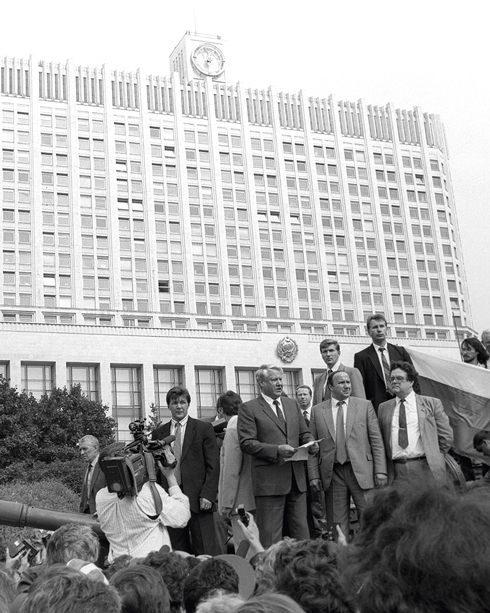
Boris Yeltsin on the tank in front of the government house. On August 19, 1991 , two anniversaries. The Moscow House of photography opens in the capital of the exhibitions dedicated to the 80th anniversary of the two largest Russian politicians at the end of the 20th century. One dedicated to the first and only president of the USSR is called “Gorbachev. PresTroika. " The other is about the first president of Russia-“Boris Yeltsin and his time” exhibitions open one after another (Gorbachevskaya-January 24, Yeltsinskaya-26th) and divorced in space: Gorbachev is honored in the Manege, Yeltsin-in the house of the photograph on Ostozhenka. Not soon they will be able to converge under the same roof, although there are enough intersection plots, because in the history of Russia there are few such dramatic crossings as Gorbachev and Yeltsin.
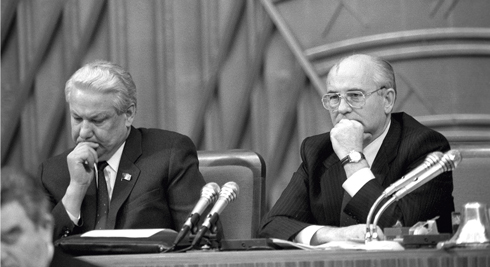
Boris Yeltsin and Mikhail Gorbachev at the IV Congress of People's Deputies of the USSR. 1990 The political drama Gorbachev appeared in some photographs of the Yeltsin exhibition - for example, a historical moment was recorded here when, after the failure of the putsch Yeltsin in a humiliating manner, he forced the president of the USSR to publicly sign a decree on the ban on the activities of the CPSU. It seems that this is the only truly sharp picture at the exhibition that collected about 200 works. Although the confrontation between the two leaders looks not as positive for the country as their possible cooperation. However, was it possible in the conditions of the sharpest political struggle and personal rivalry? Probably played a role and the diligence of the personal space around the leaders. The concentration of the characters of the level of Alexander Yakovlev and Yegor Gaidar (the exhibitions did not do without them) can never be high; Probably, by their actions, it is necessary to determine the real course of history.
Photos built in the conflict with Yeltsin cannot be found at the Gorbachev exhibition, in the organization of which Gorbachev-Fund participated. There are also almost 200 works, including Yuri Growth and Valery Gende-Rot, Igor Mukhin and Alexander Borodulin, Anthony Swo and Sergey Zinoviev. It turned out a living panorama of living time, the image of the anniversary does not overshadow the era. Gorbachev is shown inside the events, he is part of them, sometimes a leader, sometimes a victim. The Moscow rally for the abolition of the 6th article of the Constitution of the USSR, captured by Viktor Akhlomov in February 1990, recalls how the times have changed: now they are accelerated for rallies in support of the constitution, and not for the abolition of its articles. And the fans of the Moscow News, gathered at the stand of the newspaper, have seen by Pavel Kassin in the same year, cause nostalgia for times when both the press and readers were different.
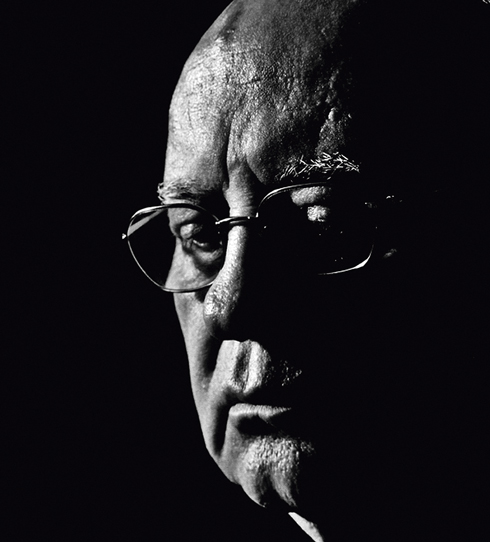
Portrait of Mikhail Gorbachev. 2009 (A. Trukhachev) The loneliness of the leader of the photograph for the Yeltsin exhibition was selected with the participation of his family, the vast majority of this photo chronicle of ITAR -TASS. Yeltsin here is the main character that determines the time, he looks like a lone leader, devoid of associates and surroundings. At the same time, many textbook pictures with Yeltsin are missing like a performance behind the armor on an impromptu rostrum near the White House or the whole world of a scene with a conducting wand bypassed. There are no works that captured it not in the brightest (from the point of view of a loyal biographer) of the moment of life. Tassovtsy, of course, are professionals, but there are also photocors of Kommersant and many other publications that shot Yeltsin from non -parade angles and with amazing psychological reliability. In the end, the empty ladder of the Russian aircraft in Shannon, who is waiting for the Irish prime minister, is also Yeltsin, we like it or not.
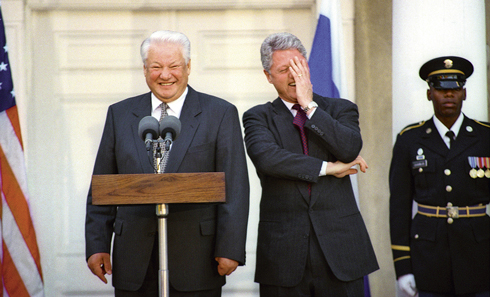
USA. Boris Yeltsin and Bill Clinton at a press conference. 1995. The image strives for redness and policemen, a retired portrait that is convenient for the environment appears, but not quite accurate historically. So Yeltsin turned out to be in the pictures that entered his Zhzlov biography - it is more likely a formal report than the story of a staggering and contradictory person. A similar turn of events is possible, but the gaps are obvious: there is too little other Yeltsin, sometimes crushed, unlearned, impulsive.
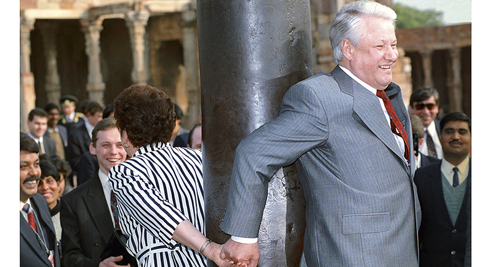
Boris and Naina Yeltsina in India. 1993. We all remember that era, carelessly called today "dashing nineties." Maybe someone at the top of the social pyramid and the dashing careers were successful, where personal and professional qualities do not correspond to the places occupied as a result. But for most 90s, there were a time of hopes that turned out to be disappointed. Rallies and posters in favor of Yeltsin at the exhibition are shown. Rallies and posters against - there is practically no exception, made only for the picket of Valeria Novodvorskaya. But Yeltsin outside the struggle is like a plane without a motor, it is impossible to imagine, and even more so to show only in the situation of meetings with the people and other presidents. A meaningful exposition should not do without opponents and those who then chose other roads, they do not spoil the anniversary, but only set off the features of the hero.
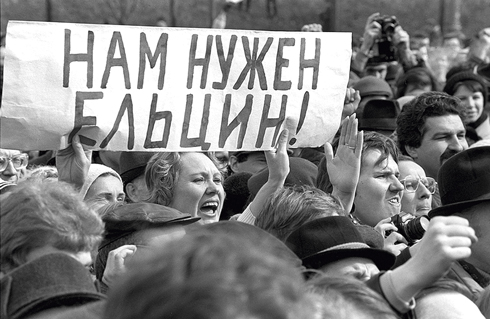
A pre -election rally in Moscow. 1989. But making problem exhibitions in countries with sovereign democracy is unpleasant. A little what - and the question stands up: your name is not Erofeev? Or tyrants? Just in case, sign in receiving a court claim.
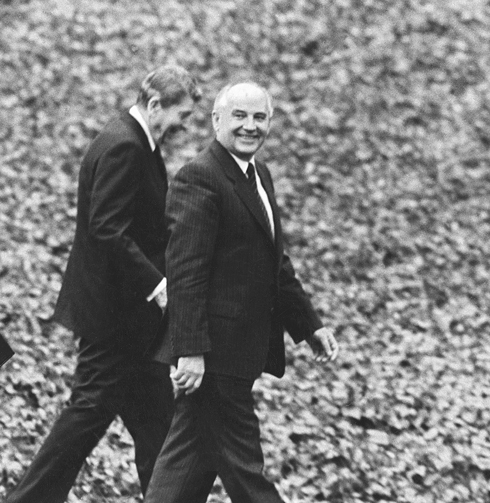
USA. Walking in the White House garden. Ronald Reagan and Mikhail Gorbachev. 1987 What will the anniversary exhibitions look like in the future? Will they become more rigid conceptually? Is their creation without the participation of family members? Will the society need a new photovicillus to free politicians from retouching? The law on the right of heirs on the right of heirs to impose a veto not only on the publication of correspondence in Russia, but it is also understood too literally for images of their relatives. The recent scandal with the biography of Sergei Dovlatov, subjected to censored cutting due to the position of the writer’s widow, is convenient for current politicians. It seems that the law was adopted in the calculation that in Russia they will never make photos regarding the personal life of politicians, because they will probably try to resist such publications. All hope for the Internet and the foreign press, where representatives of the authorities are deprived of the eastern halo of sacredness, which they are still striving to surround in Russia.
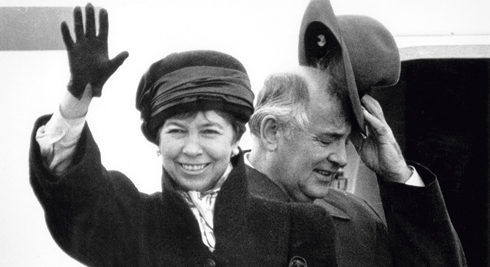
Mikhail and Raisa Gorbachev. Reykjavik, 1986