
Translated material
Sudden day
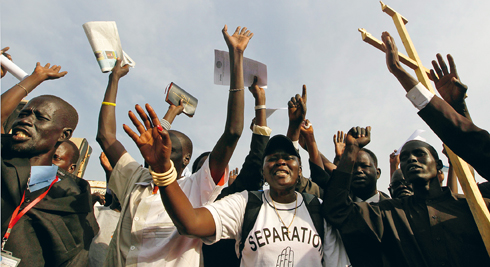
Sudden day. The East of Africa these days resembles the Balkans: Sudan, the largest country in the Black Continent, after a long-term civil war, breaks into the Muslim north and the Christian-language south. At the referendum on the self-determination of South Sudan, which began on January 9, according to Ecci-regulations, more than 80% of citizens voted for the pros. By February 6, the final results of the plebiscite will be summed up, and then, after a 6-month transition period, a new country will officially appear on the world map. Whether two Sudanes will get along with each other, - found out The New Times
On the table at the deputy head of the election commission of South Sudan Chan Madut two pennants: one shows a palm, on the other - a handshake. The palm means the independence of South Sudan, the handshake is a single state. Also on voting urns: some of them are marked with a palm, the other with handshake. And no letters. According to Madut, such a “extremely simple and affordable way of will” was invented by one of his subordinates: almost 75% of the population of South Sudan is illiterate.
"We have oil"
Mowers admit that I have never seen so many journalists in my life: more than a thousand from all over the world came to the referendum in the South Sudan capital of Jubu. How they are going to work, the official does not even imagine. Not more than 25% of the territory of South Sudan has been electrified so far, and only 40 km of all roads are paved. Some filming groups make “distillations” from the neighboring Kenya, where they get on jeeps - they purchased as many as 100 pieces for the money of international organizations, and boasts. 9 provinces of the south vote in a referendum. For international observers, getting to many areas is a problem due to off-road. There were not enough jeeps for everyone: someone got bicycles equipped with flashlights as a means of transportation. The standard of living in the south is 4-5 times lower than in the north. Infrastructure as such is absent. As a result of the Civil War, which the southerners - interrupted - waged more than 2 million people since 1956. “There can be no more single Sudan - too much blood is shed,” says they. He believes not only in the success of the referendum, but also in the bright future of the south: “We have oil. And oil is life. ” With one, however, the condition: if there are no new deaths. But when almost 90% - for, I don’t want to think about the bad.
Big game
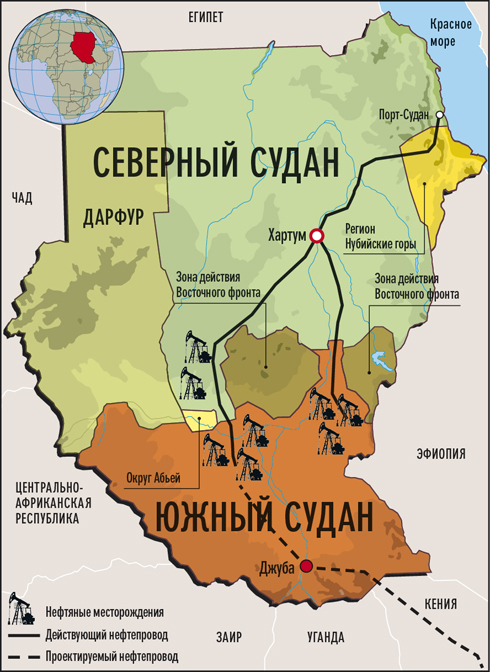
75–80% of Sudanese oil is produced in the south. Now the daily volume of oil production is 550-600 thousand barrels, of which approximately 360–370 thousand are exported. However, almost all oil storages and refineries are in the north. And the only oil pipeline is 1.5 thousand km long from deposits in the South Sudan Province of Unity far north-straight to Port Sudan on the Red Sea. In the event of a conflict, the northerners will be blocked at a time: southerners can at least sink their oil. And now, for the Omar al-Bashira regime in Hartum, the oil pipeline is almost half of all budget revenues, and henceforth it will be possible to “cut coupons” for transit. This is much more far -sighted than to start a new conflict. “The north and south, at least in the next three years, have no alternative to economic cooperation,” Roland Maresal, an expert on Sudan from the Parisian University of the University of Paris University, concludes in a conversation with The New Times. Why exactly three years? So much will be required for the construction of a new pipeline - through the territory of Kenya to the Indian Ocean, which, by order of the South President Salva Kiir, begins to build Chinese specialists. By the way, it is the Chinese National Oil Company that belongs to 60% in the consortium for the operation of the northern pipeline: the Americans left barely from the Sudan oil fields, the Chinese immediately took their place, and the Canadians and the Japanese partially took their place. "
The decay of Sudan is a serious blow to the ideas of panarabism and panicism in Africa, experts say
“American chevron and Halliberton raw materials settled in Sudan even before Omar al-Bashira, who came to power as a result of a military coup in 1989. But then politics intervened in the economy. Al-Bashir was carried away by the ideas of pan -lamism. It is no accident that Sudan was sheltered in the 1990s. The Islamicity of the Sharia, including the main Sudanese ideologist of the radical Islam, applauded the attacks against the Americans-and they left for the Economic blockade of Sudan A promising task is solved by the specialist of President Obama in Sudan Scott Greyshens. All international standards. 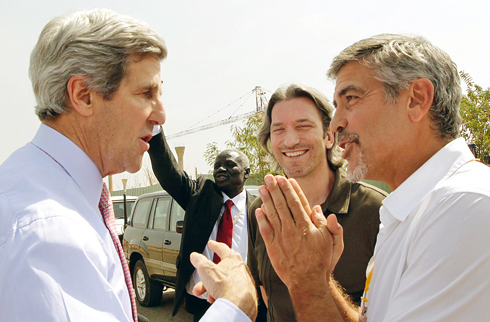
The power of inertia
Unlike Washington, the Russian independent expert on Sudan, candidate of historical sciences Andrei Stepanov, Moscow, Moscow, who sent two members of the Federation Council - Aslambek Aslakhanov and Vladimir Liquids to the referendum, still makes political rates to the north to the referendum. The special representative of the President of the Russian Federation in Sudan Mikhail Margelov did not come to the Jubu referendum, but a month before he visited Hartum, where he announced the support of the peace process in the Sudan. 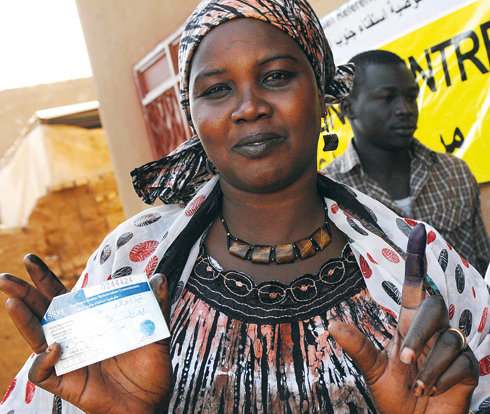
The logical consequence of that trip was the visit at the end of December 2010 to Moscow, the Foreign Minister of Sudan Ali Ahmed Picture. But what did Russia get in the end? “At one time, in Sudan, the USSR was overwhelmed by Dictatorial regime of Dzhafara Niwrii with a weapon, built a metallurgical plant in Omdurman, conducted thermal energy networks: it seemed that panarabic figures voiced ideas close to us, only in their dialect,” says Andrei Stepanov. - The post -Soviet Russia has neither strength, no desire, nor personnel for presence in Sudan, and in Africa in general. Nevertheless, Moscow, by old inertia, supports Hartum. ” What can this support can do if Omar al-Bashir, from which the Hague Tribunal has not yet removed the accusations of the Darfur tragedy *** in the mid-2000s of this Sudanese province at the hands of the Prirdoic armed groups "Janzhavid" killed about half a million people and another 2 million became references, and violates the promise to recognize any results of the referendum and It will begin to shake stability in the south - a serious question.
The fate of the hero *
The collapse of Sudan is a serious blow to the ideas of panarabism and panicism in Africa, many experts say. So whether the surroundings of al-Bashira will reconcile with such a development of events, where the positions of the Orthodox are strong is still unclear. “Al-Bashir must pay tribute: he sat down at the negotiating table with the southerners, fulfilled all promises to proportionally divide the representative office with them in power structures and equally-income from the sale of oil; Not every Arab figure will decide on this, ”says Andrey Stepanov. “And now he is the most interested in the very least to remain an international outcast.” At the same time, the expert predicts that in the leadership of the North the power approach to the self -predicted south will prevail. And recalls the fate of General John Gaul, the legendary leader of the South Sodan national liberation movement. In 2005, al-Bashir signed comprehensive peace agreements in Addis Ababe in 2005. And shortly after this, the helicopter on which the guarantor flew, crashed under unclear circumstances. 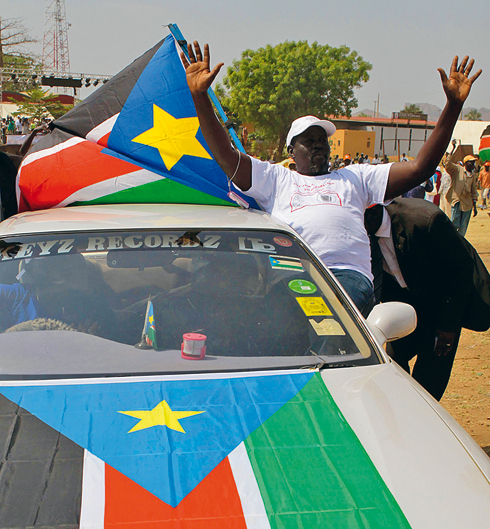
Michael Tsakh, Professor of Vienna University: "Bashir is a reality"
One of the largest experts in the Sudan in Europe, Professor of the University of Vienna, Michael Tsakh, does not exclude that other regions of the country will follow the example of South Sudan: the long -suffering Darfur, where there are also oil deposits, and the Oil Province of Abyai, where the northern Nubian tribes are a minority. * * In total, more than 400 tribes live in Sudan, including 300 - in the south it is clear that South Sudan has been under the oppression of the northern part of the country for almost 200 years. People want independence, and they will receive it. But in general, for the country, by virtue of the same factor, there is a danger of strengthening internal conflicts. Is the “domino effect” in Africa after the decay of Sudan? This is now indicated by the Libyan leader Muammar Gaddafi. However, the relatively painless branch of Eritrea from Ethiopia suggests that such fears are exaggerated. In general, the main box of Pandora was opened in Kosovo, and not in Sudan. Here, at least the referendum is carried out with the full consent of interested parties and with the support of all international institutions. How will the border demarcation between the south and north of Sudan take place? A good question ... Now there is probably no clear answer to it. A large number of nomads-nomads live in Sudan. They already form aggressive groups, because they are faced with the problem of crossing the still unofficial border between the North and Southern Sudan. When the border becomes full -fledged, I'm afraid the situation that we observed in Darfur may arise. After all, there, too, the root cause of the conflict was the uncontrolled migration of the northern Nubian tribes in areas, traditionally inhabited by Negroids. Can President North Sudan Omar al-Bashira be considered a partner of the world community? It depends on how he behaves in relation to the south in the coming months. But besides Bashir in North Sudan, there are now no serious applicants for the presidential chair. Bashir is a reality, regardless of whether it is suitable for the West or not. Olga Marchich conversation (Vienna)
---
Christianity was brought to Sudan by missionaries from the Middle East in the first centuries of our era. Already by the VII century A.D. Sudan was small scattered Christian kingdoms - Aloa, Mukurra, Nobatia - and possessions. But in the 640s from the north, from Egypt, Arabic gold miners rushed here: the territory between the Nile and the Red Sea was rich in gold and emeralds. The Arabs brought Islam with them, but their influence spread mainly in the north of Sudan: the advancement further south was interfered with tropical swamps, other geographical and climatic factors. The south of the country remained a place that was inhabited by the scattered Nilotsky tribes (blacks), who professed traditional beliefs and Christianity and underwent frequent raids of the Arab slave traders. In order to strengthen their power, the ethnic and political separatism of the South encouraged the British colonial administration, thus laying the prerequisites for future ethnic and religious conflicts in Sudan.