
Translated material
Entezelad Makes the Ring of Saturn
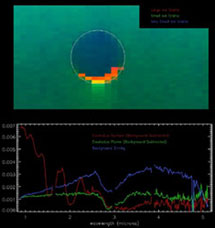
Having analyzed the data received from several devices installed at the American Cassini interplanetary station ( Cassini ), scientists were able to identify the source of the most remote and sparse ring of Saturn.
Recent observations showed that tiny particles of frozen water are stuck into space from the South Pole of the Saturnian Enzeladus satellite ( Encladus ). The source of geological activity on the Enzelad is still a secret. "We were amazed when we saw ice geysers in this world, which had long had to become cold and dead. Some unknown process intensively warms up the inside of Enzelada, especially the area of its south poles, and causes outs of torches from ice particles," Dr. Dale Kruikshank commented on the course of research from the course of research The NASA Ames Research Center, who participated in the work of the scientific group responsible for processing the results of optical and infrared spectrometry.
Ice particles from these "jets" have different fate: larger particles are mainly returned to the surface of the satellite, while small particles pushed by sunlight are distributed in orbit around Saturn.
“Most of these small particles are likely to come across the moon again, but a small part of them under the influence of light rays and interaction with the magnetosphere of Saturn is scattered and forms a wide ring“ E ”,” says Dr. Mark Showalter from the California Seti California Institute. Thus, we can say that the “E” ring is currently fed due to some geological processes that go inside the ENCELAD.
During the rapprochement of Cassini with Enzelad, carried out on November 26, 2005, a spectrometer displaying the optical and infrared components registered the spectrum of polar “torches” of ENCELADA (they are called “plums” - plums). “In the“ torches ”data, we saw a very clear signature of small ice particles in the form of a noticeable absorption strip of 2.9 micron,” explained Dr. Phil Nicholson, professor of astronomy from Cornell University (Cornell University, Itka, New York), a member of the same scientific group (Visual and Infrand Mapping Spectrometer). All this confirms the suspicions that have already previously arisen that it is the ENCELAD that is the source of the material of the Ring "E", which stretched for 302 557 kilometers.
A preliminary analysis of the data showed that the average amount of particles in the “torch” is approximately 10 microons (1/100000 meters), while particles in the “E” ring are approximately three times smaller. The surface of the Enzeladum itself also consists of water ice, but with a much larger grain size than in the "torches".
The first information about the Enzelad structure unusual from the point of view of earthly geology appeared in August 1981, during the rapprochement with this celestial body, the American Voyager-2 (Voyager 2). The Voyager passed the pictures of an unusual smooth landscape to the ground, which indicated that this moon was geologically active at least 100 million years ago.
However, a satisfactory explanation for the fact that a tiny enzlad (whose diameter is about 500 kilometers) was once so hot that no one melted. Entezelad is unlikely to contain a sufficient amount of radioactive materials to warm up at their expense, its orbit is not eccentric enough to explain the heating with top-excessive interactions with a planet-giant (Enzeladic orbit is located 237,378 kilometers from Saturn, these are two-thirds of the distance from Earth to the Moon (384 400 km)), and there), and there)), and there)) There is not even a sufficient amount of ammonia so that this can be justified by the reduced melting point of the surface of the moon. After the “Voyager”, the researchers simply postponed the problem of ENCELADA for an indefinite time, considering it at the current stage of the insoluble (some planetologists, however, believe and believe that the insides of the ENCELADA and serve as the cause of its “water volcanism” could be adequate -excavated interactions between the ENCELAD and MIMAS (MIMAS) - another satellite of Saturn).
Only at the beginning of 2005, Kassini, sending its more advanced cameras and devices to the Entzelad, was able to move the study of the Enzelad from the dead point. The tiny moon, it turns out, boasts a sparse atmosphere consisting of water vapor with an admixture of nitrogen, carbon dioxide, etc. The simplest carbon molecules (that is, the simplest organics; simple organic compounds include carbon dioxide and molecules containing hydrogen and carbon - like methane, ethane and ethylene) were found in the area of its southern pole. The Southern Pole of Enshalada itself is a kind of paradise place in the conditions of an ice desert - there are relatively high (when compared with the expected minus 203 degrees Celsius) temperature - minus 183 degrees (the Enzelad reflects almost 100 percent of the light, because the temperature there should be very low.
Among other things, the south pole of Enzelada is the center of geological activity. This area is distinguished by parallel cracks about 130 km long, standing from one another by 40 km. These cracks, which have received the names of the "tiger stripes", belp steam and tiny droplets of water, which crystallize on the surface of the Enzelad for a thousand years.
The Mission "Cassini-Huygens" is a joint project of NASA, the European Space Agency (ESA) and the Italian Space Agency. The control of the apparatus was entrusted to the laboratory of reactive traffic (JPL, Pasadena).
Sources:
Multiple Cassini Instruments Capture Encladus Plume - JPL - Cassini -Huygens News
Encladus Plume -Cassini-Huygens Multimedia-Images