
Translated material
Eight rings of wise Einstein
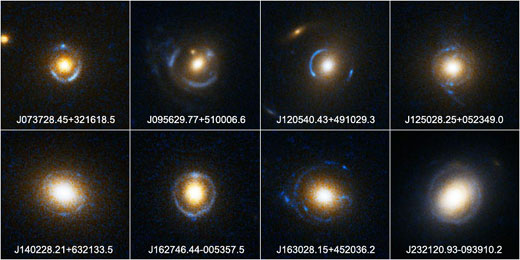
The united efforts of two famous astronomical groups - specialists of the Slanovsky digital review (Sloan Digital Sky Survey - SDSS ) and the Operators of the NASA " Hubble " cosmic telescope - managed to identify 19 new "gravitational" Gravitational "(Gravitational Lensed) galaxies, and eight of them can serve as good examples of the so -called Einstein’s rings - perhaps the most impressive manifestation of the phenomenon of gravitational lensing ( Gravitational Lensing , the effect was predicted back in 1936 by Albert Einstein, which, however, did not believe that someday it would be observed in reality). Previously, only three similar rings were known, observed in the optical range.
In gravitational lenses, light from remote galaxies on its path to Earth deviates under the influence of gravitational fields of any closer massive objects and gives rise to peculiar cosmic mirages. Due to the bending of light rays, images of remote galaxies can undergo rather bizarre distortions. A light spot can stretch out with an arc or multiply in the form of several takes the same object (" Einstein Cross "). And when two galaxies are built exactly in one line, light rays from a remote galaxy, symmetrically missing a closer (and rather compact) massive object, can form a characteristic ring (however, most often ragged), which is actually called the “Einstein ring” (another, less often the name “Holson -Einstein ring”). Such a ring is “twisted” around a massive lenses and makes it possible to know about the existence of a remote galaxy, although the original source of light rays is hidden.
In addition to creating such bizarre and delighting eyes of forms, gravitational lensing provides astronomers with the opportunity to directly prohibit space space for the presence (and even approximate distribution) of dark matter in elliptical galaxies. Dark substance is an invisible exotic form of matter, which is not amenable to observations with direct methods. Determining the accumulations of dark matter in galaxies, astronomers hope to comprehend the mechanisms of the formation of these same galaxies, because according to one of the most popular astrophysical theories, galaxies were originally formed around such clusters-narats of dark matter in the early universe.
The project dedicated to the detection of all these "lenses" is called the Slanov Lens Survey - Slacs , the first results of this review will appear in the February (2006) issue of the " Astrophysical Journal)). The group of astronomers, employed in the SLACS project, is headed by Adam Bolton from the American Harvard-Smithsonian Astrophysical Center (Harvard-Smithsonian Center For Astrophysics ( CFA ) in Cambridge (Massachusetts) and Leon Blaon (Leon Koopmans) from the Dutch Astronomical Institute named after Jacobus Kaptein. Candidates in Lenses were selected among several hundred thousand optical spectra of elliptical galaxies in SDSS (in our case, repeating and “smeared” spots should have the same spectral composition, since they are generated by light from the same object). Advanced Camera for Surveys “Hubbla” was used to get images of 28 galaxies from among these candidates (pictures were taken between August 2004 and March 2005). Studying the arcs and rings, "drawn" by the light of 19 such galaxies-guards, the astronomers appreciated the masses of galaxies-gravity lenses (giant elliptical galaxies are located at a distance of about 2-4 billion light years). These new discoveries will noticeably expand the current list of approximately a hundred gravitational lenses that have been known to astronomers so far.
“Having received the opportunity to explore these and other gravitational lenses that“ earned ”billions of years ago, we will be able to directly study the distribution of invisible and visible mass in the space time frames,” says Kupmansa. “With this information, we will be able to check the widespread theory, according to which large galaxies are formed as a result of clashes and mergers of smaller galaxies.”
Sources:
Hubble, Sloan Quadruple Number of Known Optical Einstein Rings - NASA Press Release
Einstein's Rings in Space - CFA Press Release
Links: