Billionaire Melnichenko launched the largest sailing boat in the world. The sky over Krasnoyarsk will remain black
New brand of Krasnoyarsk - cross and smog
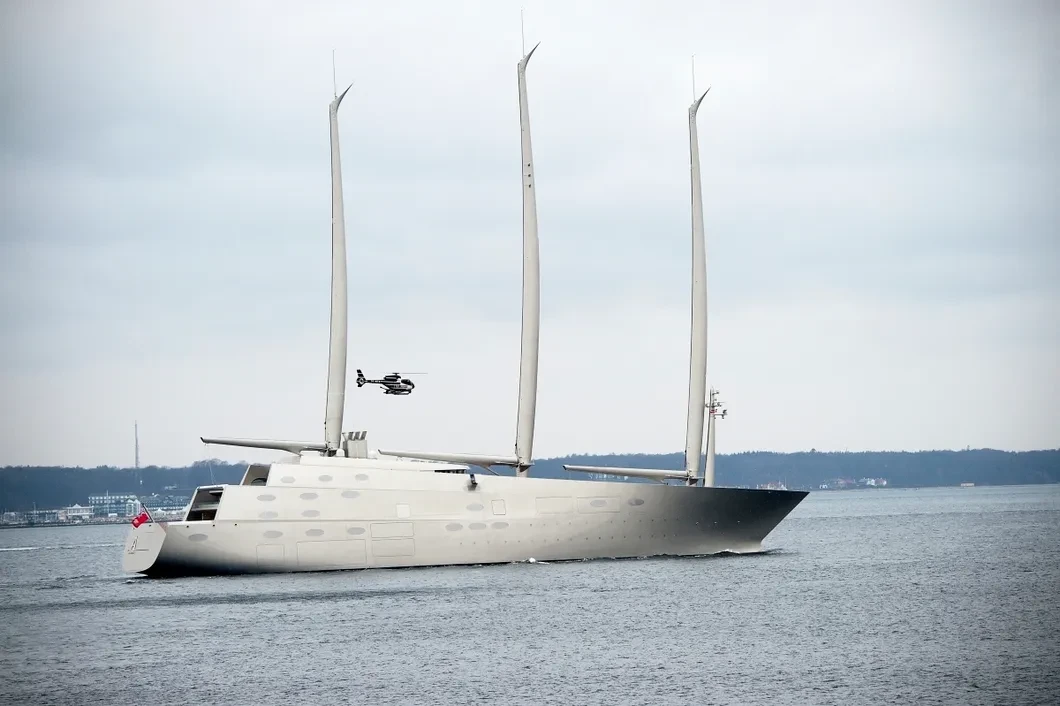
February 20 had already arrived in Krasnoyarsk, when news arrived about the arrest in Gibraltar of a yacht, welded to order by Andrei Melnichenko. The YachtHarbour portal reported that the recently launched futuristic SailingYacht A (S/YA), the largest private yacht in the world, was seized in connection with a lawsuit by the German shipyard that built it. Allegedly, Melnichenko underpaid 15 million euros. “I recognize brother Kolya”: according to expert estimates, the yacht costs 450 million euros. 143 meters, 8 decks, designed by Philippe Starck, and the main mast, as Londoners noted, is taller than Big Ben. In the British press S/YA was nicknamed behemoth.
Petr Sarukhanov / “Novaya”
And in Krasnoyarsk, February 20 was the eleventh day of the black sky regime, announced on the evening of February 9 and twice extended. The black sky, let me remind you, is not a metaphor: the sky is not visible, it is in dense haze, you can’t breathe, the authorities do not recommend going outside and opening the windows, cars move with emergency lights. This is not the case all the time, of course, but often. Especially at night, when enterprises produce volleys of gas emissions and they mix with the fog over the soaring Yenisei.
Andrey Melnichenko. Photo: RIA Novosti
Melnichenko is one of the beneficiaries of this smog: he owns (among other things) three Krasnoyarsk thermal power plants that burn Kansk-Achinsk brown coals (another of his company, SUEK, mines them).
The city will have to chip in
The year before last, the black sky regime - only officially - was in effect for 63 days, last year - 58, this year - almost half of the elapsed days. Bloody beef lungs have already been thrown onto the porch of Melnichenko's companies in Krasnoyarsk, crayfish have been released: the latest regional state report on the state of the environment noted “an increasing trend in the incidence of malignant neoplasms in the population (average annual rate of 4.99%).” At one time, the entire city was decorated with stencil graffiti: the silhouette of a smoking thermal power plant and an alternative decoding of the abbreviation SGK - not “Siberian Generating Company” (which includes three Krasnoyarsk thermal power plants), but “Death of the City of Krasnoyarsk.”
Krasnoyarsk residents - especially those with small children - are fleeing the city of environmental disaster. I asked my friend Boris Bayfa, who left Krasnoyarsk and settled in Estepona, Spain, to drive up to the Gibraltar barrier - it’s nearby. Examine the surface of the sea near this rock as long as you can see. Boris confirmed yesterday: behemoth is worth it.
Melnichenko loves yachts with names “A” in order to occupy first positions in shipping registers. So, he already has a motor yacht called “A” worth about $300 million, also designed by Philippe Starck.
Krasnoyarsk residents did not remain indifferent to the Gibraltar troubles of a man making capital on their health. Some comments: “And you say gas purification, filters, gasification. People don’t have enough money here for yachts.” “We are waiting for housing and communal services tariffs to increase.” “The mystery of the black sky is close to being solved. Direct dependence." “Now we will buy it for the whole city. Wait for recalculation." “Try using the calculator on your iPhone to convert the price of this yacht into rubles. It’s already buggy, it gives out an incomprehensible number with the letter “e.” “You don’t understand. Krasnoyarsk needs to be heated with stinking coal, and gas must be sold to Ukraine, to Europe. To make a profit. With this profit, we will build many ships, tanks to defend Crimea. To continue selling gas to Europe and Ukraine.” “Advertising says that Gazprom is a national treasure. I would like to know what kind of nation there is in mind."
"Yacht A" Melnichenko. Photo: EPA
What kind of gas can there be in Siberia?! Siberians mine it in Siberia, but not for Siberians. I won’t talk about state policy, the federal structure - according to the Constitution, let’s be realistic: a person has coal and there is a thermal power plant that burns this coal. And recently, this same person also has networks that deliver energy to the consumer. Such monopolists were written about in ancient textbooks of Marxist-Leninist political economy. Today - here he is, the surname is Melnichenko. Moreover: he is not only a reality, he is also not a unique phenomenon. Oleg Deripaska, who makes a much more significant contribution to the Krasnoyarsk smog and its carcinogenic components, also owns not only the Krasnoyarsk Aluminum Smelter (KrAZ), but also the Krasnoyarsk Hydroelectric Power Station, which supplies KrAZ with current, and Krasnoyarsk - a three-hundred-kilometer-long wormwood soaring in winter and icy in summer, aggravating smog and pulmonary diseases.
There is also news from Deripaska. Its management reports that RUSAL has registered on the Shanghai Exchange a prospectus for issuing panda bonds (bonds in yuan) for $1.5 billion.
The money will be used to purchase raw materials in China for RUSAL enterprises. This means: Krasnoyarsk - get ready! Deripaska continues to increase the capacity of KrAZ.
According to statistics just published by RUSAL, KrAZ produced 1,024,000 tons of aluminum last year. Thus, it came out on top in the world (the former leader, the Bratsk plant, produced 1.005 million tons). From an analysis of open access documentation, it is clear that an increase in aluminum production by even a fraction of a percent - according to the century-old technology by which KrAZ smelts metal - causes such an increase in emissions as if a dozen of those factories that stood in Krasnoyarsk under the Soviets were re-smoked.
In addition, RUSAL recently successfully placed Eurobonds for $600 million. There have been a lot of reports that Deripaska’s En+ Group (which includes KrAZ, Krasnoyarsk Hydroelectric Power Station, and many other industries) plans to hold an IPO (initial public offering) in London in the near future. And they are talking about plans for an SPO (secondary public offering) of RUSAL (all the same enterprises, but in smaller numbers), possibly in the form of global depositary receipts.
Behemoth vs hornless bulls
Writing about the ecology of Krasnoyarsk is the utmost hopelessness. I’ve been doing this since 1991, from the moment I first came to this wonderful city and inhaled this stench. Nothing changes. This is an enchanted place and theme. Well - almost nothing. Before Deripaska, when local bandits owned a third of the smelted metal and they carried out operational management, KrAZ significantly filled the budgets of the city and region. From under his torch he resettled the village of Korkino and the village of Industrialny, where
Children's milk teeth rotted before the molars grew. And the cows that they tried to breed here had their hooves and horns fall off. Fluoride even corroded glass in houses, as if they had been walked over with coarse sandpaper. The potatoes were rotting on the vine. 30-year-olds with softened musculoskeletal tissues were taken to the graveyard.
Tailless cats were running around the Pogranichnik cinema in Industrialny.
Now, with the expansion of KrAZ’s capacity, the entire city is under siege. And, of course, no one is going to resettle anyone anywhere. Ecological “emigration” is only a matter of your choice and your money. And in full accordance with the lobbied legislative loopholes, Deripaska pays Krasnoyarsk pennies. Large businesses, in accordance with Moscow's decisions, must pay where they operate, but exceptions have been found for some large businesses. And, as we see, neither Deripaska nor Melnichenko are affected by any sanctions, their Western and Eastern partners do not take into account reputational risks, none of them (there are a few exceptions) seem to care about the fact that, by collaborating with these figures, they also take part of the blame for what is happening with Siberian cities, rivers, and Lake Baikal.
This has long been KrAZnoyarsk.
The preferential economic regime in which KrAZ operates, its energy tariff, its taxation, and state requirements for this business (almost invisible) are amazing. Everything is woven from preferences. And last year, Governor Viktor Tolokonsky signed documents on the creation of a new industrial zone “Aluminium Valley”, promising the Chinese tax benefits, the most favorable treatment, and the residents of the region - “new jobs, an incentive for the production of primary aluminum.” The city demands to save it, but under Tolokonsky, SGK (Melnichenko), already dominant in the energy supply of Krasnoyarsk, paid for and presented a new scheme for heating the city with coal-fired thermal power plants - until 2033.
On the first working day of this year, Tolokonsky called a meeting and admitted that “ecology for the Krasnoyarsk Territory is a problem among problems.” He proposed obliging enterprises to reduce production volumes and their operating modes during periods of black skies. “And there’s nothing complicated about it, and there’s no need to be afraid!” This means one of two things:
Either the governor is deliberately deceiving the people, or he doesn’t understand what he’s talking about—there are no technologies to stop the smelting furnaces. If it cools down, that means that’s it, forever.
In the vocabulary of metallurgists, this is called “goat the furnace.” KrAZ is technologically unable to respond to the orders of officials (even if they dared). This is a continuous production, and it has always worked and is working outside the law, according to “temporarily agreed upon emissions volumes” that allow exceeding the calculated maximum permissible volumes. KrAZ always prepares schedules for temporary shutdowns of gas treatment units (gas treatment units) in advance, regardless of the weather, wind rose or calm, during which time gases are released into the atmosphere without filtration. Yes - regularly. There is also no technology for measuring emissions with gas analyzers, which for some reason people pin their hopes on. If, as is planned in the near future, they are installed at the outlets of factory pipes, in a matter of days they will simply become clogged and fail.
At the Chelyabinsk metallurgical plant. Photo: RIA Novosti
Regional authorities have continued to roll cotton wool for decades.
Instead of stopping the practice of “temporary approvals” and ensuring that claims are filed in defense of the city of a million. What kind of misfortune is this, “black sky mode”? "Old woman with a stick"? The prosecutor's office must force enterprises to reduce emissions to legal levels. In case of non-compliance, attach it to the factory pass-through lock. This should not depend on the weather; the weather cannot replace government administration. It is awkward to cite Moscow as an example, but even in the brotherly city of Krasnoyarsk, Chelyabinsk, cases are being initiated on the facts of industrial emissions. And in Krasnoyarsk the authorities are still - for years - complaining about the wind, the river, and motorists. What do they have to do with the layer of soot over the city?
How to correlate two facts: cars drive during the day, and smog covers the city at night? Or. Why doesn't smog hang over Moscow? There are more cars there
and their contribution to local air pollution tends to 100%, from enterprises - to zero. But the API (air pollution index) in Moscow is 3.5-4 times lower. We would like that.
And, by the way, it was not the Krasnoyarsk residents who came up with the idea that the cleaner Euro-5 standard fuel produced in the region goes to the metropolis, but here, inside the colony, it is problematic to find it. How can we not find Siberian gas here for us, etc.
All these are empty questions, the answer to them is known: there is no responsible government in the region.
Its last meeting, dedicated to ecology, where they decided to think about allowing cars with even numbers to drive on even days, and vice versa, those ending in an odd number - on odd days, the chairman of the committee on natural resources and ecology of the Legislative Assembly of the region, Alexander Simanovsky, ended with the words: “We are at the beginning of a long journey.” Four years ago, in the “regional state newspaper “Our Krasnoyarsk Territory” under the headline “At the Beginning of the Path,” Simanovsky, in the same status, chief of ecology, said: “The Federation is developing a concept for the ecological development of the country. For the last three years, we have been deliberately addressing this issue at the regional level. We have now reached the finish line - we will adopt the environmental concept of the Krasnoyarsk Territory for the next 17 years.”
Difficult, responsible work: for seven years now we have been either at the finish line or at the beginning of the journey.
They will shift papers and torment people until the end of time. In the previous composition of the Legislative Assembly, Ivan Rebrik, director of the department of ecology, labor protection and industrial safety of RUSAL, member of the committee on natural resources and ecology of the Russian Union of Industrialists and Entrepreneurs of the Russian Federation, together with Simanovsky, defended the environment. Now he has presented a new report, promising to reduce KrAZ emissions by 8% (!) by the end of 2018.
Physicist Valentin Danilov (Krasnoyarsk Scientific Center of the Russian Academy of Sciences) recently gave me the manuscript of a scientific article he co-authored with Viktor Suslov (Institute of Economics and Organization of Industrial Production SB RAS, Novosibirsk), Petr Polyakov (Siberian Federal University) and Rem Khlebopros (Siberian Federal University, Krasnoyarsk Scientific Center of the Russian Academy of Sciences). We do not publish scientific articles, but here are the conclusions in brief: if we transfer KrAZ to baked anode technology (which was envisaged in the original plans for the development of KrAZ by 1990) with the utilization of waste heat from electrolysis (which will allow us to burn less coal), then the overall reduction in pollutant emissions in Krasnoyarsk will be 50% . For the boilers of CHPP-1, it is proposed to switch to burning combustible gas released from brown coal with the production of semi-coke for the production of smokeless fuel for a cement plant and furnace heating in the private sector.
But who needs it?
The smell of homeland and other people's money
The President of Russia will visit Krasnoyarsk in the near future, and the city has begun to prepare. Officials, it seems, went out to shake the surviving trees, the wind blew, and on February 21, a regime of clear skies came to Krasnoyarsk.
In addition, the self-identification of Russia's easternmost million-dwelling population finally happened. On February 13, “Novaya,” let me remind you, came out with the title text “Black Sky Mode” and a central photo of a grave cross over smog-filled Krasnoyarsk.
The townspeople began to actively post the note on social networks - not surprising, since the local press says inadequately little about the most important thing. Or speaks outright nonsense. (Perhaps because the authorities don’t talk about it or talk nonsense.) And on February 16, when the black sky regime was extended again, Krasnoyarsk designer Igor Specht wrote on social networks: “Our city is suffering, we cannot find our identity, and therefore we still have not developed a brand […] today it’s like a bolt from the blue! Here it is - RFN (black sky mode). Let everyone know! We need to stand out! ...branding is necessary here. Without it, money is wasted.” And - a gallery of pictures from the master, immediately picked up by the townspeople. “This is the kind of T-shirt I would give to the president.”
Today Krasnoyarsk residents congratulate each other on the emergence of a simple, truthful and recognizable brand for the city.
Symbol of Krasnoyarsk from designer Igor Specht
“The main graphic element is the cross - a symbol of the attitude of the authorities towards the city,” explains Specht. — The name of the city is inscribed in a circle to focus attention on the sign. The slogan “Take your gasmask” has been added, which has a practical meaning: guests of the city may get poisoned if they are not used to it. For practical reasons, the classic black and gray color scheme was chosen: this will make it possible not to see soot and dust on outdoor advertising and correspond to the general color scheme of the city.”
The success of this logo is probably its “archetypalness”. These are still Soviet-era jokes - about a Krasnoyarsk citizen in a gas chamber. Everyone around him died, and he thanks the Nazis for the reminder of his homeland. Yes, the environmental problems of Krasnoyarsk are from Soviet times. Although, once again, if the Soviet government had delayed, it would undoubtedly have switched KrAZ to baked anodes.
And in general. Even if it was an illusion, aluminum was then smelted for a dream, for “to each according to his needs,” for paradise for everyone, “and so that no one leaves offended,” in the interests of the entire Soviet people, the party and the government, who needed aluminum spoons, soldiers’ bowler hats and fighter jets.
And now - for what? Who obliged us to sacrifice the health of our children by making someone’s capital? Who gave Deripaska and Melnichenko the right to include us all, the entire city of a million people, in their production cycles:
from everyone, including babies, a ton of aluminum per year, each - 0.2 tons of emissions from the sky?
Isn't it time to finally answer this simple question?
Putin’s trip is associated with checking the progress of preparations for the 2019 Universiade. The President is traveling about a minor event that is of no interest to anyone even in the sports world. And not what the city of millions really cares about. Why this is so is generally clear. When someone tried to object to Specht - they say, you need to write in Russian: take a gas mask - Igor snapped: “The language should only be English, in our own language here (uncensored).”
Krasnoyarsk
DOSSIER. SAILING YACHT A
Melnichenko's yachts: a sail the size of a football field and refueling at a cost of 300 thousand pounds
Sailing yacht Sailing Yacht A , owned by Melnichenko, is considered one of the largest sailing yachts in the world: its length is 142.8 meters and its capacity is 12.6 thousand tons. The shipyard's general director stated that the yacht A project is the most advanced of all in which Nobiskrug participated.
There is currently no exact information about the yacht, since, as Novaya Gazeta found out, it has not yet been completed and, accordingly, has not been registered. She has six months of sea trials left, and now the ship has neither a unique call sign nor a captain. When the yacht is ready, Melnichenko, having only one, will become the “king” of yachts: not having the financial ability to have as many yachts as the Arab sheikhs can afford, he made a “PR move” - he built one, but the largest one. И если самые дорогие в мире яхты арабских шейхов обычно стоят на причале, лишь демонстрируя богатство и влияние ее владельца, то с парусной яхтой так не получится — она должна постоянно ходить.
Британский таблоид The Daily Mail оценил стоимость судна в 400 миллионов евро. Яхта, по данным СМИ, будет оснащена новейшими технологиями. В частности, она будет иметь цифровую систему управления в виде сенсорного экрана из черного стекла, который установят на мостике. Поднимать паруса и опускать якоря можно будет одним движением пальцев. При этом само судно будет весить более 14 тыс. тонн и оснащено двумя дизельными двигателями и двумя электромоторами, с помощью которых сможет развивать скорость 21 узел (10,8 м в секунду).
Официальный представитель Мельниченко говорил, что создание яхты было «значительным финансовым риском» для миллиардера, поскольку ему пришлось предварительно оплатить серьезные разработки, чтобы понять, реально ли воплотить его задумку.
Над оформлением яхты работал известный французский дизайнер Филипп Старк. В интервью Forbes Старк пояснил, что это первая яхта, «выполненная в органическом дизайне», в гармонии с природой. «Она выглядит, как рыба в воде, и даже не оставляет за собой волн», — сказал он, отметив, что ему удалось создать «революционную вещь». СМИ также писали, что интерьер самой длинной парусной яхты в мире будет напоминать декорации к фильму «Пираты Карибского моря».
Восьмипалубная яхта Sailing Yacht A рассчитана на 54 человека только экипажа. Судно будет иметь три мачты и три паруса, высота каждой мачты будет превышать сто метров. Их изготовили из углеводородного волокна. Размер парусов, как отмечали СМИ, превышают размеры футбольного поля. На яхте будет большой бассейн и трехэтажный атриум.
Кроме парусной яхты Sailing Yacht A, у Мельниченко есть еще одна — моторная. Ее построили в 2008 году, с тех пор яхта побывала во многих портах: Гонолулу, Малибу, Пуэрто Рико, в Турции и Тайланде. Над ее дизайном также работал Филипп Старк.
Яхта рассчитана на 14 гостей (для гостей предусмотрены семь кают) и 42 члена экипажа. Судно оборудовано тремя бассейнами (один из них — со стеклянным полом), вертолетной площадкой и ударопрочными стеклами. В люкс-каюте установлена вращающаяся кровать. В роскошном холле — панорамные окна и дорогая кожаная мебель. Интерьер украшают шкуры белого ската, столы инкрустированы кристаллами Baсcarat. На борту судна находятся два скоростных катера.
В прошлом году первое судно российского миллиардера вошло в Темзу и направилось в самый центр города — ради яхты даже развели знаменитый Тауэрский мост, чтобы она смогла пройти. Длина восьмиэтажного судна — 119 метров, ширина — 25 метров. Это 21 по величине яхта в мире, она способна разгоняться до 23 узлов.
Эта яхта обошлось миллиардеру в 300 миллионов долларов. Одна ее дозаправка стоит 300 тысяч фунтов. В середине апреля 2016 года Forbes со ссылкой на яхтенного брокера и знакомого Мельниченко сообщил, что миллиардер решил ее продать.