
Translated material
"Independencia!"
Catalonia will remain in Spain on its conditions. Or will not remain. Barcelona report
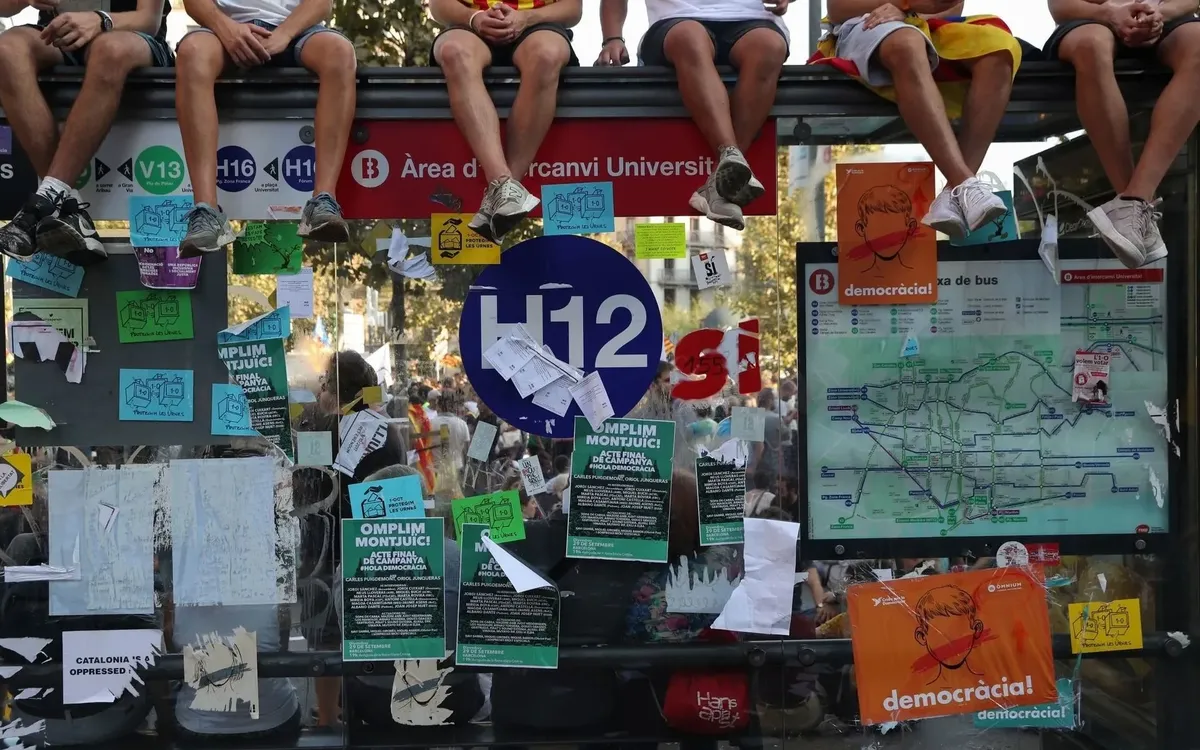
On Tuesday in Catalonia, a universal strike began. Protest actions followed one after another, to Barcelona from the province - in protest against the Spanish repressive car - tractors arrived again. One rally was convened by students, the other - firefighters ... Then half a city seemed to join them. Firefighters greeted violently: they protected people from beatings on the day of voting.
Another subspecies of the Social Group “Heroes” is the Catalan police who, after the sleeves, followed the Madrid order to close the plots and the seizure of electoral urns. On Tuesday, the police lazily watched how people fill all the central streets of Barcelona.
On the eve of 15 thousand students walked along the streets of Barcelona with adhesive tape mouths (for those who walked in the forefront). The rest could not be silent, the rest sang, chanted and clapped. Shouted: "We voted!" Sang: "We want independence!"
"What kind of song?" - I ask. “The old Catalan song,” the students shouted to shout out a new wave that flew from the beginning of the column hundreds of meters ago: “In -inde-independecia!”
A few hours before, the results were announced: to the question "Do you want Catalonia to become an independent state in the form of a republic?" - 90% answered yes.
***
“But only 2.3 million out of 5.3 million Catalan voters voted,” the Eurod. Havi Lopez (Socialist Party of Catalonia) insists, “this is just a little more than it was during the first survey, in 2014.”
“But listen,” I say, “this Sunday hundreds of people stood in lines on each site.” They stood in the rain and waited. The Spanish authorities collapsed the site for registration of voters, and people could not vote for hours.
“Well, maybe, if it weren’t for interference, it would not have voted more than 42 percent, but a little more ... But still, one cannot recognize the referendum what is carried out in violation of the Constitution,” says the Eurodsput.
The European Union did not admit, of course. So in vain people walk around Barcelona with Help Europe posters. Catalonia can only help itself.
***
The deputy Lopez calls the Sunday referendum an expression of the position of “one half of Catalonia”. The second is mostly silent.
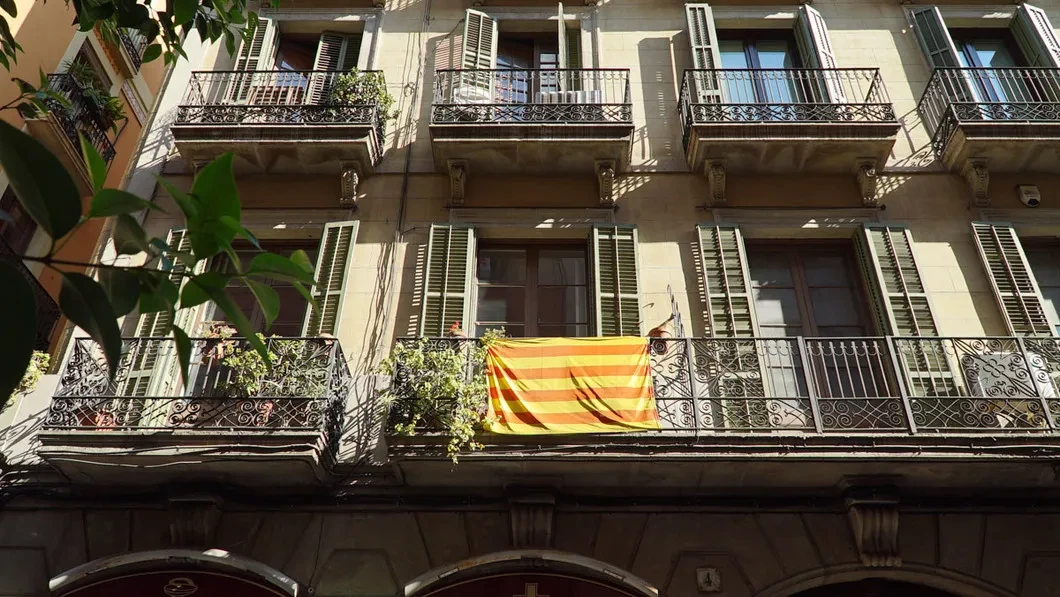
Supporters of “Life with Madrid” hung the official flags of Catalonia on the balconies (the same, yellow-red, but without a “separatist” star). They do not want to go out to the heated street.
In five days, I managed to see two groups of people with Spanish flags in Barcelona. The second group - pieces of fifteen Spanish nationalists - looked threatening even against the backdrop of thirty special forces who politely brought her outside the Catalonia area on the evening of the referendum day. Before that, the nationalists shouted “Long live Spain!” Without any consequences, and hundreds of “separatists” stood around the Catalan in response chanted “in-ind-independecia!”.
***
About half of the inhabitants of 7.5 million Catalonia today want to get away from Spanish dependence. And this is an indicator of the most serious state crisis. Which needs to be reasonably and quickly solved.
But over the years of his reign (since 2011), the Spanish Prime Minister Rahai proved that his brain does not consider this task a priority. Over six years, the number of Catalans who want to leave Madrid's power has grown three times.
The very different experts agree that the main culprit is Rahui, because he not only initiated the decision of the Constitutional Court (2010) on the cancellation of the reform of the Catalan autonomy (2006), but even after that he did not even try to listen to what the Catalans want. And he always spoke with them the language of politics, but the language of the state prosecutor, who threatens the “answer by law,” says Mark Sanjaum-Kalvet, researcher of the Barcelona Institute for Study of Self-Government. But the Catalans are still a separate and proud people.
- We want the recognition of our language, our culture and accounting of our special economic interests. In Catalonia, the industrial revolution began in the XVIII century. In Spain-in the 60s of the XX century. And this gap led to the creation of different societies. The development of different mentality, ”says Joan Kulya-i-Clara, professor of the history of the Barcelona Autonomous University . The professor is a supporter of independence, but, “like most Catalans,” “was not born with this thought,” but “came to her in the last five to six years.”
***
“In recent years, the Spanish government has made all the mistakes that could be made,” said Perevilanov, professor of political sciences of the International Institute of Barcelona , in an interview with the Ukrainian “Gromadsky” TV. - The Spanish leadership, with a few exceptions, for centuries did not understand that Catalonia was a separate issue. It can be part of Spain (like the Basque Country), but on its own conditions.
Professor Vilanova is an opponent of Catalonia’s exit and harshly criticizes the “irresponsible actions” of the Catalan government, which promised the people what he could not physically fulfill.
To declare independence contrary to the opinion of the international community - which happens after that is known for the example of Crimea. However, there is no need to confuse Crimea with Barcelona: if only because in the first case, “polite people” “helped” local residents vote, in the second they interfered. And did anyone have heard before that about the mass struggle of the inhabitants of Crimea for the department from Ukraine?
***
“I don’t know if we would have reached this if there were a different government in Madrid in recent years.” I doubt it, ”says historian Joan Kuli-i-Clara . -I think that with a government that would have at least a little more than what is commonly called emotional intelligence, everything would be different. The reign of Rajoy was absolutely destructive ... In my opinion, what happened on the day of the referendum led to a crack, which would not be possible to glue. This is a crack between the millions of Catalans and the idea of a single Spain. Of course, this is not the “idea of a single Spain” sent the police, but personally Mr. Rahoy, but you know ... People have seen Spanish police officers who distribute blows to the right and left, grabbing people by the hair, breaking the doors of polling stations. People know that the Spanish government sent ten thousand police officers from all over the country to Catalonia. And when these police officers went from their barracks, they applauded and shouted to them: “Show them a lesson!” All this created here, in Catalonia, the psychological effect that cannot be erased from memory ...
- Of course, not all of Spain refers to Catalonia like this. But there is a block, which includes almost the entire Madrid press, most of the intellectuals ( *see the text. - *Yu. S. ) and three of the four main parties. (The third, the social party, however, takes a slightly more balanced position.) And this block creates a lot of noise, it is very well audible, ”says Professor Kulya-i-Clara.
***
Nevertheless, despite all the insults, Catalonia should not declare independence - it should never, according to the Eurod. Lopez, and says that the Socialist Party of Catalonia (like Spanish socialists) calls the parties to negotiations:
“After all, both are to blame - both the head of the Catalan government Puchdemon, and the Spanish Prime Minister Rahai,” Lopez is sure. - By the way, there was also enough corruption scandals in Catalonia.
The government has a very weak position after a referendum. It can no longer increase the pressure on Catalonia. Returning is very risky: you can lose the support of the Spanish "patriots" and lose the shaky power. And professional Catalan fighters for independence can wait. For example, good offers from Madrid. Even if they are no longer rahi.
***
However, many Catalans do not want to be with Madrid under any conditions. But they better wait for them to wait, the historian Kuli-i-Clara is sure:
- I would not shoot all the cartridges this week. On the day of the referendum, the idea of Catalan independence won a serious success in the world. So now you need to correctly dispose of this political capital. In the coming days, weeks, months, you need to use it with great subtlety and do not proclaim independence either tomorrow, the day after tomorrow, nor in the near future ... Today (on Tuesday) there is a general strike. If the strike is large -scale, it will add strength to the Catalan government ...
The strike was large -scale. But obviously not the last.
Barcelona
The author thanks Alexander Dmitriev (G. Lugo), Elena Syrevatchenko, Imma Muñoz and Montserrat Radigales (all - Barcelona) for help and participation. Video: Yuri Safronov ("New") and Anna Tsigima ("Gromadskoye", especially for "New").