
Translated material
Say the truth-2
In society
 Say the truth-2
May 7, 2010 Alexey Makarkin
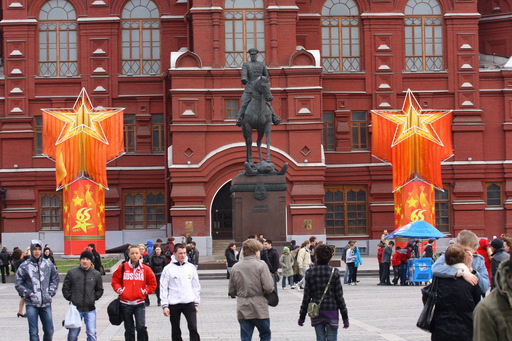
In the previous text, it was about changing the attitude of the Russian government to the history of its own country. When “cryptostalinism” (sometimes bashful, sometimes not very) was replaced by demonstrative anti -Stalinism, which cannot be explained by a sudden insight. The only way to understand the reason for such changes is to look for an extremely rational explanation associated with modern realities, political or economic.
In fact, there was a change in the model of the desirable development of the country, its positioning in the world. If Russia considered itself a “great energy power”, then this approach did not contradict - and even contributed to - the creeping rehabilitation of Stalin. However, this concept collapsed for two reasons. The first - the global economic crisis showed the vulnerability of the raw material model of the economy, in which stability depends on the price situation that can take on an unpredictable character. Any reserve fund can be spent in a short time. The second reason is that the creators of the concept of the “Great Energy Power” referred to the countries of Russian energy consumers as Austrian General Weiroter to Napoleon in front of the Austerlitz. That is, it was believed that the nasty side would freeze in place and would not take any counter -action. Napoleon, as you know, acted extremely decisively and achieved a brilliant victory. The modern West is actively looking for alternatives to reduce dependence on Russia - LNG, shales, energy -saving technologies. In the medium term, such a policy can lead to very serious problems for the supplier.
That is why now they have begun - at least at the conceptual level - measures are developed in order to get off the oil and gas needle. But the modernization of the country cannot be carried out in conditions of isolation from the most economically developed - and at the same time democratic - states. Investments cannot be obtained from North Korea, and innovations from Venezuela. India will not help us create a competitor to its famous "offshore" programming. The creation of innograd in Skolkovo or the International Financial Center in Moscow is impossible without serious support from the West, organizational and intellectual. But the normal dialogue with the West - not at the level of "oil and gas diplomacy", which the Brezhnev USSR still did not take care of the Brezhnev - cannot be built without mutual trust. And it is impossible on the part of democratic states to the country, whose authorities at least partially rehabilitate the totalitarian dictator are in conflict relations with a large number of their neighbors and are not able to guarantee property rights.
The economic conditioning of the change of ideological paradigm is a contradictory factor. On the one hand, such a pragmatic approach can be more stable than based on emotions, even very strong. Emotions often change their character, and the higher the expectations, the more possible disappointment. Let us recall the phenomenal popularity of “Westernism” in the perestroika USSR, which was rapidly replaced by the growth of anti -Western moods in the absence of common economic interests (except for the supply of raw materials). And, as a result, at least a partial rehabilitation of Stalin, who began to be perceived as a disinterested patriot, and not a mass killer, not only representatives of the communist subculture.
On the other hand, we analyze the same experience of perestroika, which, like the current modernization plans, had economic roots. When oil prices grew, the USSR built BAM (preparing for a possible war with China) and introduced a “limited contingent” into Afghanistan. When they fell, convulsive attempts of technological modernization (the so -called “acceleration”) began, which quickly failed and replaced with a rapid rapprochement with the West. After the oil prices went up again, the imperial tradition prevailed once again, however, without communist ideology, and Stalin fit into this tradition better than Lenin with a “sealing car”. Thus, the next change in the economic situation can provoke new ideological processes. And there is no guarantee that the next Renaissance of Stalinism will not happen, when the historical truth is uncomfortable and unclaimed.
What to do to avoid such a development of events? It seems that conflicting examples of Gorbachev’s time can be useful. In order for “Stalin does not return”, it is necessary to converge with the West on the basis of specific projects that could not (and, objectively, could not) propose the USSR in the last years of its existence, feverishly purchasing toilet paper and cigarettes abroad. Now there is no problem of consumer deficiency - therefore, there is an opportunity for a more meaningful partnership. Russia is currently not on the verge of abyss - changes are preventive. Therefore, there is a chance that this partnership will be based on mutual respect (it seems that some lessons from historical experience were also learned by Americans, who are not inclined to act in an offensive role of picky teachers for Russia). In this case, it will become stable, and the fluctuations in the economic situation will not lead to a change in the political course. However, to implement such a model, many conditions need - from political will to overcoming systemic corruption, without which not only modernization, but also a rational economic policy is impossible.
Author-First Vice President of the Center for Political Technology
Photo by RIA Novosti