
Translated material
Minister and Balance
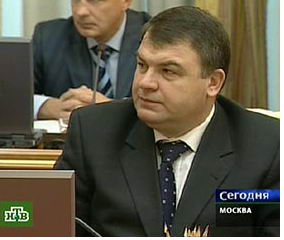
The appointment of Anatoly Serdyukov as the Minister of Defense looks like a sensation - a purely civilian specialist in tax issues was headed by a military department. However, six years ago, when the general from the special services Sergey Ivanov became the Minister, there were no less questions and bewilders. Then they got used to it.
However, unlike Ivanov, Serdyukov never wore general shoulder straps, and his military experience is limited to urgent service after the graduation of the Leningrad Institute of Soviet Trade and receiving the title of reserve officer. Later, for a long time he was engaged in business (furniture trade) in St. Petersburg, until in 2000 he transferred to the civil service - first in St. Petersburg, and then in the federal tax department, which he headed in the spring of 2004.
What is the replacement of the Minister of Defense now, and just such a person? Ivanov’s departure is quite logical - he completed the task (establishing the sovereign control over the army). The confrontation was removed through the “Minister of Defense - Head of the General Staff”, which was characteristic of the Russian Armed Forces of the Lateeltsin period. Ivanov’s interests gradually rushed into other, more promising spheres-such as military-technical cooperation and the military-industrial complex. He will preserve the curatorial over them as the first deputy prime minister. When leaving the Ministry of Defense, he relieves his responsibility for a lot of problems that complicate the life of any head of the military department of Russia: from grandfathers (the fate of the soldiers of Sychev and Rudakov - these are only two destinies from thousands of tragedies, about only parents and restless soldiers' mothers) to a low level of contractors, which discredit military reform. If we take into account the reasoning that Ivanov can claim in 2008 to one of the two higher posts in the power system (the maximum is the president, the minimum is the prime minister), then he clearly does not need such a load.
As for Serdyukov, he is not a public politician (on the contrary, as a federal official he is in every possible way to shun the press), but an administrator who does not need to think about popularity and electoral chances. Apparently, this factor has become one of the reasons for its purpose. In addition, he is quite loyal and tested in business. The federal tax department began the attack on Yukos even before Serdyukov arrived at the post of head of the Federal Tax Service, but this operation ended with him. At the same time, we add the well -known stiffness of the character of the new minister - the media have long noted that it has become much more difficult to sue with the tax authorities to commercial structures under him. It is necessary to take into account another secondary, but entertaining image component - the Second Civil Minister of Defense was appointed in Russia. Thus, if Western politicians and experts are outraged about the country's militarization, they can be presented with counterargument: what kind of militarization, if the Minister is not appointed by the representative of the military corporation, but the financier who dealt with accounting balances and paper reports? Let us recall how the topic of coming to the Ministry of Defense of the woman-financier Lyubov Kudelina “spin” in the media in the media.
Apparently, during the period of implementation of the “successor” operation, the president wanted to see exactly such a person as a minister of defense - not belonging to a military corporation and not showing any of his own political ambitions, deprived of charisma and not able to intervene in the clan struggle around the successor and future format of the Russian authorities. There is serious reason to believe that the current president has already begun to build a system of checks and counterweights, which should limit the capabilities of his successor. This context is also characterized by the “equation” of the chances of Medvedev and Ivanov (apparently, ultimately, they will balanced each other in the new system of power), and the nomination for the post of Deputy Prime Minister Sergei Naryshkin, which can hardly be explained only by the desire of Mikhail Fradkov to create an alternative to the economic bloc in the government. After all, Naryshkin has good chances to maintain his post after the 2008 elections - and, therefore, he will have to reckon with him to the future president.
However, apparently, the appointment of Serdyukov is associated not only with the immediate plans, but also with strategic calculations. Indeed, with his career, he is largely owed to the influential representative of the Putin’s environment Viktor Zubkov, who was the first deputy of the current president, when he still led the Committee on External Relations of the St. Petersburg City Hall. When Zubkov served as the main St. Petersburg tax authority, Serdyukov was his deputy. And after Zubkov was transferred to Moscow to lead the financial monitoring department (the so -called financial intelligence), Serdyukov became his successor in St. Petersburg. According to some reports, it was Zubkov that was the initiator of Serdyukov’s transfer to Moscow (some media even call Zubkova the testim of the new Minister of Defense). There is also information about Serdyukov’s close ties with the influential chief personnel officer of the presidential administration Viktor Ivanov.
And if so, then one of the key power posts in the power system is occupied by a person who is not associated with any of the two candidates for successors, but having serious contacts with other representatives of St. Petersburg community. And this will also take into account any next president of Russia. It will be extremely difficult for him to “break” this powerful system of checks and counterweights, even if he wants to do it. Recall that even Putin was able to finally get rid of the “limiters” of the Yeltsin era only in early 2004, having resigned Mikhail Kasyanov: and this despite the fact that his predecessor completely retired. The successor of Vladimir Putin will deal with a completely capable predecessor, who can take on arbitration functions in the hardware system being created now.
Author - Deputy General Director of the Center for Political Technology