
Translated material
General Gambit
Around Russia
 General Gambit
July 18, 2016 Alexey Makarkin
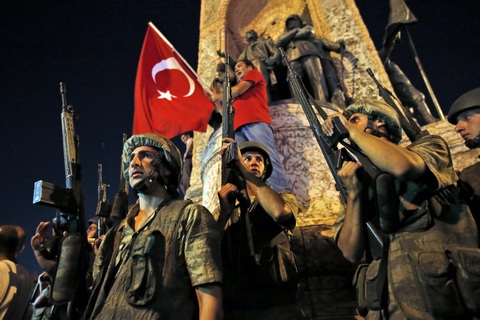
What happened in Turkey on the night of July 15 to 16? First of all, we must leave alone the conspiracy the version that President Erdogan imitated the coup in order to deal with his political opponents. Of course, after the failure of the putsch, he took advantage of the situation and fired his opponents from among the officers and judges, most of whom clearly had nothing to do with the adventure. But it is completely impossible to imagine that he painted the roles between colonels and lieutenant colonels, sincerely hateing him. In addition, in the first hours after the start of the coup, Erdogan was clearly not in the best form - apparently, this is what the information about his attempt to find asylum in Germany is associated with this. But when these data became known to the media, the situation in Istanbul has radically changed - and the question of refuge has lost all relevance.
The version of the American conspiracy, popular not only in Russia (so it had to be refuted by the Secretary of State Kerry), also does not withstand criticism. Unlike the Cold War, the United States is currently not ready to support frankly illegal change of power in countries where there are competitive elections. Americans arrange more complex mechanisms - such as impeachment declared by the President with parliament (Paraguay, Brazil), or “Color Revolutions”, where protesters act as defenders of legal norms violated by the authorities.
The question of involvement in the conspiracy of the generals looks not easy - some military leaders could well be related to the coup. However, they could not implement the standard coup plan for Turkey, when the command of the Armed Forces makes a collective decision on the displacement of the constitutional authorities. The fact is that Erdogan was able to achieve a solution to two problems. Firstly, the special services and special forces-the most capable structures, without which it is impossible to solve the priority tasks facing any coupter-for example, the arrest of the country's leaders, turned out to be controlled. During all previous Turkish coups, these structures were reliable guns of the military command. Now, as a result, the president, the prime minister, the Minister of Defense, and the speaker of the parliament remained at large. Against this background, the solution of some other classical tasks-control over the main city objects-turned out to be insufficient for success in the conditions of folk protest and the use by the authorities of modern communications (Skype, Twitter, SMS messages).
Secondly, the numerous shuffling of the highest command staff and the arrests of high-ranking generals on charges of real and potential coups have seriously reduced the desire of the highest command personnel at risk. It is characteristic that none of the current commanders of the military of the troops, as well as the chief of the General Staff, supported the conspirators (although the name of the head of the General Staff, Hulushi Akara, has already surfaced in the testimony of one of the main accused as involved in the preparation of a putty). Therefore, a model of the collective decision of the military leadership, familiar to its former Turkey and implemented in Egypt and Thailand, is quite comfortable for its participants, in this case did not work. Instead of this model, unconstitutional by definition, but capable of giving a coup at least some legitimacy in the eyes of a considerable part of society, another, frankly revolutionary. To decide on such actions to the generals was much more difficult.
Therefore, more “untied” colonels have taken up the case - and the coup little resembled the usual Turkish realities. He was more like a typical Latin American Ununsiamento of the first half of the twentieth century. However, in the history of Turkey, you can find a certain analogue - the revolution of 1960, which officially headed Jemal Gyursel, sent to the commander in vacation by the commander inaccurate. Although he was a general, the key role in the coup was played by senior officers, including Colonel Türkesh, who later founded the well -known crime organization “Gray Wolves”. That revolution entailed the execution of three leaders of the previous regime - and now Erdogan and his associates could seriously fear for their lives.
Erdogan accuses his former ally of his former ally, and now the enemy of Gulen, but it is difficult to imagine that a religious preacher was able to involve thousands of officers and lawyers in his organization. This does not mean that the Gulenovites are completely not involved in the coup, but they are unlikely to be its main driving force. Rather, it was about the protest of officers of the senior and middle links, acting for observing the Ataturkovsky principle of the secular state, which is de facto rejected by Erdogan. As for some generals, they could intervene in events at the next stage - to act as a “party of order”, which divorces the angles of the warring parties. Therefore, we can talk about a kind of General Gambit, in which light colonels could be pushed aside during subsequent military-political combinations.
If such a “two -way” took place, then she failed at the very beginning. And not only because of a pronounced split inside the military corporation. Mass protests on Taxim Square in 2013 showed the possibilities of mobilizing supporters of secular society - however, many of them also negatively relate to the possibility of military dictatorship. Now, on the streets, on the call of the imams from numerous mosques, tens of thousands of supporters of political Islam came out in a matter of minutes - from among those who ensured the victory of Erdogan's supporters in the elections of mayors of Istanbul and Ankara. For these people, a religious factor is not only important - they also benefited from Erdogan’s economic policy, who gave him and their families new opportunities (now GDP growth has slowed down, but still remains plus). Therefore, having entered into confrontation with the military, small entrepreneurs, artisans, merchants defended their religious identity and specific interests. The army’s coming to power in any format (although general, even Colonel) would mean the creation of a very authoritarian and rigidly anti -Islamist regime, which has shown a recent Egyptian experience.
At the same time, the victory of Erdogan means increasing authoritarianism - only Islamist. The winner demonstrates a pronounced desire to deprive independence by the judiciary, which is inconvenient for him not only because of the relations of judges with the military, but also due to the fact that lawyers investigated corruption scandals in the Erdogan Party of Justice and Development. Repressions regarding a secular opposition, which condemned the revolution, but supports judges are also possible. In turn, “twisting of the nuts” can lead to the fact that the thread will break - of course, not now, but in the future, especially if economic growth will slow down even more or even change in a decline.
Photo: Istanbul, Turkey. 15.07.2016. Emrah Gurel/ AP/ TASS
If you have decided to support the "Daily Journal",
You can make a transfer with the appointment of payment