
Translated material
The price of war
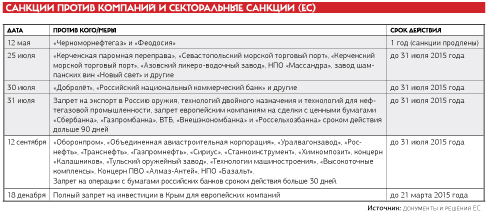
To increase at a meeting of the EU Foreign Ministry in Brussels on January 29, a decision was made to extend (with the possibility of expansion) - until September! -sanctions against specific persons and companies in Crimea, DPR-LNR and Russia, introduced in March 2014. This has become a “cold shower” for the Russian top, where since the end of last year they began to exaggerate the issue of the moment of revision of the sanctions of the European Union, up to their complete abolition. Recall: the first personal sanctions against Russian VIPs and a number of companies were adopted in March 2014 for six months-until September, then extended until March 2015. Whereas sector sanctions, the first of which were introduced at the end of July 2014, should have been valid for a year. For this reason, the deputy head of the Ministry of Foreign Affairs of the Russian Federation, Alexei Meshkov, recalled at the end of November 2014: “The sanctions are taken and extended by consensus, and in March (2015) there will be a renewal of decisions on the sanctions list, and in July (2015) there will be a decision to extend sector sanctions. We expect that those countries of the European Union that really understand the harm that this sanctions line does to the European economy, our relations, will show appropriate resistance. ” Hence the expectation of Marta: de, Europeans, losing billions of dollars, will not resist, bend.

However, in the EU itself, until recently, there was no single position on whether the sanctions against Russia should be strengthened or partially lifted. Back in early January, Brussels discussed the possible mitigation of restrictions: Wall Street Journal and Financial Times published an internal document of the EU foreign affairs council, which made the idea of distinguishing between two types of sanctions: the annexation of Crimea (restrictions on specific individuals and companies) and destabilization in the east of Ukraine (sectoral sector sanctions). If the former should remain in force as long as possible, then the latter can gradually be removed, the document read. Moreover, negotiations were supposed to simplify the visa regime with Russia, the possible cooperation of the EU with the Eurasian Economic Union, as well as permission not to comply with the conditions of the third energy package for Gazprom.
One way or another, on January 29, the “persistent countries”, which Meshkov spoke about, did not find the European Union: even Greece, Cyprus, Hungary and Slovakia, which were made by the main headquarters of Russian diplomacy, became part of the same pan -European consensus. Cause? The shelling of Mariupol, which entailed the death of 31 civilians. Already on January 26, the heads of EU state have made a general statement about the need for new sanctions. Moreover, after the shelling of Mariupol, it was already about the disconnection of Russia from the international banking system SWIFT. On January 28, Reuters reported, referring to closed documents that personal sanctions against Russians and officials of the DPR, LPR and Crimea are planned to extend until December 2015, and a list of people who will no longer be able to receive European visas and dispose of their property in the EU will increase by 33 people. In addition, it was planned to reduce the deadlines of external loans for Russian companies, and European - prohibit buying Russian government bonds. “When there was a peaceful process and heavy weapons were partially displayed, it was said that the sanctions in Lugansk and Donetsk could be weakened and completely lifted. Now, when the front line is changing and the militia is moving west, there is no question of lifting the sanctions, ”said Alexey Arbatov, director of the IMEMO RAS, director of the NT Center for International Security, in a conversation with NT .