
Translated material
The god of movement
Last Gastrolate of the Legendary Ballet
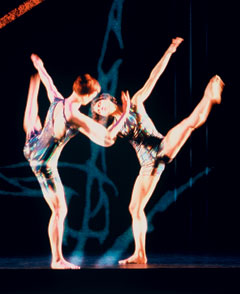 |
| "Two -legged", the production of 1999. Merce Cunningham choreography to the music of Gavin Bryers |
The god of movement. The legendary ballet of Merce Cunningham comes to Moscow to the Chekhov Theater Festival. From June 14 to 16, the troupe will show one -act ballet productions of different years. This is one of the final tour of the theater-on December 31, 2011 in New York, the last performance of Merce Cunningham Dance Company will be held. Why - found out The New Times
The beginning of the fifties, the roads of America, a battered bus. A small troupe (six dancers, two musicians, an artist and a choreographer) sometimes drags two days to get an engagement in a deeply provincial theater. They do not break the applause and are happy if they are not driven from the stage - the simple -minded audience accepts performances with extreme bewilderment. Everyone knows that dancing are girls in short skirts, and here men are in a little gymnastics, and from the stage instead of music-a creak and a cough ...
The path to fame to world triumphs to travel for more than ten years. Since the mid-sixties, everyone will know what composer John Cage (in the 50s he is driving), what kind of artist Robert Raushenberg (the monster who is trying to make the decoration clearly from garbage waste). And of course, what a choreographer Merce Cunningham, who turns his foot to his artist as if he wants to tie her around the waist.
Glory will begin in 1964 in London. At first, the troupe of the small tour will be extended for three weeks (in the States of MCDC, it has never performed in one place for more than two days in a row), and returning to the United States will become triumphant. The criticism that ridiculed Cunningham thought: maybe the British know better? And the audience decides to peer at the creations of the wonderful choreographer more closely - why would they praise them with the legend of the British scene Margot Fontaine and the Great Rudolf Nureyev? And everyone suddenly begins to understand that a world -class choreographer grew up in the Fatherland. Without teachers (however, for six years in his youth he danced to Martha Graham, the creator of American Modern dance) and without followers - because it is impossible to reproduce his manner.
Garden of Stones
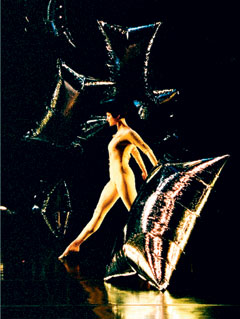 |
| The Mysterious Forest, the production of 1968. Choreography by Merce Cunningham to the music of David Tudor, scenography - Andy Warhol |
The next 50 years, the world has admired a Canningem. This sincerely entertained him, because he did not change anything in his methods of essay. It does not get simpler, clearer, more pleasant. He is still not interested in how convenient it is to look at the performances to the viewer: he deliberately puts important movements at the same time in different ends of the scene. There is no center of the scene; There is no imposition of the main thing. Something like a Buddhist garden of stones that you just need to look at and not fuss.
Cunningham occupies only the movement and capabilities of the human body: balance, flexibility, coordination. He does not tell any stories from the stage and does not even allow them to come up with the viewer. If Balanchin said: “On stage, a man and woman is already a plot”, then Canningham deprives the duet even a minimum hint of flirting, to the normal reaction of men and women to each other (or men to men; in general, all sorts of erotic reactions are excluded). The right way to fly out of the troupe was to start asking, “what” the performance. “The right hand in this direction, the left in this one, put it to bend your left leg, bend the right one” - here is the whole answer, unless, of course, you are kicked out immediately. Cunningham does not like to talk to the dancers, he doesn’t like to talk to them at all: to chat with his own palette - is this non -normally? Therefore, in the troupe, he does not have pride stars and stars in general, the backbone of the troupe consists of fans, almost sectarians, convinced that all the trials (and the joints unusual for the body wear out the joints and ligaments) is not in vain.
To get into music most often Cunningham composed performances to the music of Cage. He took away the composer, who was seven years older than him, from his legitimate wife-and since then they became a couple to the death of Cage in 1992 (almost 50 years of the Union). The educated world gradually got used to the noise and creaks, musical cramps and notes broken in the air. To get used to the fact that this score, created seemingly specifically for a particular performance, does not coincide with what is happening on the stage is much longer. The fact is that music and choreography were connected by the director only at the premiere; The troupe rehearsed in silence, and the composer only knew how many minutes of music he should compose. Cunningham believed that with this technique the likelihood of outstanding discoveries.
If we take into account that at one time both Canningham and Cage were fond of the Chinese “Book of Changes” and fortune -telling hexagrams ... Here everyone can choose a version: either it is a way to make creativity with an expression of higher will, or irresponsible magicism. The great composer Arnold Schenberg, the teacher of Cage, thought so. Talented-yes, but irresponsible co-welfare-no.
The farewell of the Cunningham troupe has never been on tour in the USSR and Russia - and now comes for the first and last time. The choreographer died in July 2009 (he was 92), and according to his will, MCDC can exist only two years after his death. On December 31, the last performance will be held in New York, and then its productions will remain only in a special archive. In Moscow, performances of different years will be shown, and it will be possible to see whether Cunningham has changed throughout life.
Biped (“Double -legged”, 1999) to the music of Gavin Bryers with the scenography of Paul Kaiser and Shelley Eshkar - ballet, who, according to the choreographer, is similar to the rapid switching of television channels: an instant change of “Pictures”, the viewer does not have time to understand what is happening. The actors are dressed in metal -colored outfits, reflecting light, light rays beat on them, flashing electric lightning emphasize strangely twisted, tense and instantly relaxing muscles.
Xover ("Crossover", 2007) to the music of John Cage, the scenography of Robert Raushenberg is one of the last productions of Canningham. The recollection of the early 50s, the first cooperation with Cage (which at the time of setting this one-act has long been not in the world) and Raushenberg. Mixing of different styles and motives; So MCDC arose from cooperation of the artist, composer and choreographer. The performance was created from instant runs of dancers on the stage; By accidentally meeting people suddenly form duets and a trio-someone for a second, and someone for seven minutes (which is in the ballet almost eternity).
Finally, RainForest ("Tropical Forest", 1968). The phonogram growls and chirping, silver clouds inflated by Andy Warhol soar, and torn, swift, curved movements of artists - a hymn of freedom from boring civilization living according to dull laws. Monkeys or birds, aliens or crabs - all half a century of success will come up with definitions for Canningham artists. Being a person is too boring. Cunningham tried to be different. He succeeded.