
Translated material
Protest orphan
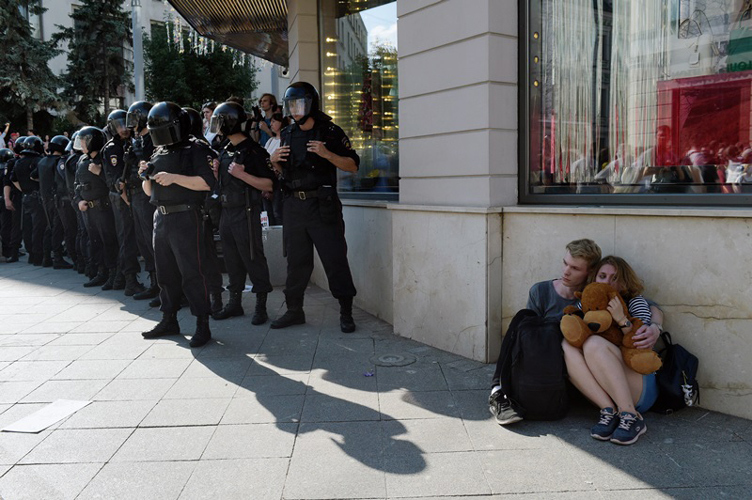
Children and protest
Media play a fatal role in the formation of the protest movement. Official media create an atmosphere of intolerance in relation to protesters, independent media form the identity of the participants and the agenda (who we are and what we are fighting for).
The image of the protester is still similar to the blurry spot of Rorshah, which is transformed either into a visiting migrant worker from Tula, then to a wiper from Magadan, then to an angry Muscovite, then to a negligent father, who transfers his child to a brutal Protestant, in order to cover his insolent muzzle by the child body.
The stigmatization of the protest movement in itself is a way of spraying it. According to my observations, there are many dissatisfied in different age, professional, social groups. The slogan "For fair and free elections to the Moscow City Duma!" And must touch all the inhabitants of the capital.
The word “children” was the key to manipulating the consciousness of the population. Official media tried to shame all participants and sympathetic protests, calling children of military service, dressed in the form of the Russian Guard. Like in the novel by Ilf and Petrov: poor orphan from the shelter, brothers-Manda-hats ... Their faces are covered with balaclavs, in the hands of clubs, and they beat the protesters not childishly. Calling the guards children, the authorities are trying to diminish the scope of aggression against the population. After marching in military uniform on the day of the victory of kids in kindergartens, the border between children and the military, obviously, was erased.
But the children's topic was not exhausted on this. The blogger was arrested, who called on (possibly also jokingly) to take revenge on the children of the security forces. Finally, urgently, according to the laws of wartime, announces the possibility of depriving the rights of parents who walked with a one -year -old baby in the place of the alleged action, and under the guise of checking the living conditions of the baby in their apartment, a search is carried out (at night!). The population is threatened: we will take away your children, if you go out onto the streets, just pick it up.
Not the peaceful word "children", but the acid word "orphan" is emerging. And this is a very painful theme for the country with centuries of experience of orphanhood and half -siring, unaccountable. Recall that the topic of orphans sounded frankly after the adoption of the "Law of Dima Yakovlev", which prohibits foreigners with the adoption of Russian orphans. The state began to use orphans as a bargaining coin. Orphans are convenient to manage, since they are completely dependent on the state, sensitive to its will, are sophisticated and trembling, glad to any alms. Ideal citizens for the state, which owns only archaic power methods of management: directive one -sided propaganda, a powerful electoral punishment system. The word "electoral" means "random", accidentally turned up, like this young couple with a baby. The electoral process in a caste society replaces elect. Just one was lucky, but no one needs you. That's all the elections.
Nobody needs you. Soviet means orphan
If you think that orphans are unfortunate from orphanages, then I shock you, because it is all of us. Psychological orphanage is washed out after a few generations, it is caustic, like fears, it impregnates everything with longing, disbelief, eternal anxiety to be abandoned, rejected, incomprehensible and unloved. They talk about the "circle of orphans" when a psychological orphan grows with living parents. Orphansion is inherited as a dominant gene. The psychological and the following on its heels is social orphanage-the main reason for the protest passivity of Russians who do not believe that they can personally change something.
Sliding all your life in survival mode - this is closer and more understandable to us. The psychology of a loser and poor man, delegating all rights to the state in the person of chiefs, was cultivated in Soviet times. Social control over private life, mutual suspicion, denunciation, envy, passive-aggressive type of relationship, when friendliness is demonstrated in public, and hatred and contempt in the soul.
I would hate everything that was connected with the Soviet one if I did not understand that all these complexes of a small fussy figure and a large universal loser have been cultivated for centuries. Everyone talks about the cult of personality, this has become a common place, but in a conjunction with him, inflating the authority of the ideal father (ruler) instead of the real father, people convey as sacred truth from the mouth to the mouth of the orphan commandment "Nobody needs you!" Nobody needs you, you can’t do anything, loneliness brought to a degree of shame, one in all space - good psychological soil for humiliation, withdrawal, refusal, lies in daily mode, and not from time to time - maybe it will slip. How quickly people take the role of a fatal victim, pull on the sheep’s skin, separate their hands, swear in the loyalty strong and domineering, shy into the void - evidence of weakness, insecurity, despair of an orphan, for which no one will stand up. And this prevents me from being angry, indignant and despised.
The psychological and the following on its heels is social orphanage-the main reason for the protest passivity of Russians who do not believe that they can personally change something.
Resentment - depreciation of oneself
Orphan psychology is also manifested in an unproductive habit of being offended. "You don't respect me!" - The phrase of jokes on duty. "Don't offend me!" In the sense of "do not refuse, otherwise I will be offended." So they persuade to drink together, enter the house, sit down at the table, get married. A rare sensitivity and readiness to be offended is not a personal or temperamental feature, but a manifestation of learned helplessness.
The depreciation of oneself is behind resentment, but this depreciation is first lived, learned as an important behavior code. Our children are still cruelly and often unfairly, without explanation punish. The punishment is aimed at the personality of the child as a whole: they do not scold the misconduct, but humiliate the child himself, who, due to age, simply cannot cope with the task. In the domestic practice of education, orders are given to the top and orally, parents are always higher in rank, often proud of their severity. They say about themselves as Stalin - "strict, but fair." It is amazing that during the years of removing strict social control, an increase in individualism, when everyone for himself can already be made a remark on the street to a stranger child, his parents seem to be happy to usurped the public right to control and punish, to a total disposal of the child’s life: mine! Relations have become even more property. I live near one of the most visited places in Moscow - a zoo. An elegant parents lead the children shouting “I will fed you tigers if you don’t obey!”, “I’ll spend your face on the asphalt to be red, like a macaques.” Stalin inside the parent.
Resentment is accompanied by a sense of depression, unwillingness to fix something. Another internal manifestation of the practice of repression is self -denial. "I do not know how ... I do not know ... I do not know if I can ..."
Resentment “freezes” the injury, and does not help to cope with it. And with her “freezes” and low self -esteem.
The main ligament of orphan vices is distrust of people and disbelief in themselves. The cohorts of sociophobes, sitting at computers and curtailed windows that do not leave home - and not just to rallies - are much more dangerous for the state than adapted Protestants. It is from such loners that Breiviks, paranoids, shooting dozens of people grow later.
I am to the fact that you, of course, can hide from the authorities and sanctions, but you can’t hide from yourself, you will have to deal with your orphan reflexes, and collectively, because the rehabilitation of orphanhood can only occur through the restoration of strong social ties.
Looking back at the Soviet past of the CIS countries, I can say: who is the first to overcome the complex of orphans, he will become a free people, confident in his mission to decorate and enrich this only in the universe planet with special colors.
Historical alcoholism
The consequences of psychological orphanhood have been affecting all life. My belief: the basic cause of mass alcoholism in men in Russia and on the territory of the former USSR is the panic of death, which is cultivated in boys. They are prepared too early for war and death. Stories and fairy tales about the death of heroes for a great goal are included in the system of preparing potential victims.
The victim is an orphan by definition, no one will protect her. I think that similar methods of preparing young shahids going to certain death are in the camps of terrorists. In a sense, Russia and the USSR cultivated, cultivated, encouraged young suicide bombers. Alcoholism can be considered as a sacrifice. Alcoholism in Russia is always surrounded by a halo of sacredness. Even at weddings they shout “Bitter!”, Demanding from the newlyweds to sweeten a bitter drink with a kiss. They recall that the dead and doomed are already standing on their backs, demand their tribute.
Female alcoholism, aggression began to spread along with female emancipation, which passed by male type. I studied aggressive forms of behavior in mothers using the example of female social groups-closed, because there young mothers communicate like a man, in a rude mat. The postpartum depression carries a trace of the existential horror of the death of a child, unbearable pain and overwhelming responsibility for a new life.
Happiness, love, joy, good food, clothes - everything in our mentality is given only as compensation, secondary in relation to the main - heavy, bitter life. “To snatch a little joy” - that’s all the happiness, which is “a moment between the past and future,” as it was in the same song. No one, and is not going to live happily, productively, without looking at his mistakes and the inactivity of the environment. “Everything is like people”, “What people, then to me.” "What am I worse than others?" - Life to the lower limit.
How quickly people take the role of a fatal victim, pull on the sheep’s skin, separate their hands, swear in the loyalty strong and domineering, shy into the void - evidence of weakness, insecurity, despair of an orphan, for which no one will stand up.
Extra people: "Hamlets" against "donkeys"
It is interesting that in pre -Soviet times in the highest classes, protest figures stigmatized exclusively as “extra people”. We are a culture of dreams and stagnations, all the unorthodox prevents us to drift in a fog of pipe plans and hopes.
The tradition of describing unusual and dissatisfied people as “extra” was laid by literature, which in the 19th century replaced social thought, philosophy, ethics. Turgenev first raised the question of the conflict of generations as the problem of “fathers and children”, taking it into the name of the novel. In 1860, he refers to the symbolic change of generations of "Hamlets" and "Donkihotov" . The choice of the Jinrian heroes denoted the novelty, the unorthodoxy of the views of new generations and at the same time-their alienness and introduction. The youth of the 1830s found themselves in the tragedy of Shakespeare, who in Russia was twice forbidden by censorship due to the motives of the regicide. The play went with great success. Hamlet was played by Mochalov , and its premiere took place on the day of the duel of Pushkin.
Turgenev proposed the concept of alternating symbolic generations of "Hamlets" and "Donkihotov". Hamlet and Don Quixote absorbed almost everything that was tragic and comic in human nature. Don Quixote for a long time was perceived as a character exceptionally noble and positive, an example to follow. Pushkin enthusiastically called Radishchev “political Don Quixote” for fearlessness and conscientiousness. Roman Cervantes was in almost every noble library. There is evidence that from 1769 to 1931 he withstood 32 publications. Later, the Don -Kilia began to be considered as eccentricity, the revolutionaries of 1905-1907 were diagnosed with pathological altruism. With the Shakespearean Hamlet in Russian psychiatry, neurasthenia was associated. The weakness of the "hazelnut" among the Russian intelligentsia was explained by the influence of the repressive organization of the state system.
Hamlet is the personification of the Russian intellectual, in which internal searches paralyze the action, intelligence depresses the volitional principle. Thus, Hamlet and Don Quixote from the heroes turned into mentally ill, and this attitude to consider dissent as a mental illness, as we know, affected the Soviet practice of imprisoning protesters in psychiatric departments. Any deviation from the canon, the refusal to obey in Russia is evaluated radically and is still cruelly punished. The peculiarity of the Russians to subject everything to harsh criticism, the search for truth (truth), which is placed above the interests of the individual, lead some Western psychoanalysts to the conclusion about the moral masochism of Russians, dictated by Orthodoxy.
The play by M. Bulgakov “Run” (1926-1927), and subsequently its classic film adaptation of the same name - the film by A. Alov and V. Naumov in 1970 - just about the painful, on the verge of insanity, the departure of the last “Hamlets” of monarchical Russia, yearning for a strong father. In death, they see the only way to resolve a moral conflict, a feeling of guilt before the dead father. For Russian consciousness, Hamlet personifies the taboo on the murder of his father and the inevitability of punishment for apostasy. Such is the power of identification of the hero with his father.
The tradition was continued by domestic cinema. The classic of Soviet cinema Grigory Kozintsev filmed two dramas one after another - Don Quixote (1957) and Hamlet (1964). Hamlet Innocent Smoktunovsky is a dissident who, in the hope of fair power, dared to go into conflict with the current government and went to the end in his struggle. Don Quixote in Kozintsev’s film - the personification of Russian idealism and romanticism, the image of a beautiful -hearted post -war idealist, embodied by Nikolai Cherkasov. If, according to Freud, the mythological son strives for edemature, then in Russian culture the figure of his father is more strong and sinister. Both Peter I, and Ivan the Terrible killed their sons. He did not save his son and Stalin . The literary father of Taras Bulba kills his son. The son as a sacrifice is a symbol of the absolute power of the father. In the Russian film version of Hamlet, the son is only an instrument of paternal will.
In the images of Hamlet and Don Quixote, the duality of domestic mentality is personified: Hamlet and Don Quixote are in the relationship of his father and son. The bearer of absolute authority of the father is Hamlet; The lost, despicable son is Don Quixote. Thus, the inheritance and formation of the ideology of new generations occur in our family type culture as the confrontation of the father and son.
The state performs the functions of such a detached presumptuous father in relation to its children, confusing their names and faces, not listening and not wanting to see longer than the air of the straight line will last.
Disharmonic family - the key to orphanage
The study of the history of generations and ideologies inevitably pushes us with a cultural-historically formed family model. In Russia, this is a disharmonious family of the Orthodox type with a dominant father, claiming the role of absolute authority, but not included in the ordinary life of the family. In no Western culture, we will not meet such an opposition to the power of the father and the responsibility of the mother, such a distance between family members. Children are most psychologically removed from the father, in fact they are orphans with a living father.
The dominant fathers who value their status above and are focused only on other male authorities, give subdominant, dependent offspring, sons, poorly oriented in the world of “adult” male ideals. They grew up in an atmosphere of contempt for fathers due to emotional attachment and psychological proximity to the mother. The sons grew in dreams, unrealizable dreams. "Hamlets" give birth to "Donkihots."
The state performs the functions of such a detached presumptuous father in relation to its children, confusing their names and faces, not listening and not wanting to see longer than the air of the straight line will last.
Media - literature in the 19th century, cinema in the XX century and now the Internet - cultivate extra people, social and psychological orphans, taking out the topic of submission to the father on the first stripes, in a hot agenda, launching the mechanism of retracous of the population, which already feels no one. In the end, this norm “feed, dress” is an orphan. The “cost of living”, the cultivation of the orphan lifestyle remains the hidden strategy of the state policy.
It underestimates the maternal fuse, does not imagine how aggressive the mother can be from whom they take away children. The state shows interest only in the draft boys and the girls of fertile age. And mothers are already raising new emigrants, telling where to run from this endless line for happiness that will never come.
Subscribe to the COLTA.RU channel in Yandex.Zen to miss nothing