
Translated material
Time program
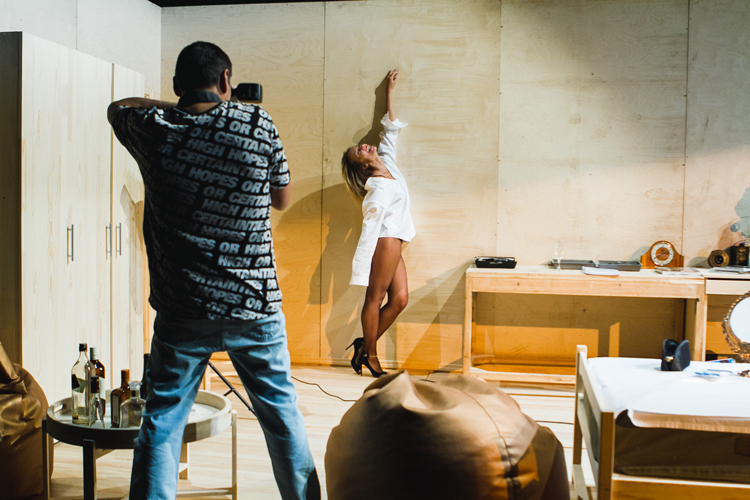
Timofei Kulyabin put his “children of the sun” based on the play by Olga Fedyanina, written based on the Gorky play of the same name. Unlike the original source, the text by Fedyanina is rapid, fascinating, there are few characters, there are many dynamics, short replicas, only two or three monologues and tells about scientists living in the conditional interiors of a conditional dormitory - from the program it was possible to find out that this is an American campus, although it seems to not seem at all. The scenographer Oleg Golovko Penals rooms, in which short meetings of the heroes take place, are advanced in turn to the forefront, where dialogs take place, then darkening-and the light grabs the next leaving pencil case. Dynamic installation, monitors count the real and unrealistic time, simultaneously designating the episodes with the names of the heroes - Elena and Pavel Protasovs, Boris Chepurna, Dmitry Vagin.
“Children of the Sun” - the play is not the most popular, they do not pass it at school, they rarely put it (at least in Russia) - it is believed that it was not too much a success to the author, so it seems to be not a pity. Gorky had the main idea that the intelligentsia (which, in fact, are children of the sun) was smart and honest, but terribly far from the real problems of the so -called ordinary people, so while scientists dream, people rebel and reach all the ugliness. The thought itself is always relevant for Russia-I do not agree in this sense with Kulyabin, who believes that today she has no place on the agenda: the isolation of intellectuals from the domestic reality, whatever one may say, is still there. But the director has the right to get carried away with another topic. Kulyabin himself defines it as a “premonition of a sharp jump” in the world, which “will change radically,” but it seems to me that in reality he is interested in something completely different, less global. Kulyabin is a very specific director, the essence of his performances is not in concepts, no matter how spectacular they may be, but in filigree work with stage space and time.
Therefore, in the "Children of the Sun" he was interested in the plexus of plot love lines in the "closed world of his ideas" - it is this line in his version of the play that Fedyanin leaves. Gorky is really all thoroughly confused, the relations of the main characters are developing so bizarre that it is clear why the director’s hands itch to play this combination in the space of the theater. Chepurna loves Lisa, Lisa refuses him, Vagin loves Elena, but Elena does not love him, because she loves her husband, the sister of Chepurny Melania also loves Pavel, Paul himself loves science, and everyone else (wife, sister, friend) is good only when they are in their places and do not interfere with business. In order to easily and coherently retelling this whole tangle of relations, you need to be a virtuoso of stage action and work very accurately with the actors - that Kulyabin just knows how to perfectly.
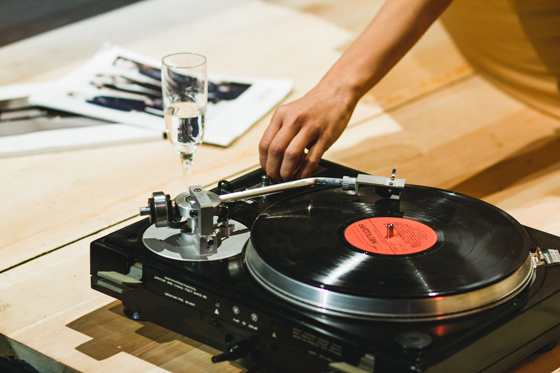 © Tatyana Perova
Cells-channels change on the advance, demonstrating nodal moments in the relations of the heroes, and for each short scene a visual image was found. Here Vagin photographs Lena in erotic poses: he is a photographer, she is a model, they are busy with business, but of course, of course, too. Here is melania, vulgar and aggressive, but at the same time miserable, tries to attract the attention of Paul. Here is Boris (he is not a veterinarian here, like Gorky, but a real doctor) skillfully and gently distracts Lisa from memories of the terrorist attack in which she got. But all together celebrate the New Year-the same, 2000, millennium, and, as a sign of change, a huge plasma TV shows the New Year's appeal of President Yeltsin, transferring the powers of the acting president, and then the acting Speech congratulations last for eighteen minutes, by stage standards-a huge time, so we do not hear the text, the presidents will mutter their fateful words, and the heroes at that time find out the relationship: Lisa is bad again, Boris is afraid to intervene, Pavel comforts his sister, Vagin supports him, Lena understands the intoxicated melania, who asked her wife to give her a husband.
The clock on the monitors count the historical time, but it flows non -linearly: some events are ahead of others, and we see what happened, and then what explains what was. Every moment is fraught with the future - but it contains the past.
This is the real modern theater - not abandoning the heritage of the past, but entering into communication with it, realizing and feeling the distance.
Of course, the film “Nine Days of one year” is constantly recalled with his love triangle - with Lelya, who chooses a husband and a loved one between a passionate science. There, too, we were talking about the utopia of the upcoming human happiness, in whose name now the victims are needed. In the sixties there was no foreboding of the disaster in the plot, but a certain feeling that the global story certainly crushes and spoils human life, of course, was present. The conflict between the personal and public in the performance of the Kulyabin is generally issued by brackets: what Paul is doing is unknown to us, although, perhaps, he does something important. For the creators of the performance, his hobby is only a way to get away from reality, at first it seems to be quite harmless, but as it turns out in the final - tragic.
A premonition of something unknown, but threatening Lisa does not leave for a second, but her life is already damaged by the injury. In the finale on the monitors, fragments of the happy past Pavel will be shown to us: here he is with his sister at the children's holiday, here he is at the party, here he is with the bride at his own wedding, and on the fourth screen we will see a series of terrorist attacks in Moscow, a boiled trolley, blown up houses - and the rumble of explosions will turn out to be the main in this noise of the past.
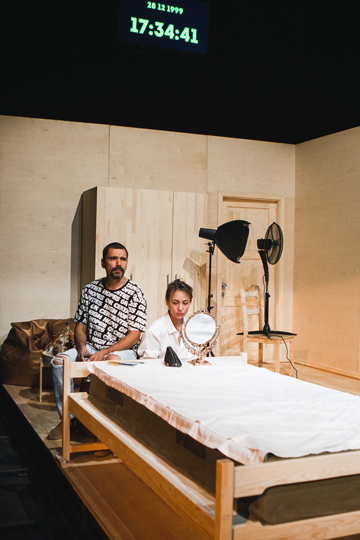 © Tatyana Perova
The rhyme of two centuries, the coming twentieth (at Gorky) and the beginning of the new millennium (at Kulyabin), on the threshold of which we are still afraid of the future, is the main component of this unusual project. The dialogue with the play by Gorky, written on the eve of the Russian Revolution, is almost the main intrigue: what has changed and what remains is still relevant is the key question of the Novosibirsk “children of the Sun”. It seems that this is the real modern theater - not refusing the heritage of the past, but entering into communication with it, realizing and feeling the distance.
For Gorky characters, an unknown threat came from the people. Gorky, although he was considered a petrel, knew real Russia and illusions about the people did not feel the people - in his childhood and youth, he fully experienced all his savagery, darkness and anger, so that he felt the inevitability of a dark power very acutely (although he believed in the idea of purification).
Kulyabin flatly refused the people, and most importantly, he transferred the catastrophe from the future to the present. The heroes are explained, quarreled, try to arrange their lives, but the catastrophe is already in them, it is connected with their past and determines their future. The fact that Lisa in the play is shown by the victim of the attack does not look just an explanation of her illness: everything around is terribly fragile, so everyone leaves reality, tries to find and does not find support in others. Only Paul was lucky - he has where to dive from a clash with reality, he has his work, others have nothing as absorbing, and therefore they are so vulnerable.
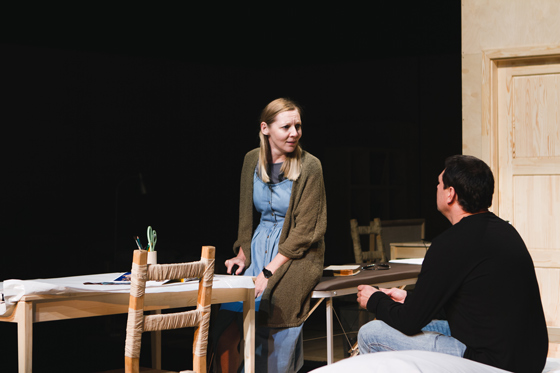 © Tatyana Perova
It is interesting, however, that of all this rather difficult story, Kulyabin makes a very funny performance in places. All heroes are recognizable, and the characteristics of them are given acute and even slightly cartoons - with the absolute reliability of reactions. By the way, the old Mkhatov “children of the Sun”, with Kachalov, also were ridiculous - which is worth the scene invented by Stanislavsky when Protasov brushes off the riot with a nasal handkerchief. In general, in the Moscow Art Theater, the scene with the rebellious “jokers” was initially resolved by comedy, grotesque, but when the audience, frightened by the threats of the Black Socialists, took a theatrical mass for real pogroms in horror that the context was changing literally on the go.
In the performance of the Red Torch Theater, laughter at first sounds quite often. And only then, when everything is rapidly approaching the sad ending, the scene immediately empty, and from living rooms the action passes to the sites, into an empty public space, it becomes clear that the story was tragic. She, however, was like that from the very beginning, but then its participants did not yet understand the degree of their loneliness and lived in an illusion.
Does the line of centuries always cause a sense of confusion and depression? Is there any grounds under this - or is it a mirage of our cautious culture? The only thing that consoles is the theater itself, stubbornly and persistently creating new worlds, where non -existent people who say words come to life, clap their doors, they raise their heads to the sky, which is not, and they drink conditional champagne from glasses. Time goes crazy, the settings are lost on the monitors, the past and the future are mixed - but applause is put in their places, let it and for a short time.