
Translated material
Blessed prize

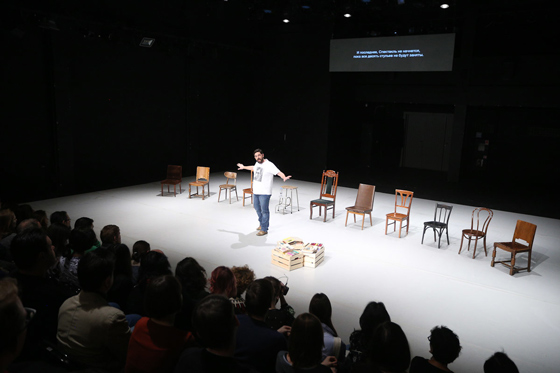
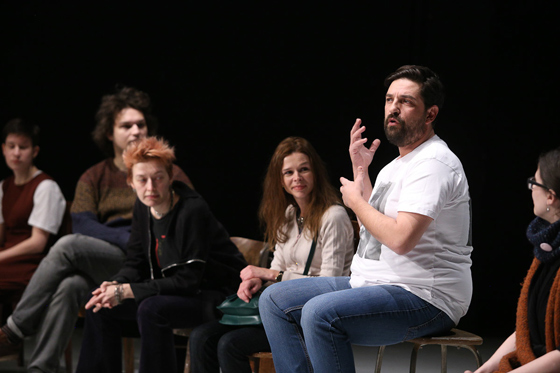
In order to play “by heart”, the Portuguese Tiago Rodriguez - the author and the only performer of the performance - are needed ten volunteers from among the audience. Rodriguez must make sure that by the end of the evening they managed to read Shakespeare's 30th sonnet from memory: the first quatrain-together, the remaining ten lines-in turn. More than an hour for such a task, perhaps, even a lot, but Tiago has most of the time to the background, explaining why he needs all this.
The purpose of the interactive theater is always one: to reward you with a new, unfamiliar experience, which will become the fact of your biography. In order to fix this experience, the audience is often issued, figuratively speaking, a certificate of participation - a photograph, a mask, a card, CD . Rodriguez gives his volunteers something better-strongly, firmly memorized excerpt from Shakespeare. This is the same as the souvenir that you will shoot again and again from the shelf in order to turn in your hands with pleasure.
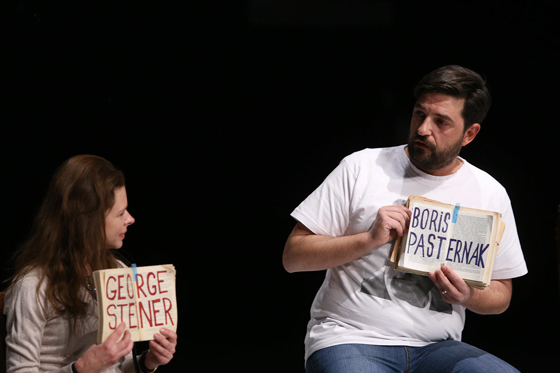
By the way, the American philologist George Stayner, more than once mentioned in the play, calls the texts learned as a keepsake, "decorating our inner house." Thiago adds that in the Portuguese, “decorate” and “teaching by heart” - the same verb.
 © Andrey Gordeev
“By heart” echoes another touring project of this fall - the installation of Robert Lepage “Night in the Library” shown in Moscow to the “Territory” festival and multimedia art museum. The virtuoso work of the famous Canadian company EX Machina was ten 360-degree videos for virtual reality, accompanied by the texts of the Canadian writer Alberto Mangel; Each video talked about one famous library from a historical, architectural or philosophical point of view. In many ways, it was a project about the fragility of literary heritage: the fire depository in Sarajevo became the highest emotional point. Rodriguez, as well as the fate of the texts with Mangel, does not give rest, but he relies on memory more than on paper.
Strongly and firmly memorized excerpt from Shakespeare is like a souvenir that you will shoot again and again from the shelf to enjoy it in your hands.
The beginning of the project was laid when the grandmother of Tiago, the candidate living in the nursing home in the deaf Portuguese village, handed over all her books to the unified grandson - and in return asked to choose one that she would learn by heart, before she blinded. Rodriguez’s grandmother “by heart” pays no less attention than Boris Pasternaku, Ray Bradbury and other literary icons. In this intimate performance, the director makes not only family stories, but also family things: the candida library laid in boxes serves as the only decoration for its production. He even gives ten volunteers to the ten volunteers, paying confidence in trust - and this cannot but bribe.
 © Andrey Gordeev
Rodriguez will not refuse either torture or erudition. In some places, the setting looks like a popular science lecture: in addition to George Stayner, the author appeals to Pasternak, and to the hope of Mandelstam, and to Brodsky, and to Ray Bradbury, explaining on a dozen examples, what is the meaning of memorizing poems (and any artistic texts) with a heart. True, the accuracy of facts and quotes is not guaranteed: since “by heart” is a performance about the properties of memory, the director deliberately makes mistakes and immediately confesses to them, justifying himself by the fact that, they say, more beautiful.
In general, Rodriguez is more like a stand-up comedian than a philologist lecturer. The performer jokes, retreats from the topic, communicates with the hall and generally behaves so naturally that a complete illusion of improvisation is created - but Russian subtitles do not allow to doubt: with rare exceptions, each word of the artist is spelled out in his own scenario.
 © Andrey Gordeev
In essence, “by heart” is a performance about resistance. Explaining his plan, Rodriguez refers to Ray Bradbury’s anti -utopia “451 degrees Fahrenheit”, where literature was outlawed: opponents of the regime memorized the texts by heart and served each other with living books. Fiction is not so far from reality: Thiago gives an example of Nadezhda Mandelstam, who learned with groups of ten guests the verses of a repressed husband in order to save his heritage. “When the poem is known by heart of 10 people,” says the ideological teacher of Rodriguez George Stayner, “neither the KGB, nor the CIA, nor the Gestapo can do anything with him.”
Jan Fabr christened his artists with “beauty warriors”, Tiago Rodriguez calls the volunteers “resistance soldiers”: both imply that art is vulnerable and needs defenders. This does “by heart” perhaps the most important performance in the NET festival program: the Rodriguez project, saturated with anxiety for culture, noticeably resonates with the domestic agenda - theatrical in particular.