
Translated material
The color of the letter w
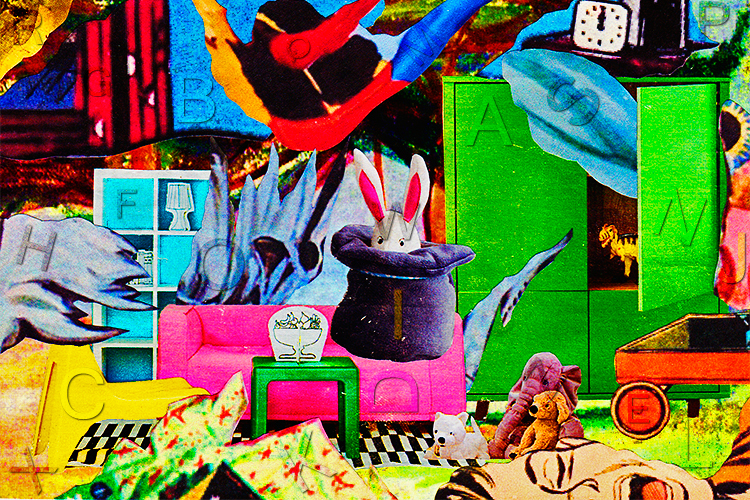
In the book of Memoirs “Memory, Speak” Vladimir Nabokov recalls how, at the age of six, he built a castle from children's cubes with letters - and between the case he complained to his mother that the letters on the cubes “Not the same color”. He, six -year -old, already had a clear idea of what color is “that”: “There are alder F , an immature apple r and pistachio t . Greens are more dull in combination with Fialkov - this is the best that I can come up with for w . The yellow includes the diverse yes I , the creamy d , the bright golden y and u , whose alphabetical meaning I can express only with the words “copper with olive tint”. ”
Neurobiologists call this effect with graphemus-color synesthesia. The last 150 years have been examined synesthesia, and during this time scientists have almost ceased to doubt that they are dealing with an innate feature of the brain. According to the calculations of the classic of the neuronauki, Simon Baron-Cohen, it is found in one person out of two thousand , and in women six times more often than in men. This is not a disorder of the psyche, not a visual illusion and not a defect in perception: reading a text filled with black and white, a person is aware that the letters are black on white - and at the same time feels them as green, blue or red. There are also colored sounds, color days of the week, voluminous smells and even the experience of orgasm in the form of a stream of geometric shapes. The latter was admitted by the son of Nabokov Dmitry, who wrote a preface to the popular book about Sinestesia “The Wednesday of Indigo” , published in 2009.
And now, in March 2015, the author of this book David Igalmen, the head of the laboratory at Baylor College of Medicine (Houston, Texas, USA), together with two colleagues in the electronic scientific magazine PLOS One work on how often two at random synestrots can find a common language.
Perhaps the letters are indeed somewhere in the world of Platonic ideas-red, green and blue, but ordinary people, not syncepts, are in the position of the blind who are not able to notice this? In such a hypothetical situation, the syncepts themselves, without saying a word, would have to see the same thing: a always red, and T is always pistachio, like Nabokov Sr..
But they see different things.
***
Why is a phenomenon in general, which does not threaten in any health, so occupies neurophysiologists? Because synesthesia is a clear example of such abilities that qualitatively change the perception of reality with a healthy brain. What does this specific ability give? At least - the ability to think metaphorically.
In 2001, the neurophysiologist Vileyanur Ramachandran suggested that synesthesia is the main source of the established metaphors that we use all without even realizing them as metaphors. Why is “strong” coffee, if we are talking about taste? Why do we call some smells sweet, and others are bitter? And the colors are “warm” and “cold”? It seems that such associations themselves arise in people for whom different modities of perception - such as color and sound - are tightly connected.
Especially a lot among artists and composers (on this occasion, Scriabin and Kandinsky always recall, who saw the sound, but even among ordinary students of art schools of synESTETS more than an average of a population).
And this observation radically diverges from the popular interpretation of talent along Malcolm Gladell, the “10 thousand hours rule”: everything that distinguishes virtuoso from the loser is the time invested in mastering skill. Everyone can be taught, but some are lazy. Spend on something 10 thousand hours-and you will allegedly become one of the best.
Therefore, the question of synesthesia is not least the question of the hidden mechanisms of talent.
Behind each familiar metaphor in the language is the experience of a synestet, which once shared with the others. Why is “strong” coffee, if we are talking about taste? Why do we call some smells sweet, and others are bitter?
***
The Laboratory of IGLEMENT 10 years ago created the Synesthete website . Org where you can find out whether you have synesthesia or not. The qualifying test almost accurately rejects the impostors. Well, let's say, the whole screen is filled with numbers 2 and 5 mixed in a mess, and I must say what kind of geometric figure the deuces form. If they are painted for you, then the eye will instantly separate the triangle or square from the doubles from the background. In all other cases, too much time will take the task.
In a new study, 6588 people who passed a graphemal-color test with a positive result were called to participate in the new study and, in addition, speak English. The sample is huge by the standards of any psychological experiment, especially if you take into account how rare the phenomenon is.
All participants in the experiment were asked to paint the alphabet as it is painted with their brain. And in order not to get lost in endless “olive castings” and other shades, scientists proposed indicating the closest color from the standard 12-color palette for each letter. When all the answers brought in one table, it turned out such a colorful carpet . And the authors of the article began to look for patterns in it.
What will happen if you break people into groups, inside which everyone is compared with letters about the same colors? A huge cluster of 400 people, where red , d green, e blue and so on, will immediately catch his eye, and all other groups are obviously smaller.
And the authors had an unexpected explanation of where this cluster could come. In 1971, in the stores of toys throughout America, sets of Fisher-Person appeared to teach children to alphabet-26 magnets for a refrigerator in the form of multi-colored letters. Red A , M , S and Y. Orange b and n . Blue E and K. Green v . And so on. The set was dispersed by a span of tens of millions and sold until 1990 inclusive - that is, 19 years in a row.
Systettes have color sounds, color days of the week, voluminous smells and even the experience of an orgasm in the form of a stream of geometric shapes.
The cluster of 400 synestets has ten or more intersections with this set - up to the situation where the colors of all 26 letters coincide. The needleman and colleagues called them "magnetic synetets." The likelihood that at randomly the participant in the experiment, the colors of at least ten letters will coincide with the coloring of Fisher Price by accident, insignificant-0.009 percent.
To declare a set of magnets on the refrigerator, the culprit of synesthesia, this is still not enough. Suddenly, the letters on the order of Fisher-Person was painted by a designer-synestrum, which belongs to the group, who sees V green, and a red (and has always been more numerous than other groups)? If you look at the age of the synesstes at Igalmen and colleagues, it is clear that such an assumption is no good.
Of the 6588 people, people born from 1940 to 2000 fell into the initial sample, but the dates of the birth of “magnetic synestrots” begin in 1967: when the Fisher Pseis set appeared on sale, the eldest of them only learned to read. Finally, the share of “magnetic” among those born from 1970 to 1985, at the peak of the popularity of the set, above 15 percent, while in the entire sample - only six percent (400 out of 6588).
So, it seems that it was 26 plastic magnets that many thousands of children with a special type of susceptibility accidentally reprogrammed the brain.
What to do with the rest of 85 percent of the synestes? The authors admit that they could well have some other-but also external-the source of associations: alphabet, cubes, a sign sign. It's just that all this is too individual, and next to each of the 6588 people you can’t put a psychoanalyst who will outplay all the details of childhood.
Another thing is that millions and millions of other children, who saw certain color letters in childhood, did not become synestrates.
***
If associations with synesthesia can be called artificially, then synestrots in theory can be taught the most incredible things, including almost useful things. It is one thing to instantly grab the “colored” deuces from the massif of five, the other is to instantly identify different characters in the crowd of people: one of the rare varieties of synesthesia - colored “auras” around the interlocutor, depending on his character. And the Nobel laureate Richard Feynman admitted that he sees physical formulas in color.
Another question is - is it possible to purposefully teach synesthesia itself? If you do not take into account the action of LSD and other psychedelics that cause it for a while, then adults cannot be lending. Such an experiment was set at least three times, and each time it failed. Even if the experimental ones memorize the correspondence between the colors and letters, the letters do not begin to look colored. The results of the needleman team hint that children are different in children. And, as in the case of teaching languages, there is, perhaps, a narrow temporary window, when a well -chosen stimulus - like a cheap set of magnets - can turn “just associations” into a bridge between modalities of perception, when notes acquire taste and volume, and emotions become music.