
Translated material
"Theory of modern drama"
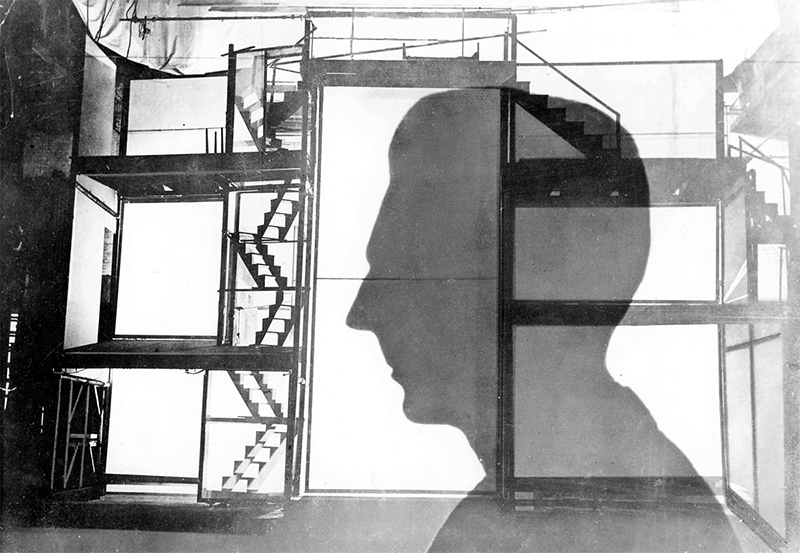
For the first time in Russia , the work of the German scientist Peter Sonda “Theory of Modern Drama” (translation by Alexander Filippov-Chekhov) was one of the most important texts of European theatrical science of the twentieth century in Russia for the first time in Russia. Today we publish a fragment of a book, kindly provided to the editorial office of the VAC Press.
The text is printed in the source.
Political Revoy (Piscator)
Despite the internal contradictions inherent in the “weavers” of Hauptmann as “social drama”, this play - along with some other dramas of naturalism (for example, “at the bottom” of Gorky) - for several decades remains the peak of dramaturgy, making an attempt to depict modern to the author of social relations. The verdict pronounced by the social subject of the dramatic form, in the 1920s , is carried out not within the framework of dramaturgy as such, but on the ephemeral field of staging. This is also happening in the work of Erwin Piscator, to whose documentary and program book the Political Theater (1929) in this context you need to contact. Attraction of theatrical history events is justified both by the influence of the pyskator's staging on the playwrights of subsequent decades and the origin of his works from the shortcomings of modern drama: “Maybe the whole manner of my productions arose due to a lack of dramatic products. She probably would not have been so out of the ordinary if I had adequate dramatic products. ”
As one of the origins of the “political theater”, the pyskator calls naturalism, and his early setting of Gorky’s play “at the bottom”, which he understands in the same way, in which we mentioned it above with the “weavers” and “before the sun of the Hauptmann, already contains some important elements of the“ political viewing ”, in which the drama would be dissolved later by the pyskor. “Gorky in this naturalistic early work gave an image of an environment that, although it was typized, but still remained closely limited by the conditions ... In 1925, I could not think within a close room with ten unhappy people in it: it went about the scale of modern large cities. I wanted to create a discussion around the new concept of “tramp”. To do this, I needed to extend the scope of the play ... These changes made a great impression during the production. When the curtain opened, the scene was full of sleeping, a snoring around and wheezing, oppressed by hopeless existence. Then there was an awakening of the big city, the calls of the trams, the spans of high and dark streets opened until the ceiling went down and did not limit the place of action to the room: the first act began. You should still stop at the noise in the third act, in which there was not only a small fight of a private nature, but also the opposition of the police from the side of the whole quarter, growing into the uprising of the masses. In the whole production of the play, I conducted the idea of raising the emotional experiences of an individual to the level of a common, typical of the present, where it is possible, extending, to break the framework, to cover the whole world. ”
Such changes, which entirely and adequately meet the intentions of social drama, concern the most dramatic form, they are directed against its absolutiness. The current scene, which in the drama already represents the whole world in miniature, a microcosm, reflecting the macrocosm, appears here a fragment, and its production is thought in the spirit of Pars Pro Toto . The attitude of the part to the whole, which integrates the meaning of restriction of the space to the size of the room, and the characters' systems - up to ten actors clearly represent the descending ceiling at the beginning of the production. The dramatic scene correlates with the outside world (which it represents, lining up in this act itself), and at the same time with the epic SI.
In this way, the Piscator corrects the forgery, which inevitably goes to the “social drama” when it contrasts the alienated world as a thematic category and the image of relevant inter-human relations as a postulate form. The Cycrator Theater provides a suitable form for the historical process of materialization and “socialization”, which in a dramatic production appears in the form of an image of inter -human relations. This is achieved thanks to another transformation - this time in the form of a staging.
This is the interaction of all the scenaries of the squeak, which gained fame.
“The proof that wants to convince should be based only on scientific penetration into the material. I can do this only when I move to the language of the scene and overcome a separate stage form, purely individual characteristics of the characters and the random nature of the phenomena. I create a connection between the stage action and events that have great historical significance. It is no accident that in every play the topic becomes the main character. From here it follows that coercion, the pattern of life and the personal fate of each receive the highest meaning. ”
“A person on the stage has the importance of social function for us. The central point is not his attitude towards himself, not his attitude to “God”, but his attitude to society. Where he performs, his class also appears, its environment. Where he has a conflict, moral, mental or emotional, he comes into conflict with society ... an era, which put in the order of the day, all the relationships of people, the revision of all human values, the restructuring of all social conditions, cannot consider a person otherwise than in his relationship to society and social problems of his time, that is, as a political unit.
If this special emphasis of the political moment can lead to a distortion of the “ideal” human image, then the fault here lies in the disharmony of the current social relations that make any manifestation of life political. ”
“What are the forces of the fate of our era? .. Economics, politics and, as the resulting these forces, society, social ... If I consider the construction of personal issues to the degree of historical, the main idea of all theatrical action, then this refers to nothing more than raising them to the degree of political, economic, social factors. With the help of this, we connect the theater with our life. ”
The main technique of the squeak is, thus, in the construction of what is happening on the stage to the level of a large history and, from a formal point of view, in classifying the current scene to irrelevant objectivity; This technique destroys the absolutability of the dramatic form and serves as a prerequisite for the emergence of an epic theater. One of the artistic means “indicating a large interaction between individuals and public factors, an individual and a class” and at the same time in which the desire of the clerk to epize was manifested in the most distinct and significant way was cinema.
The development of cinema from the beginning of the century to the 1920s has been characterized by three important discoveries: a movable camera, that is, a change of shooting point, close-up and installation. These three innovations allowed the movie - as the visible man (1924) B. Balash showed in the program work to develop its own spectrum of expressive means and become an independent form of art. The emergence of a cinema at the turn of the century was an event from the field of technology: cinema was a technical means of transferring the theater setting on the screen. As a means of mechanical transfer, cinema has passed into the category of dramatic. Thanks to the three listed artistic discoveries, the camera was involved in the creation of the image, the relationship of the camera and the survey object became a productive component of the image, and the personnel sequence began to be determined not by the sequence of real events, but by the compositional vision of the director during installation. So cinema ceases to be a photograph of the theater and becomes an independent figurative narrative. This is not just a technical fixation of the drama, but an autonomous epic form of art.
The epic of the cinema, based on the opposition of the camera and the survey object, on the subjectively designed image of objective reality as objective, allowed the writer to add to what is happening on the stage what escapes from the dramatic actualization: the alienated materiality of the "social, political and economic". In other words, the epic of the cinema allowed him to carry out "the construction of stage moments to the degree of historical."
In this sense, the pyscator used the means of cinema in the production of Toller's play “ Gop-la , we live!” (1927). He again made an attempt to "bring the fate of an individual from the general historical factors to create a dramatic connection of Thomas's fate with the war and the 1918 revolution." The main idea of the play was “a clash of an isolated person with modernity for eight years. Eight years should have been shown here with all their horrors, madness and meaninglessness. It should have been given an idea of the grandeur of this period. Only with the disclosure of this abyss does the collision acquires its weight. No other tool, except for cinema, can show eight endless years within seven minutes.
Especially for this “intermediate cinema”, a script was created containing about four hundred dates from the field of politics, economy, culture, society, sports, fashion, etc. ... a small group ... all the time was in the archives of large film organization in search of genuine material over the past ten years. ”
The use of cinematographic means gives a socio-political drama an epic character, not only thanks to the immanent epic of cinema. Epization (due to relativization) where the parallelism of events on the stage and on the screen contributes to a greater extent. Thus, what is happening on the stage ceased to exhaust the integrity of the production. This integrity now does not arise dialectically, thanks to the image of inter -human relations, but as a result of the installation of dramatic scenes, newsreels, the sound of the choir, the projections of the sheets of the “calendar”, etc. The internal correlation of parts is emphasized using a simultaneous scene, various forms of which are used by the piscator. The original time mounted by Reia is no longer the absolute sequence of the events of the present in the drama. Documentally depicting the past, cinema leaves it in the past. Within the framework of what is happening on the stage, cinema can anticipate the future and, thanks to the epic simultaneous image of events, allow the dramatic stress in the final of the production. In the production of "Rasputin" based on the play by A. Tolstoy, the cinema "connects for the viewer" members of the royal family with their coming fate, showing the audience the scene of the Romanovs storage in advance. The choir party and replicas addressed directly to the public are gradually becoming part of the real course of time. However, behind all these elements, the Reye is hidden in a certain immeasurable superiority of the epic self, which connects these elements together and represents them to the court with the help of the figure of the speaker, Erwin of the squeak of in persona . The fact that he perceived and portrayed himself in this way proves the famous scene: the appearance on the huge screen of the three -story scene of his monumental profile.