
Translated material
How to become an impostor
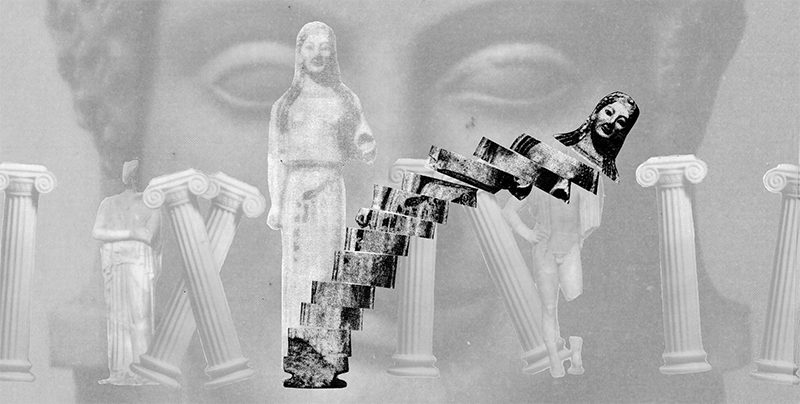
The acute question that the heroine of the Shes an Expert section is raised differently in their texts-what is this expertise formed from? Often, women in the profession are not just difficult to understand the real level of their qualifications, but also to defend their authorship - even in cases of direct plagiarism. This study on how to become an impostor was written and illustrated by the artist Anastasia Kayneanung.
The topic of self -posterity is very personal for me, because I am always in all areas of my life, as I remember at a conscious age, I felt an impostor. I felt like an impostor at school when I took prizes at the All -Russian Olympiad; at the university, when she participated in student conferences; At work, when she taught students and achieved success in this. In the field of art, I also felt like an impostor all the time, especially when I took part in the recently past Triennale. Where did this feeling come from? It seemed to me that I did not speak in some special language, which everyone around me speaks, I do not have special knowledge and skills, I do not have the necessary education. That I was in my place by chance and that someone else was supposed to occupy it (it is amazing that it seemed to me even in cases where I made objectively a lot of efforts in order to achieve the result). That I am deceiving everyone around me and in fact I am not the smart and successful person in my field, who for some reason seem to everyone. I feel like an impostor and now, when I write this text. I literally struggle with the feeling that I am not competent enough.
Let us dwell for a second and look at this word that I just repeated so many times: an impostor. I am a philologist by training, not an artist. I work with the word. What does the “impostor” mean? The one who called itself or called it. Indeed, I myself called myself an artist three years ago, although I am engaged in artistic practitioners much longer. It took a lot of courage to get into this position and declare yourself from there. But this is the moment of coincidence with myself: the fact that I am an artist, I know for sure. After all, this is not measured only by the number of work created, the number of group and personal exhibitions, this is a little different: to be an artist means having optics, and I know for sure what I have.
So, self -posterity is generally about the courage to declare yourself, your existence and visibility, about calling yourself to life out of nowhere. As in my installation that I did this winter and which was called “ Im from nowher” : arising from the void, I get on this void as a point of support. In the same way, I rely on my seemingly insufficient experience, use my seemingly poor and insufficient language, because I have no other, and I declare myself as I can. Yes, I am an impostor, no one called me. Why did someone have to call me, give me a name, explain who I am? I took this place myself, because I can’t otherwise. Because art is what I need to feel alive, even if no one taught me how to “correctly” create it.
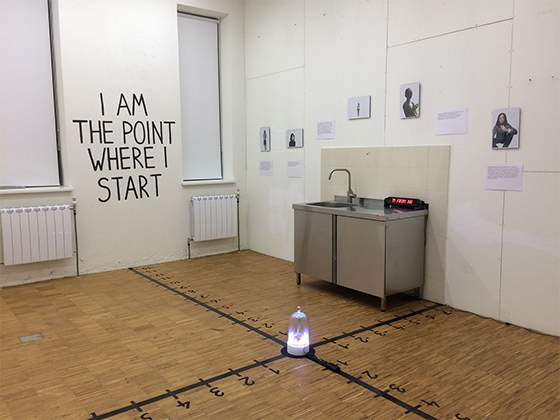 © provided by Anastasia Kayneanung Anastasia Kayneanung. I'm from nowher. 2021. General type of installation
The experience of this sensation brought me to me during the residence in the workshops of the Garage with the artist Pavla Markova. It seemed that she was more involved in the art environment: she was connected with my beloved Omsk Gallery “Left Left”, she had personal exhibitions, in Moscow they began to buy her work. And yet she feels in an artistic environment, like me, with an impostor: a little restless, a little alien, as if we had come to an alien party and trying to somehow get comfortable, pretending that we are here. The result of the Pavra residence was its installation “Experience” under the working name “soot”: she binded the whole space of the workshop with sheets of paper, on which she applied the drawings that mimic soot (as in the porches they previously painted on the walls with a lighter, and the believers depicted crosses with a candle above the door). In fact, Paul visualized the expression “smoking the sky”, realized a metaphor - as an answer to this feeling of self -posterity. It seems to me that this power creatively process any obstacle, translate this daily war (to which the goddess Athena called us, an important image in my works) into the space of art and win the enemy already in his own, and not in his field and distinguishes a real artist.
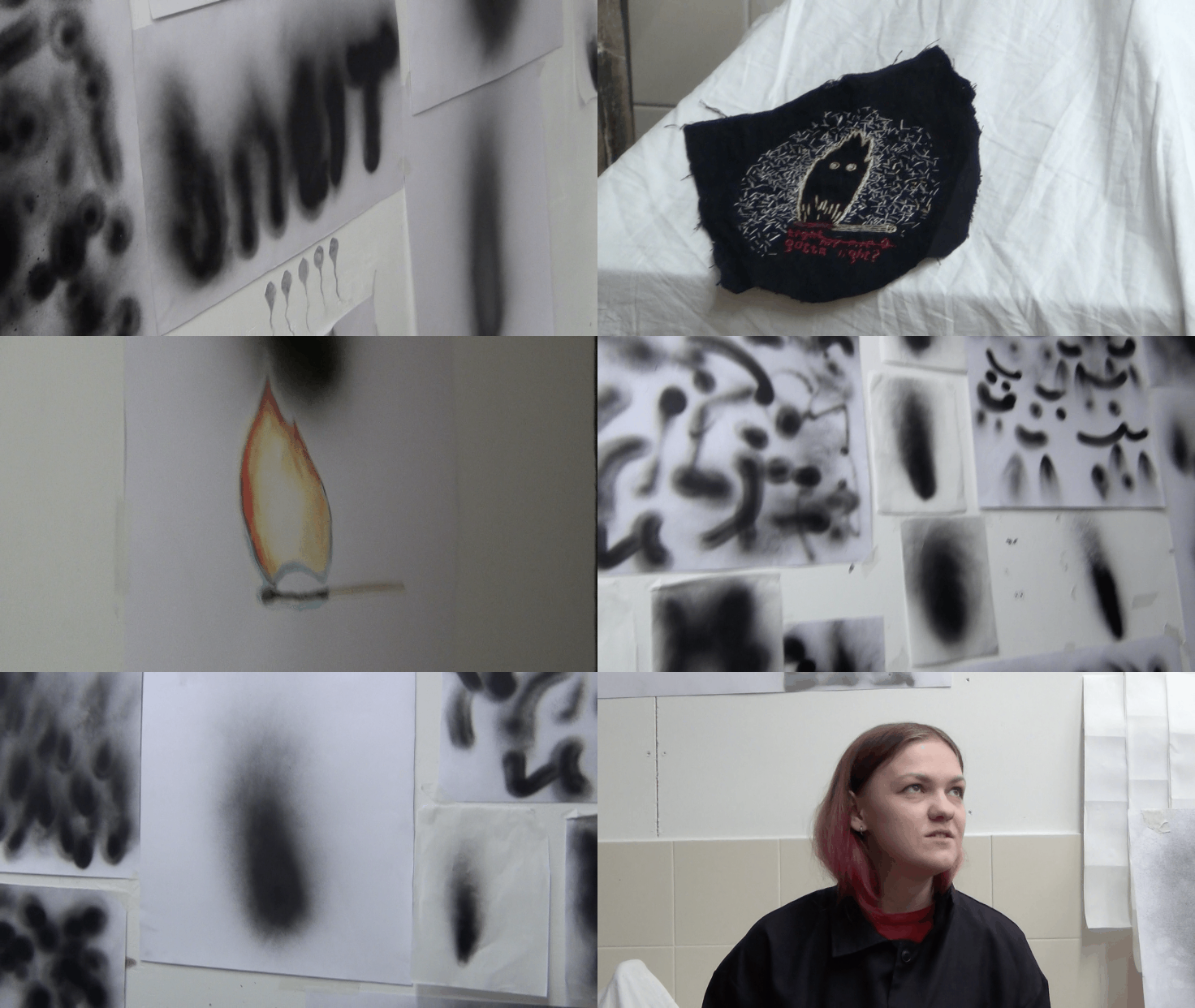
Pavel Markov and fragments of her installation "Experience". 2020
© provided by Anastasia Kayneanung
Real artist
With this opposition, with the division of artists into “real” and “fake”, Pavla and I also collided together. It turned out that there is an idea that the “real” artist is the one who: has learned to earn a living by art and is not forced to work in a hundred parallel work; He began to enter certain circles, learned to become his own in art tests and acquire useful acquaintances; He learned at the right time to correctly promote his art to the right people in order to keep afloat. If one or more conditions are not fulfilled, you are “fake” and you cannot consider yourself an artist. Pavla and I did not fit into this system on several points at once, and in our communication the image of some other artist, opposed to this, was more and more.
I do not earn money with my art, I have to work - although why "I have to." My professional activity is the same important part of me and my identity as my role as an artist. But the point is not only this. I deliberately do not set myself the goal of engage in art so that it brings money, because where there is money, there is a risk of dependence on the customer. I leave for myself art as a zone of freedom, where no one but me will dictate their rules. So: Yes, I am an artist, and I work in another area. I cannot and do not want to be a commercial artist.
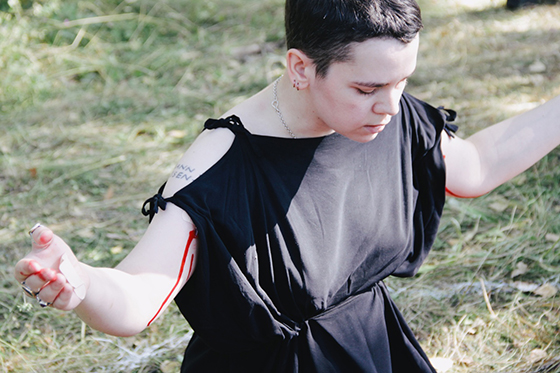 © Vera Kostryukova Anastasia Kayneanung. Performance "12 rituals for Athena"
Of course, like -minded people are important for the artist. However, like -minded people who would share my views on how to do art, I can find outside the artistic environment. It is enough to have your own view of things, which, like a prism, will pass through itself the world, refracting it to the images, and will return it back to the world. There are such people around me, and I really appreciate communication with them. Another thing is when the party becomes an end in itself, and the opening of the exhibition - a test of the debugging of social ties: am I still here? They remember me? Will they recognize me? Do they know about me? It seems to me that this takes a lot of moral forces and inspires constant anxiety: it turns out that I exist as an artist not in my works, but only in the minds of a certain circle of people: they will forget me - and I will disappear. However, I observed this in the academic environment when I studied in graduate school.
Once we had a correspondence with the artist Ilya Dolgov. I wrote that I was confused and disappointed in myself, because for a long time new creative ideas have not appeared for a long time. Ilya then answered me that, in his opinion, contemporary art looks like a race where everyone has the feeling that others are running, and you are running more slowly and therefore more and more behind. His gaze seems quite true to me: indeed, the environment suggests that the name of the contemporary artist is constantly by ear, you go from one personal exhibition to another, you participate in groups, do not forget about OPEN-collars . In fact, in this race you can lose the main thing: plastic life material, which you are as an artist and process in art.
To create something, you need to perceive something, find out, live. But how will I live a segment of life given to me if I do not pause, if I always engage in art production, like a machine? In the meantime, the art industry refers to the artist: as a conveyor that produces the product. There is a substitution: from the way to live life and creatively overcome obstacles, art turns into what sucks life energy from the artist.
Is such competition suitable for me? I think not. I want to do art, but I do not want to treat myself as a car or rebuke myself for the fact that others are running, and I stand still. To get out of the race means getting rid of unnecessary anxiety, breathing in full chest, focusing on silence - to go into your inner metaphysical forest. Yes, now many of my creative processes have stopped. But I patiently wait and do not demand from myself to jump above my head; I believe that one day my time will come again. There are other things besides the art that make me alive. And, even losing for a while the artist’s identity (although why should I lose her?), I remain a man, the main core remains in me - because I am more than any name that I can call myself.
To be honest, I would not want to introduce the opposition “real” and “fake”. Rather, this is: you are either an artist or not. What makes you an artist? First of all, optics . Any work of art is only the materialization of what the artist sees: he, as it were, barses his optics, gives the glasses through which the world sees himself. This is the first point. Second: You do this because you cannot but do , it is torn from you from the inside. He built Kurt Shviters all his life Merzbau-not because he received money for this or was preparing for some Open collars . He built simply because it answered his life task. And here is the third point: art for the artist is a way to live life , respond to challenges, overcome obstacles and solve problems with artistic methods. This is a way to conduct a dialogue with the outside world in your personal language. And the uniqueness of the work is determined by the uniqueness of the life problem that I solve in the plane of art . Each of my exhibition or installation is the head of my life, another step, and now I am coming - from one exhibition or installation to another. This also brings great relief: you release another image or a system of images into the world-as you produce a child, and a space for something new is freed inside.
 © provided by Anastasia Kayneanung
Authorship and plagiarism
I’ll tell you about the ambiguous situation that I had to face this winter. The fact is that somewhere in 2017 I have been doing a project called “Plant Bulletin”: this is a mimicry under the TV show, which takes interviews from plants. The character I created named a vegetable messenger is quite mysterious: no one knows if he has a human incarnation, no one has ever seen his face, his voice is synthesized by the computer. He is very interested in plants, but his approach is deliberately anthropocentric: he approaches plants and asks them questions in the human language. It is important to mention that the messenger is inherent in a special style of narrative with a secret bottom, something between the transfer of Grandfather Drozdov and the poetry of Daniil Harms. After his questions, about 40 seconds of silence follows, during which we see a plant trembling in the wind with a microphone directed in its direction. Does the messenger really hear the answers? Is it true that the plants are responsible for him, but we are not able to hear it? Or is he just pretending to hear something, and holds us-an audience-for fools? It seems to me that these issues, this lack of core of the project. By asking questions, we involuntarily find that they turn in our direction and we are not dealing with plants, but with ourselves.
It was in this form that the “plant messenger” reached the triennal of contemporary art. The project was a film accompanied by small installations, assembled from the materials of my trip of 2017 from Vladivostok to Moscow, which showed the formation and crisis of the messenger as a character: from the first approximation to the plant world to detecting himself in this world, a crisis of self -awareness and then a repeated approach to the plant in another quality.
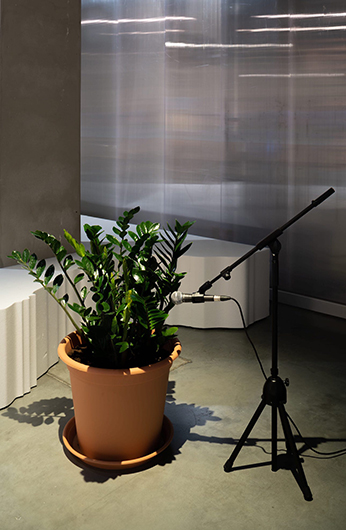 © Ivan Erofeev, Yuri Palmin / Museum of Modern Art "Garage" Anastasia Kayneanung. Plant Bulletin. Exposition on the Triennal of Contemporary Art in the Garage Museum. 2020
So, in the winter of 2021, I accidentally went to the website of the Khodynka gallery and on the online exhibition of System-Systems I came across a collective project “Answer”. It was a microphone on a rack aimed at visitors to the exhibition, and a video on the screen with a noisy tree processed in a computer program. It was possible to approach the microphone and say something, after which the branches of the tree on the screen came in motion, reacting to the speech. This was supposed to be, as planned by the authors of the project, the “answer”.
There was an extensive explication to the project: “We hear the rustle of foliage, relaxing in the shade of trees. Do they hear us, eavesdrop, remember what we are talking about, understand the meaning of words, phrases? Maybe the trees answer us, but how? What would our dialogue look like? "
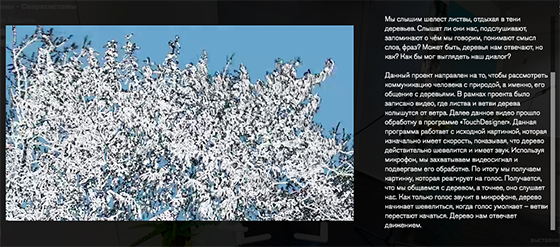 © provided by Anastasia Kayneanung answer. A collective project for the exhibition "System - Systems - Systems" in the gallery "Khodynka". Explication
A measured, leisurely syllable with observation elements, with a call from afar, greatly resembled the manner of the messenger, and some of the acquaintances, faced with this project, were sure that this was my next work. There are main questions here, very similar to those that are laid down in the Vestnik approach: do plants hear us, how do they answer us, if so, how could our dialogue look? A microphone, a video of the tree foliage - this is what the installation looked like for the first part of my project for Triennale.
Of course, there are differences, and first of all - a technical and methodological nature. The project shown in the Khodynka gallery is aimed at producing a visible way with a plant - albeit interaction and apparent: in fact a computer program interacts with us, not the plant itself. For a plant messenger, it is precisely the interaction with the plant itself is important, even if it is imperceptible to the eye. Moreover, the plant messenger is sure that this interaction is definitely, 30-40 seconds of silence as an answer are quite satisfied with; Whether this suits us is a different question, but these are our questions to himself, it should be so, but the messenger is all right with this. The “answer” to the vegetable messenger and the “answer” in this project are fundamentally different things: the messenger observes the plant as it is, and the project of the children offers a tangible interaction (the authenticity of which, however, is doubtful). Nevertheless, it is obvious that the visual, as well as the stylistic and in many ways the conceptual aspects of my project were borrowed here.
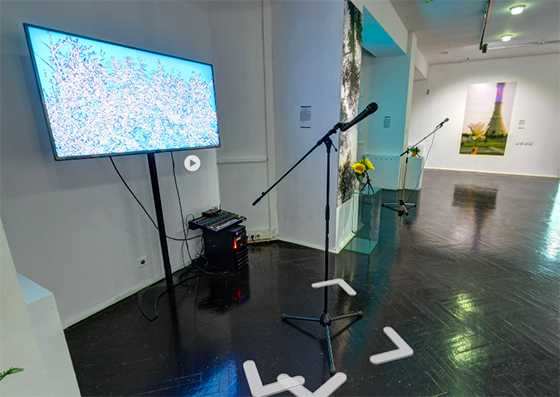 © provided by Anastasia Kayneanung answer. A collective project for the exhibition "System - Systems - Systems" in the gallery "Khodynka". General view
Of course, when I ran into this, I experienced indignation. I began to share my reaction and received the following answers from random people: there are no reasons to be indignant, because ideas are rushing in the noosphere; There is nothing criminal in the fact that they come to different people; Talking with plants is a common place, who just did not turn to this.
What is authorship? A plant messenger has its own, long -established style of communication with plants, or, as Ilya Dolgov called it, a script: each interview has a clear structure, it is repeated from the release to the release with light variations. There is your own visual style, speech and visual canvas. It was they, like the same script, that were borrowed.
Why did it happen and what is so attractive in the messenger, what do you want to appropriate? I think, of course, beckoning the tuning poetic style of grandfather Drozdov, promising some pleasant and leisurely meeting with the plant world, with nature. If you perceive the messenger superficially, then somehow it probably looks like the audience: friendly intonation is confusing, it seems that this is just such a kind Self-Care -project about flowers and trees. In fact, every dialogue of the messenger with the plant contains an acute conflict that does not receive any visible resolution. Is it true that a plant messenger hears answers from plants, but we do not? Or maybe he deceives us, pretends to hear these answers? I don't know. No one knows for sure. The other attractive side of the messenger may be the idea that the plant can somehow hear and give an answer, and the authors of the “answer” just had an attempt to realize this particular side: they literally forced the plant to give us an answer using a computer program.
I wrote about this post on Facebook, tag a gallery, but there was no answer from either the gallery or the team of the authors of the project. Valentin Dyakonov, the curator of my project for Triennale, spoke like this: if the authors of the “answer” were inspired by the messenger, then the imitation turned out to be not very successful, and there is nothing to worry about. Илья Долгов написал мне, что это, скорее всего, студенческий проект, который в силу жанра всегда бывает на что-то похож, а главная проблема в том, что куратор, пропустивший проект на выставку, не прочекал вовремя контекст. В любом случае одновременное появление двух похожих проектов в культурном пространстве — это как минимум повод для серьезного диалога. Его не случилось.
Я попробовала найти информацию об авторах «Ответа». Действительно, две художницы из списка авторов — студентки: об остальных сведений не нашлось, но на сайте галереи было указано, что среди художников есть «выпускники и участники “Свободных мастерских” MMoMA , музея “Эрарта”, фестивалей в Ельцин-центре». В сети можно найти упоминание презентации проекта на форуме «Таврида» и в выставочном зале СпбГУ, где проект был упомянут как студенческий. И это немаловажно.
Education
В современном художественном пространстве есть очень разные авторы с разным бэкграундом. Но нелепое деление художников на «настоящих» и «ненастоящих» во многом опирается на очень важный фактор: художественное образование.
Вспоминаю смешной случай из своей жизни: был период, когда многие люди вокруг меня были уверены, что я окончила школу дизайна «Вышки». Мне даже начала приходить вышкинская рассылка с постоянными предложениями поступить к ним учиться, хотя я вроде нигде не оставляла адрес своей почты. На самом деле у меня нет художественного образования (кроме нескольких классов художки в детстве), по образованию я филолог-германист. Надо сказать, что мне это мало мешает. Одна моя ученица (в прошлом я преподавала немецкий), обучавшаяся дизайну, посмотрела как-то мой зин и сказала, что он выглядит как дипломная работа на их факультете. А я чувствую в себе способность создавать что-то подобное без всякого специального образования в этой области.
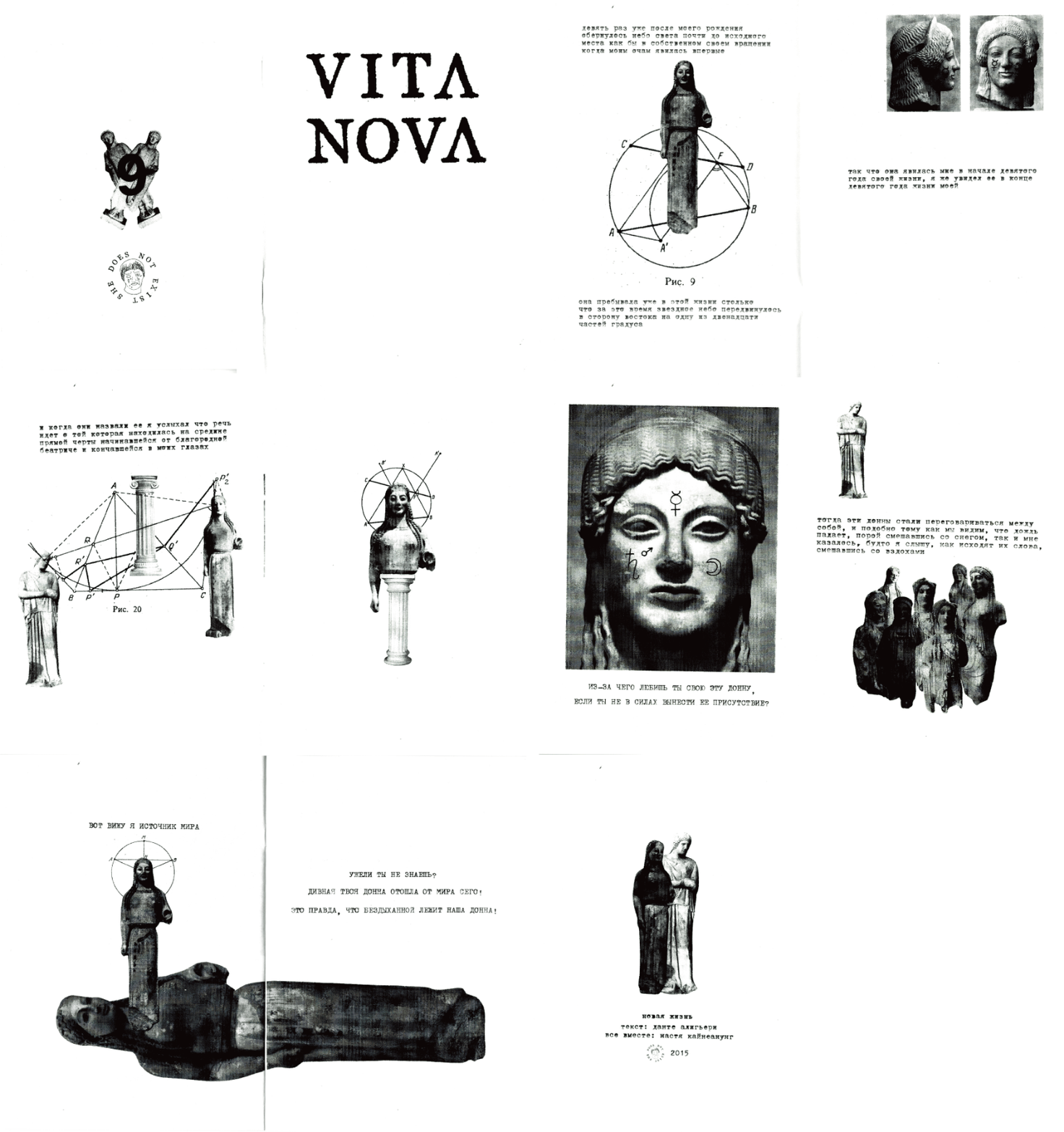
Анастасия Кайнеанунг. Развороты зина Vita Nova. 2019
© Предоставлено Анастасией Кайнеанунг
И все же я ощущаю на себе нехватку художественного образования. What is it expressed in? В том, что мне практически невозможно где-то выставиться без приложенных к этому титанических усилий, в то время как по другую сторону есть художники, которые получили или получают образование, — и для них выставка является обязательной формой отчетности. По этому принципу могла быть устроена и выставка «Системы — Сверхсистемы».
Одна из причин, по которым я не получила художественного образования, заключается в том, что я никогда не смогла бы заниматься искусством в качестве домашнего задания. Мне достаточно ощущения, что я создаю нематериальные, но при этом существующие высказывания: достаю что-то из мира идей и пытаюсь перенести это в мир вещей, дать этому физическую форму.
Жизнь сама с большим успехом справляется с тем, чтобы давать мне задачи, которые я пытаюсь решить в удобном мне темпе в художественной плоскости. В этом я чувствую свободу и какую-то удивительную игру. Если же жизненная задача превратится в домашнее задание, это перестанет меня волновать. Или продолжит, но вместо зоны свободы станет большой травмой — как до этого произошло у меня с филологией.
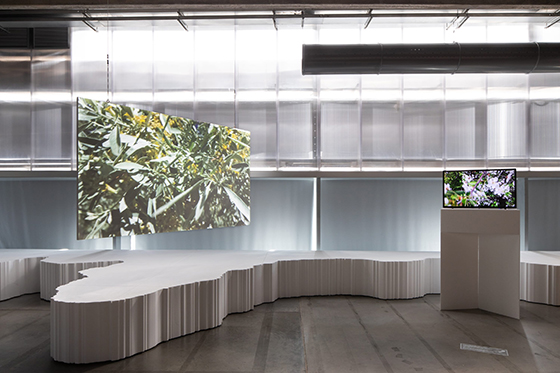 © Иван Ерофеев, Юрий Пальмин / Музей современного искусства «Гараж» Анастасия Кайнеанунг. Растительный Вестник. Экспозиция на Триеннале современного искусства в музее «Гараж». 2020
Вернусь к разговору о плагиате. Есть такая закономерность: чем проще идея, тем одновременно и легче, и труднее ее скопировать. В основе «Растительного Вестника» лежит простой скрипт: рука с микрофоном, растение, вопрос, заданный синтезированным голосом, и 30–40 секунд тишины, пения птиц, шелеста трав и леса в ответ. Но никто, кроме меня, не знает, что является живой душой Вестника, что в это вложено. В основе Вестника лежит не идея, а очень сильное эмоциональное переживание природы, которое однажды захлестнуло меня волной — и я ясно увидела именно этот образ прикосновения к природе, к Соседней Жизни с помощью максимально неадекватного способа. Но, по отзывам любителей и поклонников «Растительного Вестника» (господи, у этого скучнейшего на свете сериала действительно есть поклонники!), именно это и проступает в каждой серии, сквозит во всех однотипных интервью: не формулируемое никакими словами восхищение той самой Соседней Жизнью.
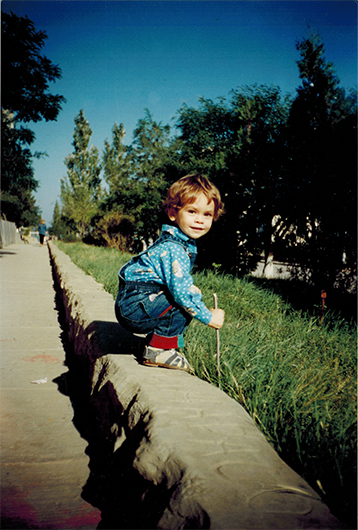 © Предоставлено Анастасией Кайнеанунг Анастасия Кайнеанунг
Можно скопировать формальную сторону Вестника, стиль, визуальную составляющую, но нельзя заглянуть к нему в душу и что-то взять оттуда. Потому что душа Вестника — все же моя живая пятилетняя душа. Это тот ребенок во мне, который присел на корточки в зарослях родных крымских сорняков и пораженно наблюдает за удивительными тайнами растительного мира, не находя и не зная для этого никаких слов. Вот кто он такой. И это никакому плагиату неподвластно. Об этот кристалл разбивается любая попытка скопировать, оказываясь бессмысленной и бесполезной, — разбивается, как волна о скалы.
Независимому искусству сейчас, безусловно, не хватает пространств, которые оно могло бы занимать и где могло бы реализовывать себя. По моему мнению, существует очень большой перекос в сторону тех художников, которые связаны с образовательными институциями: они по большей части и попадают в галереи. В то время как независимое искусство вновь вынуждено ютиться по домашним выставкам и пустырям, всеобщий ответ на вопрос, что такое искусство, звучит очень просто: искусство — это то, что выставляет условный «Винзавод».
Создается ощущение, что современное художественное образование направлено не столько на то, чтобы научить человека стратегиям в создании искусства, сколько на то, чтобы уметь себя преподносить, успешно продаваться, интегрироваться в нужные сообщества и занимать место в иерархиях и структурах. Но имеет ли это отношение к самому искусству? Или мы наблюдаем создание и становление среды, аналогичной той, что мы имеем в разных академических кругах, — например, научно-филологической, из которой я в свое время сбежала через полгода после того, как поступила в аспирантуру? Мне это видится в том числе вопросом привилегий: ведь, чтобы получить художественное образование, недостаточно одного желания. Чаще всего это стоит довольно больших денег. Но почему именно деньги должны все это решать?
Новую форму делают те, кому есть чем ее наполнить, кто обладает новым содержанием. А содержание, если это касается самого художника, его жизненных задач и стратегий, огненной искры в его душе, всегда новое: пускай мы живем в мире, которому тысячи лет, пускай нас волнуют те же проблемы, что и людей за тысячи лет до нас, пускай нас окружает та же природа — оптика у каждого художника собственная. Не случайно в начале каждого выпуска «Растительного Вестника» звучит фраза «Мы смотрим на растения новыми глазами» — неявная рифма к манифесту ОБЭРИУ, который, кажется, почти полностью был написан Николаем Заболоцким: там есть фраза о том, что на предмет нужно смотреть «голыми глазами», так, будто мы видим его впервые в жизни. Мир, на который смотришь «голыми глазами», все время нов, его обновляет оптика смотрящего художника. А значит, преломившись в сознании на образы, он сможет дать нам новое содержание — и новую форму.

We make this section together with the She IS an Expert project-the first database of women experts in Russia. The purpose of the project is to make the opinions of women who produce knowledge and are ready to share experience in the public space.
Look for an expert here for your events.
Register and become experts.