
Translated material
The fifth went

The Trans-Siberian art festival is gaining momentum for the fifth time. In 2014, the hometown of Vadim Repin received a musical project, which seemed a miracle. It is recalled that in those very first days, along with the emotional rise and oversaturation of oxygen from the opening opportunities, it was as if a slight confusion. Too scale of the event was unusual for Novosibirsk, exorbitant, incredible. Today, the festival, whose heart remains Siberia, is expanding to the West and East, and its artistic director calls its main task the construction of a cultural bridge between them. Along with Novosibirsk, Moscow and Krasnoyarsk have already joined the festival program, St. Petersburg and Samara will soon join, later the cities of Japan and the USA.
The festival, in fact, became a tribute to Arnold Katsu, the conductor, who, from scratch, who created orchestras in Novosibirsk, the same one with whom Little Vadik Repin once first entered a large stage. The new concert hall is named after Katsa - the long -awaited one, thanks to which the festival was finally possible. Trans -Siberian is also a kind of monument to Katsu, intangible. The hall, of course, will stand, but it is important what level the concerts fill it. There is no stability: the governors are changing in the region, the leadership of the Philharmonic is changing, and each turn brings its changes to her life, unfortunately, not always consonant with its level. Against this background, Trans -Siberian remains a project that is constantly improving the taste of its public. Bringing the leading world performers on one scene (Charles Dutueti, Leonard Skatkin, Rudolf Babbinder, Nicholas Angelich, Juliano Carminol are only some names) with local groups, the festival gives them an impetus to development and irreversibly changes the idea of their own capabilities. While the project lives and sounds, the Novosibirsk musical culture is guaranteed to develop, and the name of the city included in the world context is gaining new brilliance and weight. The leadership of the region perfectly understands this, invariably providing the project for support - and all the vectors of the festival program set from the very beginning grow over the years.
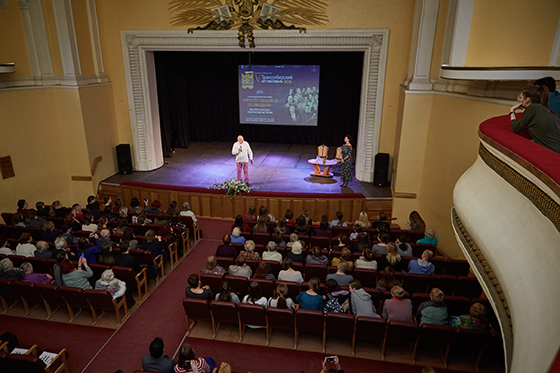 © Alexander Ivanov Bruno Montsenzhon in DK Energy
In the palace of culture "Energia", which took care of organizing a program of master classes, accompanying concert, full halls gather. On the stage are the stars of the festival and young musicians who have passed the preliminary selection, who came from Moscow and Italy this year. Among the listeners are not only musician students, Philharmonic artists, teachers and students of music schools, but everyone else. And they are going decently, especially on the master classes of the Vadika, beloved by the Siberians. Here is an additional show of Bruno Monsenjon, Mstislav Rostropovich. An indomitable bow. " And the place is already so prayed that the session announced the night before by 10 in the morning collects a full house.
The director’s official Russian premiere (this is one of the festival directions from the first year) the director spends a couple of days before in Novosibirsk, and then carries the film to Toguchin, one of the district centers of the Novosibirsk region with a population of 20 thousand people. There he is met with an open heart and with the whole soul - of course, with a loaf and in kokoshniki. Talking, perhaps the most sincere of the audiences he saw about meetings with the hero of the tape, about working on it (there are memories of the daughters of the musician, Natalia and Ignat Solzhenitsyn, Gennady Rozhdestvensky), Monsenjon says that he is especially valuable in Russia, where the figure and fate of Rostropovich are of particular importance. And it is admitted that the Toguchinsky cultural and leisure center is in no way inferior to the hall, where he represented his film in New York. A grateful audience explodes with applause.
An equally grateful audience is gathered in the satellite of Novosibirsk for a chamber music program: the Berdchan is listening to the piano quartet of Schumann and the piano quintet of the jar, almost without moving-all elegant, everyone came to the holiday. And the opuses, whose performance gathered on one scene of brilliant musicians (Vadim Repin, Clara Kan, Maxim Rysanov, Pablo Ferrandes, Marie Kodama), three of which are played on Stradivari, sound even more slimmer and more perfect than in the thousandth hall of Novosibirsk the day before. Both dry acoustics and rattling piano are not a problem for listeners or artists.
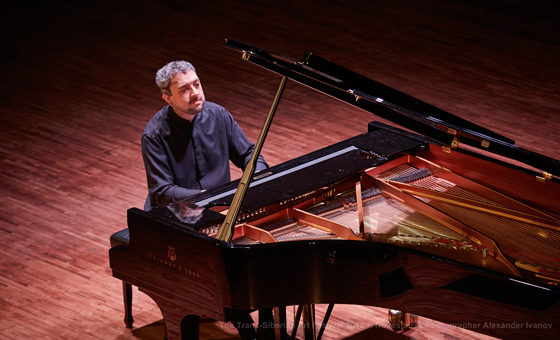 © Alexander Ivanov Konstantin Lifshitz
Not the problem and duration of the concert: Konstantin Lifshitz represents a solo program of three departments on the Trans -Siberian, in each - the English suits of Bach, played in a gusty, expressive manner, and the works of Bernstein, performed in connection with the anniversary year of the composer. Someone in the hall is unscrupulous that “the head was exhausted from such a number of Bach,” and retreats ahead of schedule, but most supports the Renom of the Novosibirsk public and if they do not receive complex intellectual pleasure from the clash of two musical universes, then at least arrange a long, not at all on-duty ovation.
The culmination of the festival program is still an opening concert: Kent Nagano, Vadim Repin, Konstantin Lifshits, the Novosibirsk Academic Symphony Orchestra, the Novosibirsk choir chapel. The conductor, whose first appearance in Novosibirsk four years ago seemed a phenomenon from the field of violation of the laws of physics is now perceived as a good acquaintance. Nagano himself speaks of Siberia willingly and warmth and admits that he compiled a concert program from the works that reflected his impressions of this region. He discusses the cultural traditions of the region and is sure: it is in them that is the uniqueness and salt of Trans -Siberian. Thusily and leisurely, a fucking speaks of a unique combination of professional and mental characteristics that he feels in the manner of a symphonic orchestra: “In the final part of Strauss’s poem (“ So said Zarathustra. ” - M.M. ) there is an episode where two violin soloes. I asked them to play a melody as if it doesn’t sound now and not here, as if it were a memory, and about the events of not yesterday, not week ago, but separated from us for centuries. They played - and I can say with confidence that I have never heard this. You won’t find this either in Bavaria, nor in New York, or Tokyo or San Francisco-this is something unique, local: the memory of what was a century ago here on this earth. ”
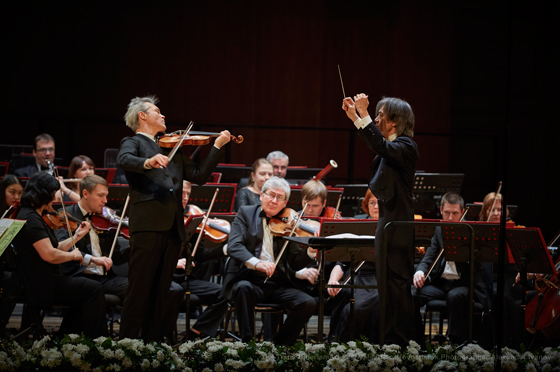 © Alexander Ivanov Kent Nagano and Novosibirsk Academic Symphony Orchestra
The orchestra inspired by Nagano, in an organic romantic repertoire for himself, joyfully plays with timbre: the sound sparkles, triumphantly flies, hot, melts and fills the hall. At the same time, the characteristic hidden anguish, hidden anxiety, extinguishing exaltation (such is he, the genius of the place?) Are also heard in it. Steps on the thin ice of orchestral difficulties in most cases take to the right road. And as for the few misfires-they make them reflect on the proportionality of the load that the musicians take out, for some reason, performing their subscription concerts during the festival.
Vadim Repin, habitually demonstrating the execution of the world class in love with him, emotionally resonates with the orchestra. His “Stradivari” in the concert of Bruch is noble and restrained in a European man, but breaking through the hidden melancholy is that he is related to the team.
Ahead in the festival program-“Lady with Camellias” of the Bolshoi Theater on the stage of Novat, the jazz program of Thomas Kvasthoff, the first recent Vadim Repin on his native stage, dedicated to his mother, the French program under the control of Jean-Claude of Kazadezyus, the performance of Guidon Kremere, and the main world premiere of the V Trans-Siberian Festival-a violin concert. Sofia Gubaidulina: He will sound in the presence of the author.