
Translated material
Russianness as a problem
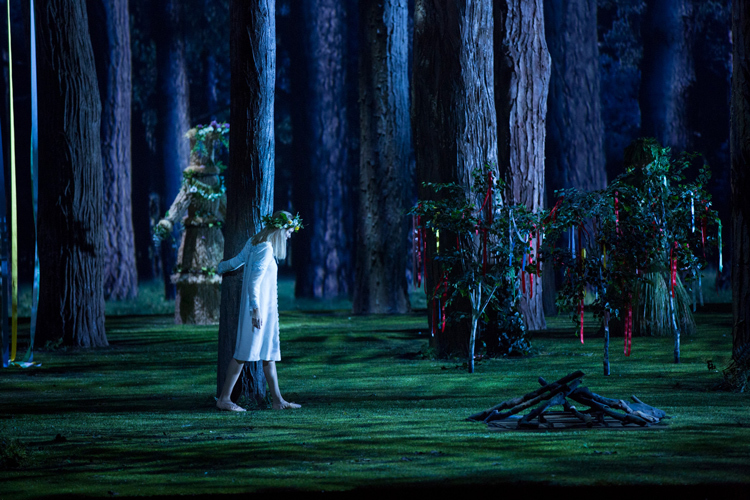
Dmitry Chernyakov put his new performance, “Snow Maiden” by Nikolai Rimsky-Korsakov in the Paris Opera. Once again, at the performance of Chernyakov, you need to fly. However, it is somehow embarrassed to complain about it. The director belongs to the group of authors who have deprived themselves of a territorial binding. And to worry about his work abroad is like perplexing why Ai Weiwei is shown in Royal Academy , and not in China.
But the international career of Chernyakov creates significant restrictions for the reviewer. Viewing the play, and therefore the review, in the least degree depends on the editorial policy, and above all, on the desire and capabilities of the journalist. Watch Chernyakova becomes expensive and troublesome. And to write about him is also troublesome. A new review format is required for the performance, which the reader can either see either in the prepared film version (the Paris “Snow Maiden” can already be found on the network), or in an indefinite perspective.
Of course, this production became an event. Chernyakov’s relationship with the Paris opera develops well - they clearly trust him with the choice of material, and they don’t squeeze with the budgets. In last year’s “Iolante/Nutcracker” and in this “Snow Maiden”, the combination of the material unobviable for the western context and the scale of the production, to which theaters traditionally go only in relation to Verdi-Vagner-Pochini are surprised. In the Snow Maiden, Chernyakov built a forest on stage, which could seduce the most sophisticated mushroom pickers. And if in the middle of the premiere, according to eyewitnesses, in the endless B Astille , free places were still visible, then at the last performance - I can testify - there was a full house. And this means that the name and the composer still do not provide the audience reflex, but the French public is mobilizing on Chernyakov - at least at the last moment.
The art event also took place. The “Snow Maiden” is built into an important line for Chernyakov’s productions of Rimsky-Korsakov, whom he is trying to withdraw from an ethnographic ghetto. But now with a fundamentally different strategy. If in the previously set “legend about the invisible city of Kitezh” and “The Tsar’s Bride”, he muffled the national flavor and set universal stories, then in the “Snegurochka” Chernyakov brought Russianness as a problem.
 © Elisa Haberer / Onp
At the same time, it is important for his performance that the opera is not based on folklore material, but on the play of Alexander Ostrovsky. Chernyakov returns the opera to the authors and insists on modern sensuality, the eroticism of this fabulous - more often passing in the category of children's - history. Remaining within the framework of the canonical text, without surgical techniques, he adds human to these sterilized by collective unconscious circumstances of the action in the relations of the characters.
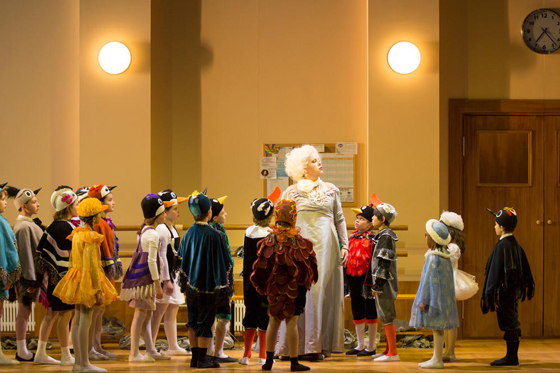
In the prolon Spring (Elena Manistina), the head teacher with an air permanent and bulky beads, rehearsing with the children's children's performances for the matinee, and Santa Claus (Vladimir Ognovenko), a caring head of the department in some institution, dispersing boredom and family dysfunction of vodka, tiredly scold about the weather (the Snow Maiden is on the back of the door). Both agree to let the daughter go to the Berendeev camp.
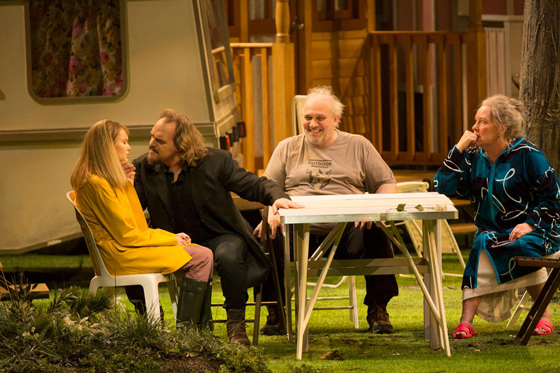
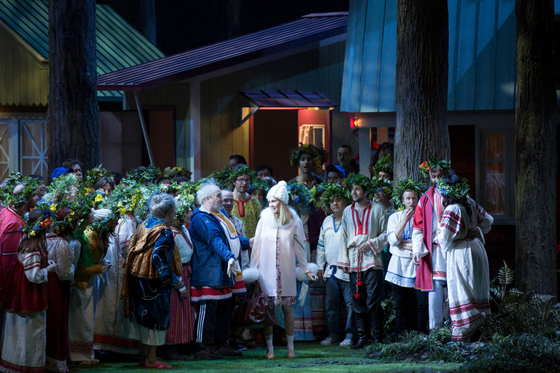
The campsite, which became the Kingdom of Berendeev, is quite modern (maybe organized by the institution where Santa Claus works?) Or, as usual for Chernyakov, timeless-is collected for some folklore trip for Shrovetide. Tourists change into Russian folk costumes - without fanaticism, depending on their capabilities and resistance to cold. Berendey (Maxim Pasteur) leads this folklore expedition, because he is the most immersed in the material - a sort of senior researcher at the profile academic institution. It is most accurately performed by the Russian Vestimental Canon. Tourists obey him, but without fear and without much Pete. The community completely preserves the freemen, which spring appreciates so much and which manifests itself, first of all, in some general relaxation and the inappropriateness of what is happening.
- Chernyakov builds his cold, albeit noisy, Russian golden age.
For the Snow Maiden, this will does not become as important as for spring. She is nicer than the song that Lel sings-Counterpoint Yuri Minenko with perhydric long hair and the scum of drag-jinn. But Lel is not a free irresponsible “bird”, he is a man of Berendae, all the time spins somewhere nearby. And it is with him that Berendey conceived and discusses the plan for sacrificing the Snow Maiden. Mezzo Lelya is funny with the unexpected Berendei tenor unexpected for the ruler. And, it seems, over time, Lel may well take this bossy place.
Chernyakov introduces another intrigue into the performance. During the song of the Guslyari, Berendey brings up a portrait of spring from a photograph made in the Homerically ridiculous non -renewal aesthetics of the magazine "Peasant". And his famous aria “full, full of miracles of the mighty nature”, in a hurry with apologizing rattling (and not with traditional oriental shamanism), is not addressed to the Snow Maiden, but to this portrait itself. The viewer is free to think about anything, up to the lover of Berenda with the headache in the spring. Which rhymes with the fixation of the Snow Maiden on the Lele and, as it were, demonstrates a possible successful version of her fate.
And in the meantime, the local guy Mizgir (the gloomy Wagnerian baritone Thomas Johannes Mayer) laid his eyes on the Snow Maiden, possibly from some nearest village. In this region, plastic dishes, down jackets and high votes, he really seems to be a stranger - in a caftan with a chin and real tsatski as a gift to a kupava. And he likes the modest - not at all like a bathing, a red -haired torn with a hysterical voice (impressive transformation of the dramatic soprano of Martina Serafin). Chernyakov does not put anything incredible in this hobby of Mizgir: no meeting with a UFO, just a guy needs a “highlight”, so that with his eyes lowered. Yes, and it may well be that the Snow Maiden is more like girls from his native village.
 © Elisa Haberer / Onp
The Snow Maiden (Aida Garifullina) does not show any embarrassment at Chernyakov, it is quite calm to contact people, kisses them when meeting and growing. In her modesty of the game as much as in the openness and extroversion of Kupava. And this game is not so convincing (Chernyakov’s ability to specifically put a “bad” acting game has become one of the strongest impressions of his “Iolanta/Nutcracker”). But there is not a drop of otherness or sacrifice in it. Moreover, coldness. Her love does not require any mystical kicks of spring, she remains faithful to Lelia and dies, turning to him.
However, the fixation of the Snow Maiden on the Lely is different from what is called love in this community. It is called, for example, a quick romance of Kupawa and Lelya. The Snow Maiden dies, because she finds out from spring what love is in this world (she first pronounces this word closer to the end of the opera) and what love needs to be. Her sacrifice was needed by Berendeev camping not at all to bring the sun and warmth, but in order to preserve this freemen and the local idea of love. And about Russian.
There is no in the Berendee camping of neither love, nor passion, nor eroticism. Chernyakov builds his cold, albeit noisy, Russian golden age. For him, the author’s nature of this world is really fundamental. Chernyakov does not reconstruct the Russian. Carried away by the game of Ostrovsky and Rimsky-Korsakov, he creates his own Russian folklore-in the formal frame of camping, but still like reality (this is not a masquerade-as in his Ruslan and Lyudmila). And this reality is familiar to everyone: who is to blame that Russian is always Soviet for us, and no one believes in fairy tales and romantic love.
 © Elisa Haberer / Onp
This act of creativity (and not reconstruction) is freed from any criteria for adequacy. You can regret that he did not become the Russian world. You can get bored of the disappeared lyricism and song (however, the responsibility for this lies in the orchestra under the leadership of Mikhail Tatarnikov, who has that compiled musical drama until the opposition of the comicism of mass scenes and the tragedy of scenes with the Snow Maiden). But in this country version of Russian folklore, everything is sewn tightly, the rhythm of the narrative is observed clearly, reliability is not in doubt.
New worlds can only be accepted or not accepted, it is pointless to evaluate them. But demiurges are unforgivable weaknesses. Moreover, human ones as mercy and nostalgia. Chernyakova puzzles “Snow Maiden” every time when the cold mind of the director retreats before the memory. When children's suits and bags with a shift in the gate are too sentimental. When the dancing forest in the scene of the gifting of the Snow Maiden is too beautiful and seductive with love. When mittens dangling on the elastic band cannot be distracted.
Humanity does not know the creators - even the largest - without a children's tear. But it is also known that the human in the creators leads to their death. And then the ownerless people begin to restore their old and familiar and - to admire their old and familiar. His “ringing Russian coloring soprano”, his “Bilibin and Afanasyev”, poetry and what else has survived from Ostrovsky and Rimsky-Korsakov. Which have now become genuine Russian.
This strategy for updating the folklore Rimsky-Korsakov in the Paris "Snow Maiden" seems important and problematic. And even more it is a pity that she appeared in a safe abroad. And you won’t run into.