
Translated material
About freaks and children

The 70th Cannes Festival Pierre Leskeur and Thierry Fremo decided to open at home to open Arno Deplehen “The Ghosts of Ismael”. Western European cinema, primarily the birthday of the cinema - France, has long lost to the palm of the championship to Asians and other “barbarians”. The directors of the former metropolis, minus several madmen, like Lars von Trier, are immersed in melancholy and passizism, sorting through the images of the past, like rosary. Here is the “ghosts of Ismael” - an example of a typical Gallic nostalgia for recent years in France de Gaulle and Godard, a semi -mystical parable of barren torment, oversaturated with various cultural editions - from Joyce to Lacan through Hasidism. The main character, who lost inspiration, the director (Mathieu Amalric), rushes in the Structuralist delirium night, dreaming of seeing the ghost of the deceased wife (Marion Kotiyvyar), but instead of her, he is either Sartre, then the meaningful Louis Garrel named and surname - oh gods! - Ivan Daedalus.
But the main intrigue of the first day, of course, was not depleted, but Andrei Zvyagintsev, who returned to the “dislike” to burn the hearts of people. If the Leviathan soils reproached for the outline of modern Russia, then “dislike” can be safely written in the cinema in general. Now it’s definitely clear - Zvyagintsev does not care about Russia and Putin personally, he looks at things wider: sin has no nationality, history does not compromise geography.
The dialogue with the audience, begun Zvyagintsev in Elena, looks like a conversation between Polota-Samoznan Voronov with the Siberian writer Ermakov from "I walk around Moscow."
"Well, all the people are bastards?" - asks the viewer. “People ... people drive love, hunger and fear of death, that is, selfishness,” the director replies (with one amend - now love was written off). “And the rest is the varnishing of reality.”
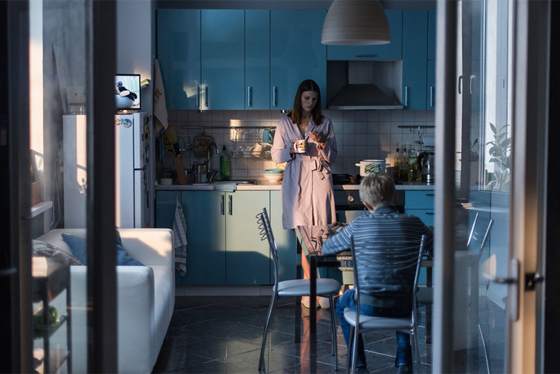 © "Non-stop production" Frame from the movie "Nelyubes"
The conflict of "dislike" is laconic, the film can conditionally be considered the sequel "Elena". Oburjuasias from the inheritance of lumpen from the outskirts of happiness did not find happiness and now they are divided again. Zhenya and Boris, a married couple thirty plus, are bred and forced to sell an apartment in Tushin, a stylized Kricman's camera under the Brueghelevsky “snow hunters”. The acquired good worries heroes much more than offspring. The only child, Alyosha, parents plan to give to the boarding school. Zhenya has a new promising lover, Boris already has a deeply pregnant mistress. Having overheard their exchange of obscene courtesies, the son runs out of the house. The remaining one and a half hours of screen time we are observing the search operation flowing against the background of late -tier ruins and forest -park edema near Moscow. A complete set of attributes familiar to Zvyagintsev is here: a tree of life on which a snake-excellent tape, flooded workshops-curtsy Andrei Arsenievich, as well as a caressing utensils, familiar to us by “exile and revolutions”, is hiding, like a snake-and-white fencing ribbon.
Like another coriff with domestic dramatic art, Konstantin Bogomolov, Zvyagintsev is convinced: the heterogeneous "Russian life" the screen to endure. In the menu “Littlebells”: Russian-European cuisine, land, pizza, hookah, karaoke, children's room. The foreign press compares Zvyagintsev with Bergman and Antonioni, but because they simply did not hear about the Leningrad group - only Sergei Shnurov manages to marry Lutin with autocracy and nationality. Zvyagintsev is alien to all irony, for him the training of Bosco Sport Russia and Dmitry Kiselev (or, wider, television - it is obvious that VGTRK can easily be replaced with Fox News ) - these are full -fledged signs of the apocalypse and the Last Judgment.
By the way, about the court: it is completely incomprehensible why the author subjects his heroes to torment if he decided in advance that cleansing is impossible. “Dislike” is a movie about nonhumans. In fact, all the characters in the film are characters of thrash news from the Internet like: In the city n, the grandmother killed her grandson who stole a pension and fried him in a frying pan, or, conversely, grandmother’s grandson. Zhenya, Boris, office colleagues, police officers, and even volunteers are completely devoid of any human feelings, they live instincts - self -preservation and reproduction. The world of Zvyagintsev is inhabited by mammals. It is curious that many critics note the sex scenes that have been successful in the “dislike” - this is really a rarity for Russian cinema. After all, only mating animals are always natural, on a camera or so. But is it worth it to present to the animals their low -sized essence, soar the moralizer over the abyss? Unreasonable creatures did not know the differences, what claims to them?
The most important thing in “dislike” (and indeed in all the work of Zvyagintsev) is, of course, which has already become a signature reception: generalization. Boris and Zhenya are ideal strangers. It seems that there are so many speaking details - icons, radio watering, selfies, life, but this is all about time, and not about specific people, whose story they seem to tell us. We do not know who they are and where - how do we believe that they go exactly where the director’s desire drag them? “Dislike” is a new abstraction of Zvyagintsev, who interprets the universal, universal, because he simply does not know the private, intimate about his heroes.
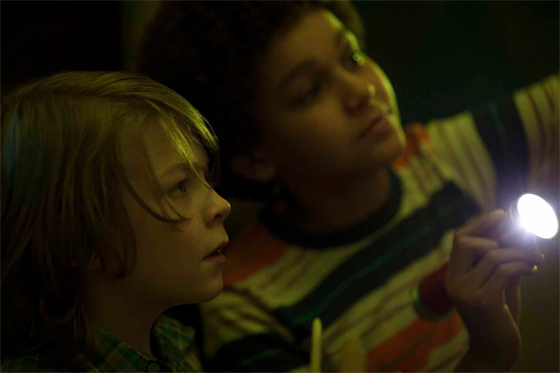 © Metropolitan FilmexPort Frame from the movie "Wondersstruck"
Juvenal problems devoted his new film and Todd Haines. A history of Wondersstruck has different things - for example, the “incredible journey of Mr. Spivet” to the wife - but the main reference of Haines is still from literature: an eternal story about an orphan, a soup and a dickens, and a hector. Heins chose him to interpret the manner of Donna Tartt. Having lost his mother in a car accident, baby Ben goes from Snezhnaya Minnesota to New York in search of his father. The action takes place in the 1970s, a delicious era for a perfectionist stylizer. City scenes are definitely the best that is in Wonderstruck , the exotic texture of the Queens of those years is recreated by Haines with such love scrupulousness that it almost exceeds the authenticity of Serpico or any opus of the Blaxplo ITATION . The rest of the Wondersstruck is an experimental high -budget yoga and the cinema of the very “good smile”, which, alas, has not come off the face of many masters lately.