
Translated material
Akademgorodok.doc
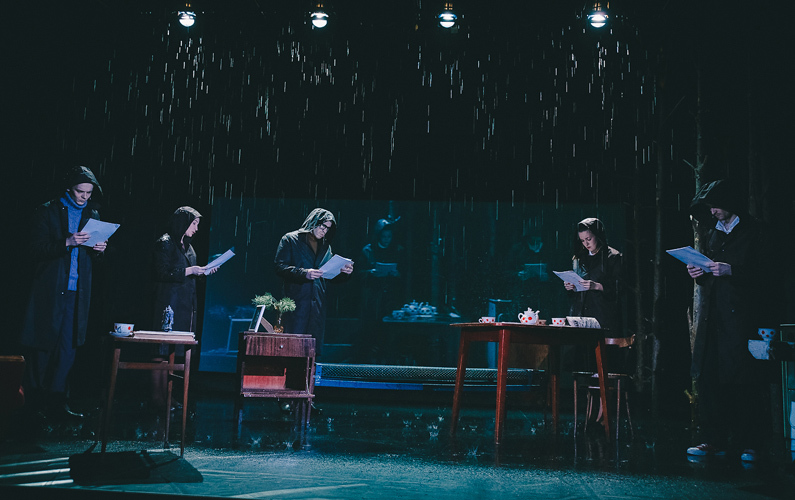
Having released two performances last season in the framework of the project of the “Group of the Yubilee Year” in the Taganka Theater, Semyon Alexandrovsky again returns to the topic of sixties, Soviet social romanticism and his subsequent crisis. This time, the heroes of the new production of the director were not “lyrics”, but “physicists” in the literal sense of the word: in the Novosibirsk Theater “Old House” Aleksandrovsky issued a performance about Akademgorodok - a unique scientific center founded near Novosibirsk in 1957, in the wake of euphoria in the thaw.
“Elementary particles” are the second experience of cooperation by Alexander with the “old house”: two years ago he had already set in Novosibirsk the show-masculum performance “The Golden Mask” shown by the Offer program “The Golden Mask” “The Broken Mask, or where did Andrei go?” . Then the director was occupied not so much by the text of Vyacheslav Durnenkov as the methods of his report: having pushed away from the profession of the protagonist of the play - the Moscow reporter, who comes on a business trip to the village - Aleksandrovsky issued a “cadium” as a journalistic investigation, and history was unfolded in dictaphone notes and their transcripts, in slides and notes on the map. Such a format was chosen from the reluctance to “play rustic” and in particular to bring to the scene of a living local saint: it is easier for the viewer to imagine a charismatic figure himself than to attribute to the actor of quality that he does not possess.
The Academgorodok, which the director calls the “last Soviet utopia”, appears in the “elementary particles” not only by the scientific and educational center, but also the place of unique social experiment on emancipation and the creation of civil society.
The Brushnik has benefited Novosibirsk as the experience of vaccination of the current theater, but such a performance could, in essence, appear both in Moscow, in St. Petersburg, and in any other city. But “elementary particles” are the most perfect SITE-SPECIC : the director invites the residents of Novosibirsk to realize the hometown of events that have become a fact of not only Russian, but also world history.
Soviet science interests Alexandrovsky primarily as a social phenomenon. The Academgorodok, which the director calls the “last Soviet utopia”, appears in the “elementary particles” not only by the scientific and educational center, but also the place of unique social experiment in emancipation and the creation of civil society - a space where unofficial culture and sexual education were legalized, where samizdat and Western music flourished. At the same time, scientists who did not want to live in the “reserve” tried to influence public processes taking place in the country: in 1968 , the “process of four” - the famous business of the four activists of Samizdat Ginzburg, Galanskov, Dobrovolsky and Lashkova - they responded with a “letter of forty -six”, where they demanded a “revision of the case in complete publicity”. The internal courts began in the Akademgorodok, many lost their jobs, professors who signed the letter, forced to publicly repent to their own students, among the scientific community there were those who were ready to attack their colleagues. So the “social experiment” ended ingloriously - social activity has gone, only scientific work remained.
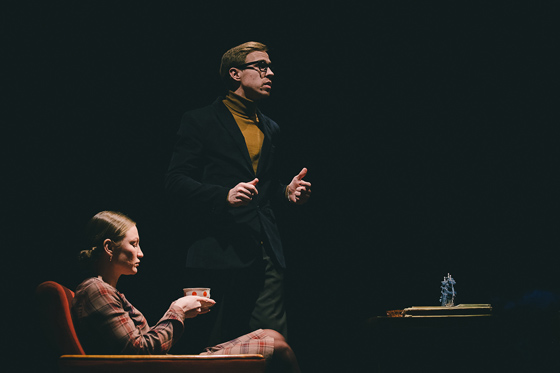 © Frol Podlesny
Composing "elementary particles" a couple with playwright Vyacheslav Durnenkov, Aleksandrovsky interviewed several Novosibirsk professors. When documentary materials became a play, wherever the Akademgorodok’s life was about the “letter of forty -six”, the past time was replaced by the future - to emphasize the utopian, design nature of the Soviet science of the sixties. In the first, most voluminous, part of the performance, nameless heroes, conventionally generalized scientists, are still planning to create an academic city: built on the principle of “question-answer” (“how do we explain this power?-but this is how”), their discussion resembles Plato’s dialogs, where a dramatic form is needed only for the convenience of perception. Young actors of the “old house” have to move away from the text of the text to relatively neutral “voicing” - and so far they are far from always possible.
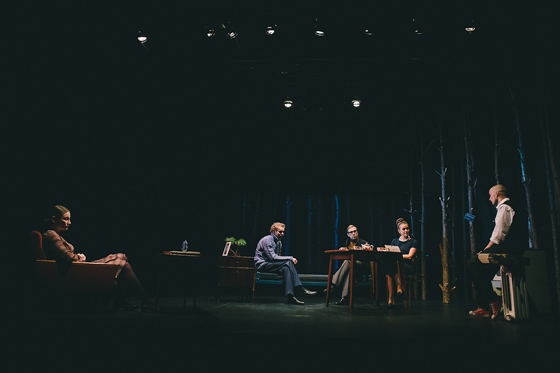 © Frol Podlesny
The visual component of the performance dominates the plot of the rivalry of the mind with nature: the scenography of Lesha Lobanov remembers the harsh climate of Siberia, in which the utopia of the Akademgorodok was carried out, and the famous experiment on the mate of the fox and the search for the “Gene of Friendliness” among manual descendants of the wild animal - as you know, it was in Novosibirsk that Soviet genetics were revived, which under Stalin was revived under Stalin. Stamped like a pseudoscience. From the artist’s point of view, the first, optimistic, half of the performance looks like a story about the development of nature, about a person’s appropriation of wild terrain. Part of his decoration-several dry trees in the right square-Lobanov photographed from the other edge of the stage, and then gave this black and white picture a background: in dark photography, even two rows of young, thin trees become similar to an impenetrable taiga. As the action develops in the picture, the same furniture appears as on the stage: first - the only lonely chair, then - tables, chests of drawers, armchairs. Finally, the actors “fit into” the picture: at some point the image comes to life, the video broadcast starts in real time-the camera that the photos are taken, all this time is on the stage and just at the right time goes into the shooting mode.
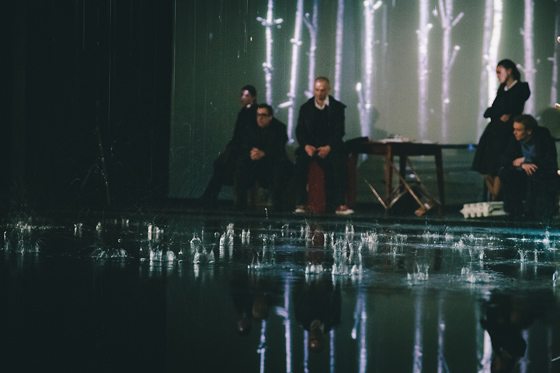 © Frol Podlesny
When it comes to “a letter of forty -six” and the crash of utopia, the artist and director respond to a metaphor that puts an equal sign between the forces of nature and the repressive state, the rain is collapsed onto the scene: the actors read the documents from the sheet, standing in cloaks under the streams of water, and then go beyond the veil of water spray in the depths of the scene, telling from the discoveries about the discoveries about the discoveries. glorifying Akademgorodok, but in fact about the internal emigration of Soviet scientists. In the epilogue of the performance, the teenager’s voice sounding in the record convinces a friend that one day people will find such tremendous energy that, changing the tilt of the earth's axis, control the climate and stop the rain: “The main thing is that the task is set. I imagine my way - I do not want rain all the time to pour. " Of course, Aleksandrovsky and Durnenkov are talking here not only about physical, but primarily about the social climate. The heroes of “elementary particles” are going to change society and nature, however, both utopias end with disappointment: the first with the decline in the euphoria of the 1960s, the second is apparently with the threat of a world environmental disaster, which put the cross on the plans of the perestroika of the planet for their needs.