
Translated material
And who is Pushkin?
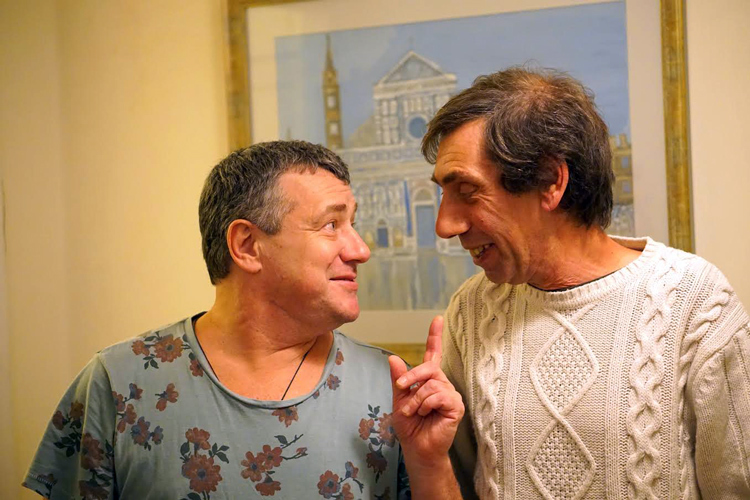
Leonid Fedorov and Igor Krutogolov recorded 14 songs on Pushkin’s poems and called this business “The anthem of the plague”.
This news is postmodernist at least according to the criterion of the number: after all, they had the same number of songs according to Harms. But we firmly know after Harms that Pushkin stumbles on Gogol, and then, on the contrary, Gogol about Pushkin. Kirill Serebrennikov and Alexei Agranovich wanted, so that in their play “Little Tragedies” the song “The anthem of the plague” sounded - and he wrote it instantly in half an hour. For 200 years, people from the people and court composers write romances on Pushkin, but so that a whole disk for verses of “our all” is the first time. The poetic circle of interests of the LF is very bizarre, if you leave aside the poetry Dmitry Ozersky, the author of almost all the songs of the Auctsyon. Having made the cycles of songs to the verses of Khlebnikov, Vvedensky, Khvostenko, Analiani , Volokhonsky, Old Testament and Harms, Leonid Fedorov looked at Pushkin for simple, without frills. However, what does it mean “without frills”? There are enough frills on the hourly disk, and they are three types. The first (and the most interesting) - two songs made by the LF in almost one voice, including the accompaniment: “insomnia” and the final “Chizhik”. The second is the thick recognizable riffs and the cold counterattacent of Igor Krutogolov. And the third is what LF calls “I wanted to sing Pushkin”: recognizable guitar chords and a rather ironic voice. Yes, and a strange, magical instrument of a glucophone, a quite congruent Lyra Pushkin, appeared.
At home at the Fedorovs at the audition and discussion of music and Pushkin was the poet and anthropologist Sergei Solovyov , who once gathered artists, writers, philosophers and musicians at “speech landscapes” (2005-2006, clubs “House” and “Bilingva”). We decided to practice before the meeting of LF friends in Tel Aviv and check how the discussions will look when the Internet is closed and put on the chip for the tracking of thought-offers. Pushkin, on the other hand, is our everything, a gold staircase without a railing and a chocolate scrap, only it is safe to talk about it in every kitchen. By the way, immediately after this conversation there was an absurd “Pushkin-Dront”-and “Sheremetyevo” is now the name of Pushkin, and our everything is now called “Our SVO ”. Moreover: on the show "Aifak" Bogomolov - Pelvin in the Tower "Mercury" the bar "Onegin" worked. Yes, and why not call all the metro stations “Pushkinsky” - 1, 2, 3, 4, 5 ... Then the numerical apocalyptic numbering of the metro lines would not have tormented passengers. However, we are talking ahead of Pushkin-mathematics. It is not interesting to evaluate on the scale “wretched/brilliant”, every listener will do it. But, of course, we dive, like a kite. If you briefly summarize our fibilities for the LF with Sergey Solovyov, then two opposite things were expressed. The SS noticed that with Vvedensky and Harms there was an accurate hit: there were an acute Oberiutian relevance and personal tone of the LF. But our sun is not taking a gaze, trained by the Oberiuts. DL noticed that it would be nice to go further than the Oberiut gloomy sarcasm and blow up the meanings and rhythms of Pushkin with completely after the afterlife, applying, for example, a specially made by the Opera-Blant's Voice of Rubashkin.
"Flower"
Leonid Fedorov: I came up with such a thing that 20 friends will gather in Israel. We put the camera and remove how they discuss it in one familiar apartment with a large terrace, with a good view of Tel Aviv. And post the video with the album.
Dmitry Lisin: How did you look for poems? Where did the four -line song “Chizhik” at number 14 came from - did the last volume of Pushkin took from the shelf?
Fedorov: No, of course, just stupidly leafed through poems on the Internet, he is all there. And “Chizhik” is really the last verse. I looked at the fact that I can sing. He took it to the folder, threw it to Igor, and he took his own. It so happened that I did not come up with anything in advance, as it was with Vvedensky and Harms, but sang right into the text. I wanted to take “I loved you” and “monument”, but I realized that I was in a certain rut. It is impossible to go around the romance, spoil Tchaikovsky, so they did not do it. So other verses fell out, and I wrote five songs at once. And Igor made a “flower”, “prophet”, “gift” and “echo”, the rest are jointly. You see, Pushkin was recorded also because I escaped from the premiere of “little tragedies” in the Gogol Center. At the level of tone for actors, except for Lesha Agranovich, it turned out to be water flowing past the meaning. I believe that “little tragedies”, and especially the “feast during the plague,” is the strongest thing with Pushkin.
What was important for Pushkin was garbage for us.
Lisin: And lightness is incredible in sounds, air instead of water.
Fedorov: Yes, I remember how in childhood I liked to teach, everything was remembered itself. But in 16-17, who needed this “Eugene Onegin”, an encyclopedia of Russian life? A set of stamps - and that’s it. What are the duels and Tatyana honest rules? This is so far from what we live.
Lisin: I remember, being a pioneer, I was very interested in Seraphim in the Prophet, I began to flip through the encyclopedia. Why six wings? Insectoid, or what? Balda was struck by clicking power, I thought for a long time about the barrel - how much air was enough. And "Ruslan and Lyudmila"? There the pictures could be examined for a month.
Fedorov: Yes, yes, yes.
Sergey Soloviev: We always think about how to bring art to the territory of life, so we recall the oddities of the school and Pushkin. And the devil with two about Pushkin will say something shallow.
Lisin: Guys, improvise, you are in the Channel One studio. Question: What is Pushkin for you?
Fedorov: We go to the Don Monastery, and there is the grave of Chaadaev. He left for good, traveled all over Europe, but returned after Pushkin’s death. And he never wrote anything again, did not mention his English.
Discussions in Tel Aviv, fragment 1
Soloviev: But he, the educated and witty, was at first omitted to be healthy.
Fedorov: But this is not the point, he was also released to England. And what did he see that he returned there? He was the most free of all aristocrats, he would like to say something-he would say. But he did not speak. I walked through all the salons, was accepted everywhere, sparkled and joked, but did not talk about the reasons for the return.
Soloviev: As he said, it is interesting if the reputation has long been completely spoiled.
Fedorov: Pasha Litvinov and I (Auktsyon percussionist in 1985-2005. - Ed. ) We loved the deceased to talk about Radishchev, who was the first to be crazy. Several thousand nobles are one company, everyone knew each other and knew very well what Russian riot was. Everyone was discussing each other, but did not forgive the publication of Radishchev, they said: you are ours, you yourself are opposed to yourself. The same story with Chaadaev.
Soloviev: Disrupted corporate ethics.
The archive of Pushkin consisted of 30 encrypted scrolls placed in a leather folder, and was called a “golden chain”.
Fedorov: I think Chaadaev understood something important in Europe: after all, he did not need to return, he was a man, he could live anywhere and as much as he wanted. I am to me that my daughter (31 years old) wrote to me - all friends rushed to make Israeli citizenship. Now you do not need to wait a year, have the closest relatives there. Enough of the seventh water in jelly is enough. Or it can be announced that the third great -grandmother was a Jew. This is ridiculous, because in the 70s they changed their surnames so as not to be Jews, and now the northern nibelungs declare themselves Jews with whole families. During the scoop, three percent left, and now there are already six.
Soloviev: But even then it was an outcome.
Lisin: Do you think Pushkin wanted to leave?
Fedorov: A friend of Chaadaev would not want to leave yet.
Discussions in Tel Aviv, fragment 2
Soloviev: It's not about Chaadaev; He languished, could not be a nightingale in a golden cage. Yes, he was brought up by Europe for two -thirds, read all Byron, Shelley, Voltaire. Why is he perceived with such difficulty in the West? Because they see the secondaryness of poetics and all Pushkin topics. Tolstoy, Dostoevsky - yes, and Pushkin - who is this? Joyce considered the Hero of our time Lermontov one of the best books in the world, and who Pushkin who? For us, the atmosphere of his language is extremely important, and for contemporaries Pushkin was a shock after Sumarokov. Pushkin made his tongue light, bright, simple, folk.
Lisin: Still: I spoke a thousand noble families exclusively in French, and Pushkin encrypted in Old French. I have to notify you, the gentlemen are good, about Pushkin’s secret: you have to understand why he is a universal genius and our everything. In the early 90s, at the Intellekon seminar in the MAS, where strange paracacle Kunshtuki were studied, a descendant of the guardians of the secret archive of Pushkin in Taganrog appeared. The Kuteinikov clan held the archive secret until January 27, 1979, because Pushkin appointed this date. Of course, Pushkin’s home museum was not officially recognized and closed after the death of the last caretaker. According to the legend of the Guardians, Pushkin made a big hook and drove to Novocherkassk in 1829, on the way to the Caucasus to transfer the archive of Kuteikov, the chieftain of the Donskoy army. On the way back, he also drove and received five thousand rubles from Kuteinikov in gold. The archive consisted of 30 encrypted scrolls placed in a leather folder, and was called a “golden chain”. It contained the art of predicting the future, developed by Pushkin, who, according to the Guardians, operated on a certain wave logic. Despite Pushkin’s ban, the information translated from the old French from the archive became known to everyone who wanted the one. Dostoevsky knew about the archive, Lobachevsky studied, like Khlebnikov, who allegedly took several formulas and the number 317 in his treatise “Boards of Fate”. And Tatyana Larina is a secret casket. How do you like such Pushkin Studies?
Fedorov: Such a story would definitely liked Henri Volokhonsky. When he saw him two weeks before his death, he hardly spoke. And I came to him from London, where Ilya Khrzhanovsky “Dau” made a track for the film, which Henri did not know about. The song was “Gori, Gori, my star”, and I thought it was a romance of the XIX century. Tears strangled me when I leaned to say goodbye to him. He said: “Do you see a shelf with books over me? Take anyone. " And suddenly he says: "Do you know who wrote" Gori, Gori, my star "?" I say: “No,” and he: “I am sure that Kolchak.” These were his last words to me, and I went awesome.
Discussions in Tel Aviv, fragment 3
Soloviev: Do you know what the last words of Pushkin were? He also pointed to a book rack, upstairs, and said: "There, there." I think he wrote a “Chizhik” as an appeal to his own soul.
Lisin: And as you think, Pushkin was a master, a refined aristocrat or a sort of stalker, a man of the future, a person without properties? Or maybe he hid in himself an ancient, violent, wild man?
Fedorov: When he came to Mikhailovskoye, he went to the fair in a red shirt, with a sieve and handed out something. Well, the master, of course, loved to feel.
Soloviev: Rather, an aristocrat and a Western. When he was locked, he suffered painfully, despite the surrounding beautiful nature. And in St. Petersburg, he happily described nature.
Fedorov: And you remember your 37 years, what you did and how. And he is already a sage. I am generally silent about Lermontov. According to our concepts, he, for example, is a rare bastard, but pulling things inaccessible to Pushkin. That is, other criteria for them are applicable, we still have to live and live to the level of their age.
Do you know what the last words of Pushkin were?
Lisin: And in general, the Decembrists are a superhuman project of refined aristocrats who went to Senate Square without fear and trying to change the course of history. And after a hundred years, their impulse degenerated into Bolshevism.
Fedorov: We are saying this now: here he hung people, Nikolashka. And it was the elite of the empire, the nearest circle and the support of the tsarist power. And there was no fear, even more so in Pushkin. Bulgarin why did he write about Pushkin that he was a great man, and died like a hare? The fact that for Bulgar was garbage was the most important for Pushkin. Alexander Etkind, with whom we made friends, explains in the awesome book “Internal Colonization”, why the path of the country, which goes in a circle from Ivan the Terrible to the present day, is so inevitable. The fact that for Pushkin was important, for us - garbage, because we cannot just say: "I loved you." What was the air, the sun and the syllable of Pushkin, also disappeared to us. Our current language makes a cord. The task of becoming Pushkin in songs is meaningless, it is impossible to be air, but you can be directly in the text, that is, sing.
Sergey Solovyov, Leonid Fedorov and Glucon
Soloviev: Pushkin - the air of Russian literature, which has become the air of our speech. And in this sense - the cosmogonic phenomenon: there were fire, earth, water, and now air arose, the atmosphere. We breathe Pushkin, hear them, see through him, think, love, draw closer and part - to them, through him, and he himself is varying and unreasonable. Therefore, it is so difficult to talk about him. Here is about the creation of the world in the "Upanishads" it is said: breathing, spilled in the body, is a speech; Therefore, we pronounce it without breathing or exhaling. So Pushkin we also pronounce our life - without breathing or exhaling, because he is the breath itself, spilled in the body.
Lisin: Here, specially wrote out what you say to it? “Gogol falls from behind the scenes on the stage and lies quietly. Pushkin comes out, stumbles on Gogol and falls: “Here is the fuck! In any way about Gogol!” Gogol (rising) : "What is the abomination! They will not let them relax." He goes, stumbles on Pushkin and falls: “No way, he stumbled about Pushkin!” ”
Soloviev: This alternating stumbling at Harms about Pushkin and Gogol can be read through the principle of complementarity - about the wave and particle in the description of the world. So the lights of the beginning of Russian literature - a dual -pound in its unity. And so we are “falling”. But the fall is not at all what you think, saying a “fall”, as Harms wrote in the treatise “Zero” about the stroboscopic fall of the barrel.
Download Album "Plague Plague" whole (1 GB)
Subscribe to the COLTA.RU channel in Yandex.Zen to miss nothing