
Translated material
How to become a periphery
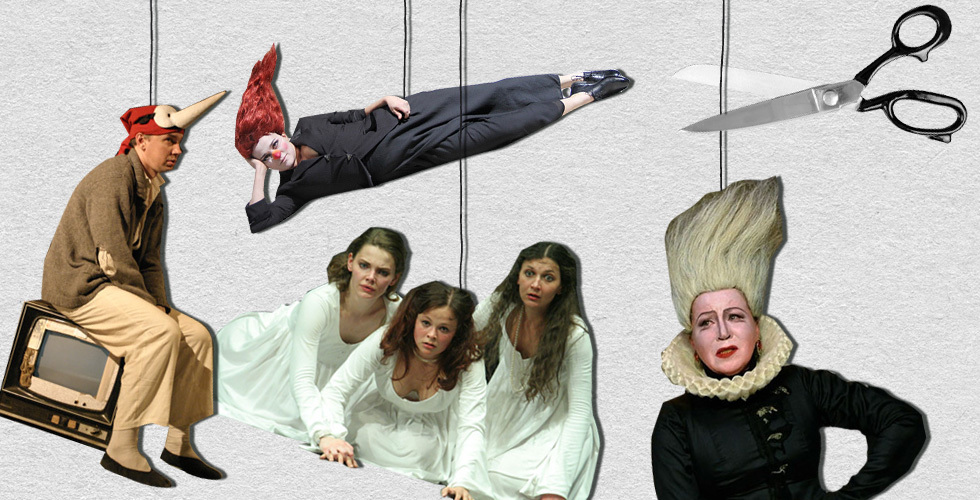
Tatarled in the bowels of the Ministry of Culture and recently published in the newspaper Izvestia, the Fundamentals of State Policy in the Field of Culture, shocked the foundations without exaggeration. Having learned that “Russia is not Europe” and for this reason it is necessary to “abandon the principles of multiculturalism and tolerance”, the most peacefully configured representatives of Russian culture began to wall, to murmur and write - mainly, however, on Facebook, letters of protest.
But then the adviser to the President of Russia Vladimir Tolstoy came and reassured everyone.
He said that the text published in Izvestia is only one of the many proposals entering the presidential administration in connection with the work on the “Fundamentals” project, and not everything in this text causes delight among the administration. Of course, Russia “must maintain its unique state-civation state,” but the main thesis of the Ministry of Culture-“Russia-not Europe”-will not be included in the final document, and assured everyone Tolstoy.
Here, some cultural figures took a breath and began to look into the future with timid optimism.
All this reminded me of a joke, which I would allow myself to tell exclusively within the framework of the “rejection of the principles of multiculturalism” proclaimed by the Ministry of Culture.
The white -skinned non -altitude Russian woman tells her no less white -skinned non -altitude husband:
“You know, dear, I always dream of the same strange dream - as if we should have a black man with two heads.”
This lasts all nine months of pregnancy. In the end, the wife is taken to the hospital.
The husband calls to find out how his noble is doing.
Nurse (also, as usual in Russia, is unspoken):
- Congratulations! You had a boy. True, I must immediately tell you that he ... Negro.
Husband (in horror):
- What, with two heads ??
Nurse:
- No, that you are with one, of course!
Husband (beside himself with joy):
- Well, thank God!
Now I will try to explain why, in our particular case, two heads of the newborn are bad, but one is even worse.
The text “Fundamentals”, born in the bowels of the ministry, is a tough version of the conservative revolution, in essence, does not leave stone from Russian art on stone.
In the one, so to say, the paradigm, which is proposed by the Ministry of Culture, no one will fit. Neither Lev Dodin with MDT, nor Andrei Mighty with the BDT, nor Valery Fokin with Alexandrinka, nor Oleg Tabakov with the Art Theater. Look a little more closely, and you will see that all of them do not correspond to the “spiritual and cultural matrix” of our people, everyone is one way or another integrated into the European theater process, everyone has a stigma in a cannon. If you strictly follow the laws of the Ministry of Culture, which is set by himself, of several hundred theaters available in both capitals, it will be possible to leave a small member of them on subsidies. Doronina and the Russian Spiritual theater "Glass". Together with the Shilov Gallery and the watercolor school, Sergey Andriyaki, they will compose our “civilizational and cultural core”. The rest will have to be extended!
By the way, you will also have to deal with the history of culture. From it, as something completely alien “matrix”, it is necessary to throw out not only the avant-garde of the 20s, not only futurism, imazhinism, symbolism and other decadence, but at the same time a huge part of Russian classics. As you think, how many outstanding writers-from Sumarokov to Zhukovsky-rewritten, remade and turned western tragedies and ballads in their own way, and sometimes not the most outstanding, so it turned up from the soul, by golly!
In general, "Drown everything!" - As the Pushkin Faust Pushkinsky Mephistopheles said correctly.
But it is precisely this tough version of the conservative revolution that gives not a ghostly, but a real possibility of consolidating cultural forces. Here, all any sane people should be shouting to the Ministry of Culture, stand up with a wall, declare a universal strike and, probably, make the authorities change their minds. Well, to whom the hunt is to conduct their cultural leisure, wandering between the Andriyaki Gallery and the Russian Spiritual Theater "Glass".
What Vladimir Tolstoy is talking about and what the representatives of the Ministry of Culture themselves, clearly frightened by their own pampleous formulations, suggests a different, softer, version of the revolution. Of course, it is also conservative: the idea of modernizing society is curled up in all directions. Operations on the "healing" of art will be not total, but local in nature. Here we cut out the mat, here we will find alien trends in the performance of the director X and advise the artistic director Y no again to the production of it, we will not give this alien film a rental certificate, we will smash the financing of the foreign theater. We will take advantage of the Council in the bud - and there is a lot, in truth, we have that Council. All this most likely will not meet a friendly rebuff from the venerable cultural figures, hoping that the formidable sovereign eye would look at their activities through his fingers. All the horror, however, is that not for specific people, but for art as a whole, the final result of the soft version of the conservative revolution will be completely the same as the hard: monstrous and irreversible provincialization.
Russian art is now an important component of European art. The softest and most delicate version of the conservative revolution gives him a chance to turn from a unit into no one interesting cultural periphery.
Russia is really in many respects - domestic, religious, etc. - not Europe. Then the minists of the Ministry of Culture did not hit the sky with a finger. But Russian art, whatever one may say, is still European art, and neither the president, nor the minister, nor the intelligent descendant of the great Russian writer can cancel this immutable fact. In connection with the Russian economy or politics, we can still talk about the Chinese model, the Singapore model, some special path. To put it mildly, these thoughts are not close to me, but they have the right to exist. In connection with Russian art, such reasoning is completely meaningless. It is not about national color or originality: they have both Italy and Sweden, and French romanticism was as unlike German as German unlike English. It's just about the matrix, about genealogy, about the fundamental principles and vector of development. For centuries, Russian art has been moving and continues to move in a pan -European fairway. This is our most important cultural tradition.
So, the current state of European art is such that it existed within the framework of censorship (and the “foundations of state policy in the field of culture” is the complex euphemism of the word “censorship” - though not so much political as aesthetic), it simply cannot. In the middle of the XIX century and even at the beginning of the XX, it could still, and not only exist, but even bear fruit. And now not. His landscape, his components, itself, the very way of his existence has changed. Any attempt to outline the art in the 21st century, to enter it on some shores and say: you can go here, but it’s no longer here-this is an absolute misunderstanding of how and for what it now exists. For its main task is the endless problematization of these very boundaries, the endless stay on some frontier, in a dangerous border zone.
The world develops and is changing at an inconceivable speed. He solves the problems that have arisen, rises to a new civilizational step and immediately encounters new problems, even more complex. And in this variable world, art also has to be changeable. He must always comply with the new challenges of time. Do not follow any already well-known code, but endlessly look for a new code. Do not learn the usual territories, but invade new, previously protected. This applies not only to the notorious Council, this applies to contemporary artists in general - from Katie Mitchell to Andrei Mogeliy , from Stefan Kagi to the Ahe group, from Ivan Vyrypaev to Dmitry Volkostroelov .
As soon as the boundaries are outlined by Russian art - it does not matter, more or less wide - it will cease to be part of modern European art; As soon as it ceases to be part of modern European art, it will cease to be itself. What it will become and what it can become in these conditions at all is an important question.
Starting from the Petrovsky reforms, there was only one period when we turned out to be as fenced off from the Western world - this is a Stalin restoration project. I'm trying to remember what such a specifically Russian arose in our art at that time. What is included in the world cultural treasury? Shostakovich? Prokofiev? Not immediately destroyed chamber theater? Art Theater turned into the Moscow Art Theater of the USSR? Everything noticeable, outstanding, brilliant continued contrary to isolationism and a conservative trend to exist in a pan -European fairway. What fell out of this fairway and moved to the hitch, the world and we ourselves have long forgotten. But the consequences of this first conservative revolution into culture, which turned it into a closed system and forced to cook in their own juice, are still acking to us.
The consequences of the second revolution, even in the softest version, can be much worse. The provincialization of Russia in the field of culture will go on a pace directly proportional to the speed with which the world is now changing. And any conservative idea (I repeat - any!) Will enter into an insoluble contradiction with the tasks that contemporary art solves. How can the boundaries be outlined that it is called to expand, change and problematize them all the time? Where to find vital carriers of a conservative idea-they are not visible around.
The driving force of conservative uprisings in the hot spots of our theater-from Taganka to Gogol Center-are not charismatic artists, directors or playwrights, but dull losers with soviet thinking that have lost in the crowd: it is amazing how many members of the Communist Party are amazed among them. These are people who have surnames, but no names. They will not be able to create any kind of Russian culture. The only thing they can is to scribble endless complaints to higher authorities.
Russian art (and definitely the Russian theater - I can say about this responsibly) is now an important component of European art. The softest and most delicate version of the conservative revolution gives him a chance to turn from a unit into no one interesting cultural periphery. Moreover, which is characteristic, the periphery of the Western world. What else?
Why be a part of a bad part, but the periphery is good, I do not know. And, I'm afraid, no project of “Fundamentals” will explain this to me.