
Translated material
The Second Coming of Steve Jobs
Which Silicon Valley entrepreneur should have become like the eccentric and successful head of Apple?
After Steve Jobs passed away in October 2011, many wondered who would take his place. Not in terms of the corporate ladder - the post of head of Apple passed to his successor Tim Cook even before Jobs' death - but in a spiritual sense.
Business Insider 's Nicholas Carlson recalled Jack Dorsey, the co-founder of Twitter and head of Square, who not only became one of the most prominent startup leaders in Silicon Valley, but was also seen as a direct copy of Jobs' personality. TJ publishes a translation of an article by Carlson, who wondered who Dorsey really became.

“His ideas are the ideas of the future”
In 2011, representatives of the IT industry openly talked about the fact that Jack Dorsey, co-founder of Twitter and Square, would definitely become the next Steve Jobs.
Steven Levy, a respected IT journalist, wrote in an article for Wired : “When people speculate about who might fill the vacuum left by Jobs' death, Dorsey's name comes to mind first. Talented geeks who once dreamed of working with Jobs now yearn to be with Dorsey."
One day, one of the authors of the GigaOm blog, Matthew Ingram, saw Dorsey speak at a conference. The next day, he published a post describing Dorsey as "a strong enough opponent to cast aspersions on the founder and CEO of Apple."
Ingram asked: “Can Dorsey change the way we interact with the world and technology as dramatically as Jobs did?”
 Photo by Robert Stribley
Among those who predicted Dorsey's leadership in Silicon Valley, the most convincing voice was Randy Wigginton.
When Wigginton was 14, he would wake up in the middle of the night (no later than half past three) and work on software for the computer he was building with fellow Apple founders Steve Wozniak and Steve Jobs. Together with the latter, he left the company in 1985.
He later got a job at Google. Until 2011, he worked on Jack Dorsey's new startup, the mobile payment system Square.
That same year, after the death of Steve Jobs, Newsweek reporter Daniel Lyons invited Wiggiton to talk about his former boss. Toward the end of the interview, Lyons asked about his new boss: “You're currently working on Square, created by Jack Dorsey. It's no secret that many people talk about his similarity to Jobs. What do you think?
Wiggiton replied : “I completely agree. His ideas are things of the future. And I truly believe he will be the next Jobs."
Why Dorsey?
There are several reasons why Jobs and Dorsey were so often compared at the time.
Firstly, journalists liked this image. Jobs was not only the best CEO in the history of Silicon Valley, but also its main favorite. By turns he was both an inspiration and a mediocrity, a threat to competitors and a charismatic. We didn't want him to leave. And we hoped that Silicon Valley would find a new rising star.
Secondly, even the life paths of Dorsey and Jobs were similar. They both dropped out of college and both co-founded startups that changed the world. Remarkably, they were both fired from their companies, and then - years later - they both returned safely.
Thirdly, Dorsey himself seemed to be trying to subtly emphasize this similarity.
Dorsey lived through Jobs' life milestones, wore Jobs glasses and even spoke in Jobs quotes
In the summer of 2012, a blog appeared on Tumblr called “The Spirit of Jobs.” It is unknown who its author is, although there were rumors that it was an Apple employee. There has only been one blog post ever published under the title: “What I think of Jack Dorsey,” allegedly written by Jobs himself.
The post begins with the words: “I’m not worried about your success. What worries me more is that you have almost completely ripped off my entire personality. I'm not talking about little things, I'm talking about big things - you're not just trying to be the next Jobs, you're literally trying to be me."
The author of the post then methodically lists all the traits that Dorsey used to emulate Jobs.
This is a comparison of two photographs - Jobs in his iconic glasses with round rimless lenses, and Dorsey - in a similar model. This compares two quotes about being fired - Jobs' quote from a 1987 Playboy interview: "It's like I got punched in the gut," and Dorsey's quote from a Vanity Fair interview about being fired from Twitter: "It's like I got punched in the gut." This is a comparison of two video presentations, where they characterize the products of their companies with the same phrase: “No one has ever done this before.”

And so on throughout the text there are examples of how Dorsey constantly quotes Jobs without, as they say, referring to the original source.
“Do you understand what I'm getting at? Stop trying to be me. Stop trying to be “the next Jobs.” Better be the first Jack Dorsey. Remember that your time is limited - don’t waste it living my life,” the author concludes the post.
Two years after the publication of this note, a funny thing happened: representatives of the IT industry completely stopped comparing Jobs and Dorsey.
Why did this happen? And who did he become instead? Let's try to figure it out.
Terrible rookie CEOs
The main thing that people forget when they remember Jobs's dismissal in 1985 is that the board of directors made absolutely the right decision.
At that time, Jobs was simply unbearable to work with: he was irritable and rude. He had great ideas, but he couldn't implement them on time or he was over budget. In this respect, Dorsey is absolutely similar to Jobs: his first experience as CEO turned out to be pretty lousy. But unlike Jobs, Dorsey became a bad CEO at Twitter for other reasons. Where the first turned out to be unrestrained, the second was simply inappropriate.
The first few chapters of Hatching Twitter, written by New York Times columnist Nick Bilton, sound like an indictment of the managerial abilities of a young Jack Dorsey.
There is a story about how, shortly before Dorsey was fired, a top Twitter executive met with one of the company's board members: "We have a little problem here," he said. Greg - that was the name of the specialist - discovered that Twitter basically had no backups: “If something happens to the database right now, we will lose everything.” By “everything,” Greg meant every tweet, every user for the entire existence of the platform, including the source code.
Horrified by the possible consequences, members of the company's board of directors met with other Twitter specialists and asked how Dorsey could have made such a ridiculous mistake?
They were told: “Development and implementation are lame on both legs. Jack is a great guy, a great friend, a cool boss. But when it comes to the basics of management, he is a mess in his head. He's like a gardener who became president."
Although anyone would have had a hard time as CEO in the early days of Twitter. There were several obvious rebels on the company's staff.
At some point, the company introduced weekly “vertical” meetings: all discussions took place while standing. These anarchists did not like the idea, and they boycotted meetings while sitting down, and when managers asked them to join the whole team, the rebels did not mince words. One evening it was decided to hold the meeting sitting down, so these rebels, on the contrary, stood until the very end.
Dorsey was never able to cope with his inner chaos. Partly because he did not pay enough attention to corporate affairs. As Bilton writes, as soon as the clock struck 6 pm, Dorsey rushed like a bullet to one of his sections - sometimes to yoga, sometimes to drawing, sometimes to fashion design courses. Part of the reason Dorsey couldn't control the anarchists was because he was an anarchist himself. He even had a matching tattoo on his forearm.
To put it bluntly, young Jack Dorsey was never really the true CEO of Twitter. No, according to the papers, of course, he was, but at that time most of the powers that usually belong to the CEO of a startup were in the hands of another Twitter co-founder, Evan Williams.
Early on, Twitter was just a project within the walls of a company that was directly owned by Williams. When the project became stronger and was ready to set sail, Williams invited Dorsey to become its head. The shares were distributed as follows: Williams - 70 percent, Dorsey - 20 percent.
Throughout Dorsey's tenure, his partner Williams did what a CEO typically does for Twitter. He also regulated the collection of funds, and also made decisions on personnel issues.
Dorsey, making $70,000 a year, was more of a product manager than a CEO. Most often, no more than a dozen subordinates were under his leadership.
 Evan Williams, Biz Stone and Jack Dorsey. Photo Twitter
Once at a party, Dorsey organized a Twitter presentation stand, but for him the fun ended quite quickly: after a dozen shots of Red Bull with vodka, he ended up in the hospital.
Finally, thanks to a couple of similar failures, the backup story, and especially the company's continued decline in stock, Williams decided to become Twitter's CEO himself.
After winning investor support, Williams fired Dorsey and named him "emeritus" chairman. According to Bilton, this title allowed Dorsey to act in public as if he were still part of the company, but in reality they tried to keep him away.
A lesson he never learned
Dorsey was fired at the end of 2008.
In May 2009, he tweeted: “Getting ready to launch something new and completely unusual. I'm looking forward to it!" This “something new” gradually evolved into the Square mobile payment system.
 Square card reader. Shardayyy Photos
According to the official version, Square was created specifically for Dorsey's friend Jim McKelvey, who worked as a glass blower. One day he wanted to sell an item worth about $2,000, but because he didn’t have a card reader and the buyer didn’t have cash, the deal fell through. McKelvey complained to Dorsey, who launched a startup that would allow small store owners to accept bank cards for payment using smartphones.
Surely the conversation with McKelvey, co-founder of Square, really took place. However, as often happens with startups, the true story of the emergence of the payment system sounds much more prosaic than the official version. It was told by one of the employees who started with Dorsey and McKelvey.
Dorsey had an epic project in mind. He was going to disrupt the financial industry and literally reinvent the way goods were bought and sold. “After Twitter, Jack was looking forward to creating something special,” admits a Square employee.
Dorsey began hiring people and developing his own applications. One of the first was a project called Log - “a private space for keeping diaries and notes.” To bring it to life, Dorsey hired IT specialist Tristan O'Tierney, but then for some reason the project stalled. After about 9 months, Dorsey settled on the idea of a payment system, calling it Squirrel. It was she who became the prototype of Square.
“The premise of the startup was simple: the way payments are processed today sucks. The modern financial industry sucks, too,” says an early Square employee. “It’s not good for business, it’s not good for people who want to buy and invest and save.”
Dorsey felt that no one in the financial industry was "designing the product to address user needs, and that's a real tragedy because making a payment is actually quite a personal thing, especially when it comes to the small business sector, which is less than entirely dependent on them."
However, Square was intended not only as a solution to small business problems, but also as a product for consumers.
“The main goal of the project is to make it easier for the world to pay for things using a device that fits in your pocket,” says another employee who worked in the early stages of Square's system.
For Square to operate, it was necessary to control both sides of the network, a company employee admits. The plan was simple: “We need to reduce the number of intermediaries.”
Square's first product, a credit card reader that plugs into the iPhone's headphone jack, was supposed to be the fulcrum with which Dorsey and his team could revolutionize the world of payments.
 Malybelen Photos
When creating the company, Dorsey did everything to avoid repeating the mistakes when launching Twitter. According to former Square employees, the changes affected several things.
Unlike his previous place of work, here Dorsey stayed up late. He carefully selected venture capital investors who would not undermine his power, as Twitter's management once did. And unlike Twitter, here he began actively hiring new employees, which within a few months became much more than he had ever had.
He decided that Square (unlike Twitter) would be more selective in entering into partnership agreements with third parties. According to Dorsey, Twitter's very structure did not allow the company to respond to problems in a timely manner. So he consistently reorganized Square every 8-10 months.
Dorsey put an end to any anarchy, or any appearance of it, in a new startup. According to him, the company should be managed from top to bottom: before promotion, each top manager must first demonstrate his achievements.
Before the first Square device was released, and at a time when the company had only 20 employees, Dorsey was looking for someone to help him shape just such a company management organization. It was Keith Rabois, a Silicon Valley veteran who started with PayPal and was at the time leading an important project at LinkedIn.
Rabois told Dorsey about the micromanagement techniques that famed NFL coach Bill Walsh used with the San Francisco 49ers to transform his players from underdogs to regular Super Bowl winners. When Walsh became a coach, the first thing he did was teach all the team secretaries how to answer the phone correctly. That is, in other words, every role in the company has a “standard of performance,” and if everyone understands what is required of them and tries to do everything right, then the result on the field will not be long in coming.
Dorsey then immediately hired Rabois.
As the company grew, the responsibilities of any top manager included a weekly report to Dorsey on achievements and implementation of set goals.
Dorsey often compared his controlling management style to running a restaurant. In a gourmet kitchen, 10 people put their hands on the dish before it reaches the table. Each of them has their own task: someone browns the meat, someone decorates the dish with vegetables, someone pours an appetizing sauce on top, and so on. Finally the dish reaches the chef. He runs his eyes over the checklist to make sure the dish is cooked to perfection. Are there enough spices? Is everything in its place? As Dorsey said, in the company he was assigned the role of just such a person, and this applied to any decisions.
“Dorsey was kicked out of Twitter because he had no idea how to run a company at the time. However, little has changed since then.”
Anonymous Square Employee
Sometimes Dorsey's desire to control every little detail was effective and even charming. A week before the company released a product called Square Wallet, Dorsey had an epiphany. When users open Square Wallet on their smartphone for the first time, it should feel like they're unboxing a real wallet. According to Dorsey, to achieve this effect, it was necessary to wrap the wallet in virtual silk paper. He approached William Henderson, product manager for Square Wallet, with this idea.
Henderson then retorted to Dorsey: “Dude, do you have any idea how long it would take to create a realistic texture on this paper? We're only a week away from launching the product, and we haven't even fixed all the bugs yet! Why do you even care so much?”
Dorsey calmly ended the conversation. Two hours later he re-entered Henderson's office. Interrupting his lunch, he leaned over the manager's desk and said ingratiatingly: “William. Embossed paper,” and then turned and walked out.
When users first opened Square Wallet after release, it was wrapped in virtual silk paper.
At times, Dorsey's management style, as well as his sincere belief that all employees should work as hard as he did, became incredibly infuriating to those around him.
Another thing that Jack Dorsey has in common with Steve Jobs is his emphasis on micromanagement, a habit that arose after he was fired from Twitter and turned many employees away from him. By the way, before succeeding at Pixar and returning to Apple, Jobs also did not achieve much success at his own company, NeXT.
 Photo by Rodrigo Icaran
In 2011, Monica Langley, a correspondent for The Wall Street Journal, wrote that Dorsey was going to track the location of Square employees and contact them if they were absent for more than a couple of hours. Moreover, Dorsey asked them to refuse vacations, and even forbade one employee to have a bachelor party.
Gradually, employees turned against Dorsey. At the general meeting, they directly asked him why he forces them to work seven days a week, 12 hours a day.
Dorsey refused to make concessions, citing the fact that the company had new competitors who were literally stepping on its heels, so at this time everyone needed to be especially persistent for the company to get ahead.
In 2012, Square employees began publicly criticizing their working conditions. They left a number of negative posts on the sites Glassdoor and Quora, accusing Dorsey of scaling the business too quickly, hiring too many inexperienced managers and squeezing all the juice out of his subordinates.
A couple of notes were directly related to Dorsey: “Ever since Jack entered god mode, working here has become simply unbearable. He may actually be a god, but if you don’t admit it, you’ll soon be asked to find a new job.”
Very different ways back
Obviously, in 2011, people began comparing Dorsey to Jobs because he returned to Twitter as chairman and executive. This was reminiscent of a similar episode in the biography of Jobs, who many years later also returned to Apple.
However, in reality, their paths “home” were significantly different.
Since being fired in 2008, Dorsey has become an unofficial Twitter icon. Then, in numerous interviews, he talked about how he created the company, and also traveled around the world as its representative. Outwardly, it seemed that he could still make decisions, but this was not the case.
A person who was applying for a job at Twitter at the time asked why Dorsey wasn't participating in the interview. They answered: “We prefer not to talk about Jack. Now he’s aloof and busy with his own projects, but no one here cares about him.”
In 2010, the situation gradually began to change. That summer, company executives hinted to Dorsey that Ev Williams was not such a good CEO. In response, he advised them to raise this complaint with higher management.
Williams was soon fired, and Dorsey was hired back as head of the development department.
According to Bilton's book, Dorsey orchestrated the entire coup from behind the scenes. Square employees could not believe that he had become a follower of Machiavelli's ideas.
Dorsey himself admitted in an interview with The New Yorker: “Did I want Ev to screw up? Don't even know. Perhaps he wanted to." Whether Dorsey's return to Twitter was carefully planned or not, it turned out to be a mistake.
During his first meeting with Twitter employees in early 2011, Dorsey unabashedly stated that the project they were creating was just a prototype, a raw beta version. He called it Twitter 1.0.
“Needless to say, his neglect provoked widespread hostility, an attitude he never managed to change,” writes Nick Bilton in Hatching Twitter. By July, company employees began to complain to senior management about Dorsey’s intolerability, blaming him for his inability to make clear and informed decisions.
For about a year, Dorsey juggled two jobs, appearing every day on both Twitter and Square. Which makes comparisons with Jobs, who continued to run Pixar even after returning to Apple, even more justified.
However, it's not entirely clear how dedicated he was to Twitter at the time. Bilton claims that he focused exclusively on interviews with potential employees of the company, among whom the most talented, by a strange coincidence, later received jobs at Square.
By 2013, the ambitions for Dorsey's second coming on Twitter had faded. He appeared there no more than once a week, having lost his last subordinates.
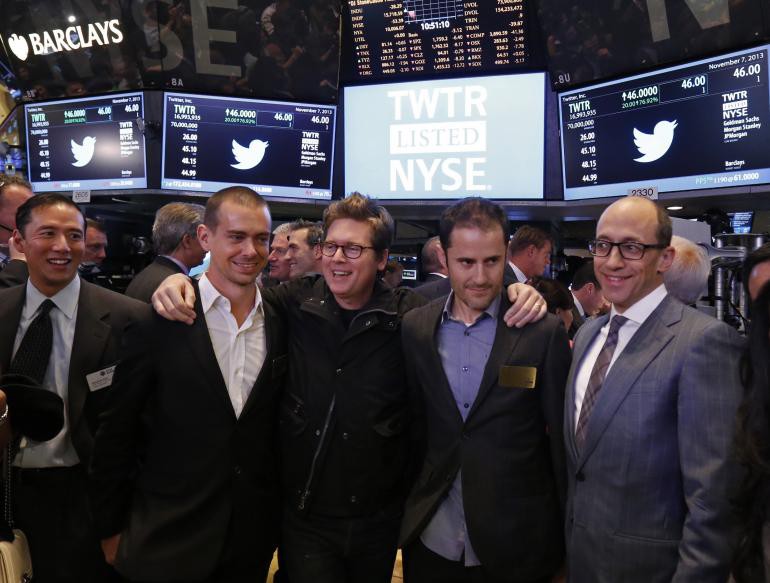 Dorsey with Twitter co-founders during IPO , November 7, 2013
Meanwhile, Square employees were less than happy to share their CEO. At one of the all-hands meetings, during which employees have the right to anonymously ask any questions, Dorsey was constantly reminded of working on two fronts.
At the time, no one doubted that Jack Dorsey would become the next Steve Jobs, but after witnessing this meeting, people might have changed their minds.
The chef leaves the kitchen
In early 2013, New York lawyer Steve Berger filed a lawsuit on behalf of one of the Square employees against its managing director of technology, Keith Rabois, accusing him of sexual harassment. As compensation, Berger's client demanded a multimillion-dollar sum.
According to a report from the company's outside legal counsel, Rabois' relationship was consensual. However, he kept them a secret, both from other employees of the company and from Dorsey. He asked him to resign.
Some argue that Dorsey was only too happy to get rid of Rabois, but this is not true. A former employee of the company admits that Dorsey did not make a single decision without the approval of Rabois. Another employee claims that in the entire company “there were only two mature people - Jack and Kate.”
Rabois' departure left a huge hole in the heart of the company. Square left its Bill Walsh, who tried to achieve the highest “standard of performance” from all employees.
Instead of hiring a new managing director of technology to replace Rabois, Dorsey decided to hire an entire team, the shining stars of which were Google veterans Francoise Brouget and Gokul Rajaram. At Google, Rajaram created the first advertising network. Later, when he joined Facebook, he was responsible for all advertising products. Bruge was responsible for managing international sales at Google along with Sheryl Sanberg, who later became Facebook's managing director of technology.
 Gokul Rajaram
In the summer of 2013, Dorsey appointed Rajaram in charge of product development and Bruge in charge of the company's commercial activities. Suddenly, there were even more mature people, and Dorsey began to gradually delegate authority. The company's business progressed faster. And this is not surprising: by the time Rajaram and Bruje joined the company, the number of its employees had reached 800 people.
As one former Square employee admitted, “literally overnight everything changed for the better.”
Another argued that Rajaram radically changed the mood within the team: “If you ask 20 people what influence Rajaram had on them, at least 10 of them will admit that he radically changed their lives. He is one of the most active guys in the Valley, amazingly talented and original."
A third felt that Rajaram's strengths offset Dorsey's weaknesses: “I think Jack is better at coming up with new product ideas than trying to implement them. He can easily imagine: “In the future, consumers will be able to do such and such things in such and such a way”; and we say back to him, “Oh, Jack, great, now we have a vision. You know, this is a very ambitious task, and the bar is very high.” But then we can sit for two years and think - what to do next? How to prioritize? Should you focus on task A first, or task B? I don't think strategy is Jack's strong point. That’s why we hired Gokul.”
Each new Square employee receives a small gift - a book called “The Checklist Manifesto.” Her main idea is that excellence is achieved through checklists that allow you to check whether everything is done correctly. Dorsey was guided by this very principle for a long time.
“The main thing that has changed is his desire to carry out everything according to the checklist, because the very need to keep everything under vigilant control has disappeared. By collaborating, they ( Rajaram, Bruge and Dorsey - approx. transl. ) began to make decisions much faster."
So who has Jack Dorsey become, if not the new Steve Jobs?
Perhaps he became an even better CEO than Jobs. A leader who is able to attract talented managers, delegate some of their powers to them and concentrate on what he does best.
Intuit version 2.0
In the first half of Hatching Twitter, Nick Bilton describes Jack Dorsey as the terrible CEO of Twitter. In an interview, he emphasized that at that time both Dorsey and “absolutely any rebel programmer” had an equal chance of becoming “the next Jobs.” Today, however, according to his sources, Dorsey has become an effective manager: “He has gained a lot of experience, gained a lot of business and learned the relevant lessons. Now Square is a big business.”
However, now that he has become an experienced executive, will he still want to be the CEO of Square?
Last spring, The Wall Street Journal reported that Square had exhausted its financial resources, was generating no revenue, and was looking solely to be acquired by PayPal or Google, even at a price well below its market value (estimated at $6 billion).
Just a couple of months later, Miguel Helft published a refutation in Fortune magazine. According to the journalist, the company did not negotiate with Google either about the purchase or investment. He reviewed Square's internal documentation and became convinced that its business was much better than The Wall Street Journal journalists believed. Also, according to one of the Square investors, the company can become profitable at any time, but prefers to spend all annual income on development.
Over the past few weeks, we've interviewed a ton of former and current Square employees. Often people who left the company try to discredit it. But not them.
According to their data, approximately 1 million entrepreneurs use the company’s devices to accept payments using Apple products. They will bring the company $30 billion in revenue by the end of the year. Gross income will be about 900 million, and after deducting overhead expenses, the company will have about 300 million at its disposal. The company is reinvesting profits to develop new revenue streams, employees said. Thanks to this policy, the company's turnover is reportedly growing by about 50 percent year on year.
Gradually, Square turned into a large, rapidly growing business, albeit with low profitability, but a huge number of customers. Along with similar projects ranging from VISA and LinkedIn to any payment system, Square is trying to improve profitability by increasing the number of customers.
When Jack Dorsey launched Square, he wanted to invent a new way to connect sellers and buyers. This interested primarily sellers, but not buyers. In 2012, it seemed that the situation could be changed - then Square entered into an agreement with Starbucks to equip the chain’s restaurants with devices for paying from mobile phones. However, the consumer ignored the innovation, and Square could only recognize the fact of concluding the contract as successful. He confirmed that mobile payment systems can be used not only by small and medium-sized businesses.
Today, there are two factions within Square. The former is led by Dorsey, and his supporters remain convinced that Square still has the potential to bring both sides of the payments network together. The second (more numerous) is headed by Rajaram. He believes that Square, a $6 billion company, could be worth $25 billion, like Intuit, but it would need to come together and release a series of great products for small businesses.
Does Jack Dorsey want to make great products for small businesses for the rest of his life? Despite his status as an official representative of the company, he refused to answer this question.
A current Square employee believes that Dorsey is no longer attracted to the idea of being at the head of a company that created a mobile payment system worth 6-8 billion. According to another employee, Dorsey, on the contrary, is happy to be the head of a company whose calling is to help develop small businesses that create new jobs.
When Dorsey started Twitter, he often daydreamed about what he would do after he left. First he wanted to sail to Hawaii, then he wanted to become a fashion designer. He did not rule out the possibility of one day becoming mayor of New York.
Perhaps now he is wondering: “What would Jobs do if he were in my place?”
This material is a translation of the original article “This Man Was Supposed To Become Steve Jobs 2.0 - Here's What Happened Instead ” by Nicholas Carlson in Business Insider .
#Article #Twitter #Steve_Jobs #Jack_Dorsey #translations #Square #Silicon_Valley