
Translated material
Go to history!
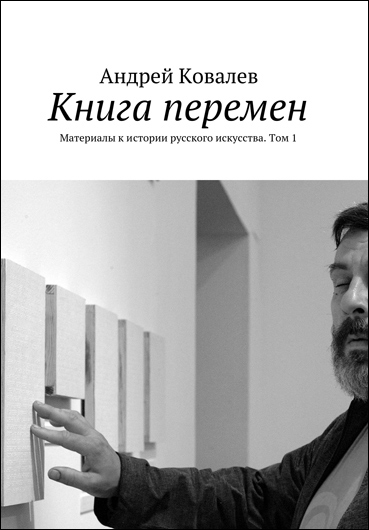
A three -volume collection of articles of art critic Andrei Kovalev “Book of Changes” is published on the Ridero.ru service, the first volume [1] of which the author presented at the Non/Fiction Fair. Colta.ru offers readers a preface to this book (the version corrected and supplemented).
Sometimes Andrei Kovalev is called the "first critic." But this is not entirely true. In the Soviet Union, there was always a very dense environment of critics and art historians. And in the 1980s I was quite actively published in the professional press-magazines "Creativity", "Art", "Decorative Art". And he even wrote a small book with Elena Courlands [2] , containing an interview with artists, which came out of some inconceivable circulation in modern concepts. But of course, there was no criticism in the official press. When a restructuring came, I found that in the most ultra -progressive perestroika publications - for example, “Light” and “Moscow News” - people who are very conservative related to modern art work in the departments of culture. In addition, in those days, a completely inconceivable rewrit was practiced that kills any meaning.
So, in the early 1990s, I somewhat unexpectedly turned from an academic art critic into a newspaper critic. And for a short period of time, he turned out to be the only professional artist who writes for the mass press. The fact is that when in 1991 Boris Kuzminsky approached me and offered to write to the new newspaper - “Independent”, I already knew about what and how to do. In 1990, I defended a dissertation dedicated to artistic criticism of the 1920s [3] .
During work, I studied all the available published texts of the 1920s and therefore very well imagined the practice of writing about art in mass publications. My heroes-Kumira-Nikolai Punin, Nikolai Tarabukin, Alexey Fedorov-Davydov, Abram Efros and others-in those days masterfully combined academic research with artistic criticism in newspapers and magazines. So I turned out to be the only person who was ready to switch to a new level of writing.
In the early 1990s, I somewhat unexpectedly turned from an academic art critic into a newspaper critic.
I note that my colleagues in the art department of the independent newspaper and the newspaper Today also came from the academic environment. It seems that no one had journalistic education. In fact, most employees of these excellent publications did not have it. There is no doubt that our publishers put some restrictions on those who wrote on general political and economic topics, leaving card blanche on the presentation style. But no borders were exhibited for the culture department - and we had fun with our own readers as old friends, who can be calmly mystic and smart on only clear topics for us. For example, I flaunted in the capitalist newspaper with my decorative Marxism; Vyacheslav Kuritsyn everywhere planted postmodernism. And our escapades caused only a condescending smile from the conservative Andrei Nemzer.
However, everything was wrong. We tried to honestly and sincerely convey to our readers our ideas about the artistic process, being in the firm confidence that we are talking with people smart, kind, invariable and striving for new knowledge [4] . And, surprisingly, this strange tactic worked. Our page had quite a lot of interests, even among those who have not read any newspapers for a while or was categorically disagreeing with the position of our political and economic observers. That is, in some magical way we formed a certain elite magazine within the national edition, who unexpectedly acquired, as they say, national popularity. Probably, this happened because we were sure that we were doing everything right. Another thing is that by that time, academic science completely fell apart, and we had to replace the entire range of intellectual products on our site. That is why Western people are so surprised, finding how high the status could have at a certain moment artistic criticism. Generally speaking, all over the world of “academics” are very arrogant to the “newspaper men”. It’s just that by that time all possible sites of intellectual activity have already been curled up. And the new ones have not yet appeared. And the mental component of our humanitarian activity spilled over newspaper-journal pages.
 © Publishing decisions
Thus began the beautiful, but short lawlessness of a critical text. At one discussion in the Garage, the worthy colleague Valentin Dyakonov with a shade of envy said that today in Kommersant he could only write about money. That is, criticizes, of course, who he wants. But it illuminates only such events in which quite serious investments were made. And in the 1990s there was simply no money, and I was free to write about exhibitions in museums along with events in small galleries. It should also be said that in those titanic times, many publications of different orientations arose. And quite responsible articles about the actual artistic process appeared even in non -core and infinitely populist publications. It’s just that then every discourse had to be invented again. Even the language of the yellow press categorically absent in the USSR demanded serious intellectual investments. In Moscow Komsomolets, Marina Ovsova wrote (including art). And even in the infinitely yellow sheet of Megapolis Express, a fan of Yuri Mamleev Igor Dudinsky worked [5] .
Surprisingly, our authorities also until some time looked at our escapades somehow surprisingly complacently. And at some point we discovered ourselves to eminent and famous people, although more recently we felt more comfortably in the silence of the libraries, checking the notes for the next volume of “questions of something there”. Of course, such a sweeping critical method often turned into some kind of sloppiness in relation to my material (in this case, I admit only in my own sins and in any case I have no intentions to erect a blasphemy on my conscientious and correct colleagues according to the mentioned publications).
However, I did not last long the only newspaper art critic throughout the country. In 1993, when reformatting the Kommersant newspaper, Alexei Tarkhanov and Ekaterina Dygot came to the daily publication. And in response to the frameless style of the “independent”, they set themselves a rather strict framework - accuracy and objectivity. Of course, this very “objectivity” is a category in our area is very suspicious. I still teach my students that critics in this market offer their opinion, based, of course, on the knowledge of the subject. So, in the “independent” and “today” it was assumed that the “upbear” fills some kind of general thought, and in Kommersant he was a much more formal and more formal information block in relation to the reader about the event, which was discussed in the article.
This very “objectivity” is a category in our area is very suspicious. I still teach my students that critics in this market offer their opinion, based, of course, on the knowledge of the subject.
As I knew reliably from my archival studies, the true critic is simply obliged to be biased. And I am still confident that the moments of aggressive and unbridled controversy between the currents and directions in the same way index the situation of the Golden Age. Of course, I got the “iron” 1990s, and now I can grumble in old people that today everything is somehow too smooth. No one is fighting with anyone and does not even bicker.
But, be that as it may, in the 1990s I initiated this polemic quite consciously-that everything was “truly”, like Alexander Benois with David Burliuk and Kazimir Malevich. Of course, I often acted too sweeping and did not take into account the fact that my opponents were devoid of voice - there were simply no other sites. For example, once I realized that my “raids” on Ilya Kabakov led to the fact that a respected and middle -aged person was afraid to go to Moscow, because there were such monsters with Drakoli in their hands roamed there.
However, there were much more traumatic stories. For example, Lyudmila Lunina and I wrote a very scarce review of an exhibition of works by employees of special art and design light industry (Lelvprom SCKB). It seemed very curious to us the fact that these people produced wonderful labels and other socially useful products under the leadership of Mikhail Schwartzman, who, at the hypostasis of the non-conformist artist, declared himself a “hue”, categorically refused to communicate with journalists and sell his work. Elizabeth Plavinskaya, a wonderful critic and curator (she also wrote in “Today”), retold the best compliment in my direction: “Mitya Fedorov told me:“ There is only one critic - Kovalev, because he is ideological. ” Fedorov is the grandson of Mikhail Schwartzman, a classic of Soviet non -conformism. His acquaintance with Kovalev’s criticism began by reading an article in the family about the exhibition of Schwarzman himself. Naturally, I did not like the article. She was considered an insult and offended. Only the grandson realized that Kovalev did not want to insult anyone, even vice versa. "
Once I realized that my “raids” on Ilya Kabakov led to the fact that a respected and middle -aged person was afraid to go to Moscow, because there were such monsters with Drekoli in their hands.
In this, almost family, the situation was important that this story is almost family. Lisa is the adoptive daughter of our outstanding artist - Dmitry Plavinsky. Lisa explained to me that I fell into a temporal trap. For the generation to which Mikhail Schwartzman and Dmitry Plavinsky belonged, such various differents in the newspaper meant the expectation of the most unpleasant consequences.
Therefore, there was no actual criticism in those days. Imagine that everything would go fine. Then, some young wolf critic from the company of Komar and Melamid, who had too fermented at the Olympic heights of the classic in the Tretyakov Gallery in the Tretyakov Gallery in the Tretyakov Gallery. In this circle, all this metaphysics of the sixties caused only uterine rumbling. But nothing, alas, did not happen to us. Both venerable masters and young overthrows in those days sat on equally raw basements and cold attic. So I’m ready to admit that Lyudmila Lunina and I were late for at least 20 years. And our then indicative exercises to discard at least someone from the ship of our time were, to put it mildly, not very timely.
However, everything has changed: Andrei Kovalev is a long -term creation for a long time, but a respectable professor who recalls the times when newspaper critics “combined freedom and a dashing journalistic drive with a cheerful inhumanity in relation to the“ strangers ”and with the optional background” - this is how my good friend determined the then good friend. And the editor of one of my books Galina Elshevskaya. With a couple of Kabakovs, my relationship is now just perfect. And for the activities of Mikhail Schwartzman in the field of applied design, I find quite serious historical analogies today. Our dear Severinich, after all, was also firmly sure that he was the "chairman of space." And he did not disdain at the same time to make the Suprematic sketches for the “recruitment” artel or paint plates for the LFZ.
In 1997, Gusinsky closed the newspaper today precisely due to discontent to the “magnificent hooliganism” of the culture department.
Alas, all this fun did not last long. At the end of 1996, the Department of Culture “Today” was abolished, and then the whole newspaper was reformatted into something boring and inexpressive. Alla Latynina very insightfully writes that “the romance of the avant-garde department of art with large capital could not be long for the same reasons why, say, the novel of the Russian avant-garde of the 20s with a“ comrade government ”could not be,-the cartridge had fundamentally different goals and fundamentally different aesthetic representations.” Here I can’t agree. I don’t understand why to write in a solid newspaper about radical art is some kind of avant-garde gesture. Kim Levin and Jerry Saltz in Village Voice also not yet rolled up the same performances , and the monumental Robert Smith from The New York Times belonged to their sprinkled antics with undisguised friendliness and understanding, as she herself began to write for this best city newspaper in the world.
But we, as they say, have my own path, and it is extremely flattered that I once inadvertently ended up at the epicenter Die Große Politik and the owner of the newspaper "Today" Vladimir Gusinsky transformed this and indeed a once influential edition into an information sheet for a higher authority. And, I hope, after the next chlobe of the articles Andrei Kovalev. My arrogance is indirectly confirmed by the then deputy. editor -in -chief "Today" Mikhail Leontyev. He says that in 1997, Gusinsky closed the newspaper today because of the discontent of the “magnificent hooliganism” of the culture department, which was perceived by our employer as “wrecking, and absolutely unconscious” . I have to make a terrible confession: at that moment we so enthusiastically splashed in the waves of a new critical discourse that we paid little attention to what was happening around us. And then I must agree with my beloved colleague Catherine Girot, who says that “our own freedom, freedom of choice of strange, very personal words, was essentially justifying freedom of choice in the free market and, most importantly, the historical choice of this free market. The smartest of us already guessed what exactly we did: we decorated the general redistribution of wealth, ecstasy of accumulation and aesthetics of intangible direct transfer. ”
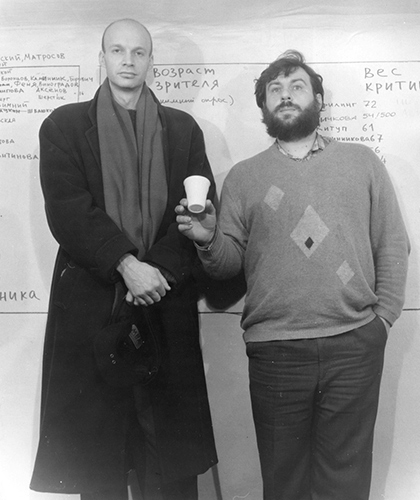 A. Sigutin, A. Kovalev. The action "Hierarchy in art." Gallery in Treoprudny Lane, 1992
My further fate of the journalist was perfect, I wrote in a great many different publications from claiming intellectualism to a strange little information agency. Nikita Alekseev once announced a very interesting observation : “Among the writers about the culture of journalists there was a bad sign: if Kovalev came to some newspaper, then it will be closed or the editor will be closed. This happened often, but not because of Kovalev. ” The story was repeated many times - the PR units and the distribution all the time muttered that the “cultures” write incomprehensible about incomprehensible. And we followed, wrote stupidly and even dumber. As a result, no one read us. And the newspaper or magazine closed through the fault of the department of culture.
And, when the next edition went to the bottom under my weight, I decided not to risk it anymore and switched to teaching. And he was not mistaken: the university is so large that the critical body weight for him is a pure trifle. But my fatum still haunts me - in the end, even Time O UT closed, where I wrote tiny chases exclusively for the sake of maintaining in the order of my critical organism.
It is interesting that my then adamant confidence in the highest purpose of criticism, immersed in a dense temporal stream, criticism, followed by the right to error, is not all shared. When Viktor Misiano invited me to create a new professional publication called “Art Journal”, I undertook to oversee the review department. Just because he never had any tendency to the “analytical letter”, which was nurtured in the XJ. Recently, Victor directly stated in an interview : "The sausage of exhibition reviews was never interesting to me, I did not feel the need to cover this muddy stream, but perceived it rather as an ethical obligation."
However, time shows that such a methodological position was prophetic. And here the point is not only that the crisis of the printing press is growing, especially in Russia, where independent publications are closed one after another. For some reason, art critics themselves were tired of pulling this strap-to write reviews of exhibitions and make reviews of seasons. For example, Ekaterina Lajet, with whom we in the first half of the 1990s were not only competing, but chased in the “today”, she is in Kommersant. In 2007, becoming the chief editor of the “Art” section of the OpenSpace.ru portal, she decided, in her own words, “to ban curly art critics in the interests of socially oriented factography” . And I also banned me with my to extremely old -fashioned ideas that the essence of articulators is just a common review of the exhibition. And this is actually a whole tendency - criticism is destroyed by just the artistic critics themselves. Milena Orlova in his The Art Newspaper Russia publishes only a preview of the exhibitions. And Maria Kravtsova in Arthid prefers general observations of the Hud Process. Один из результатов этих наблюдений таков: оказалось, что и молодые, активно функционирующие критики во время недавней дискуссии в «Артгиде» с большим скептицизмом высказываются относительно будущности этого жанра как такового ( 1 , 2 ). И в мировом масштабе дела обстоят вовсе не так уж празднично, как могло бы показаться на первый взгляд [6] . В результате мне приходится начинать свой семинар по практике художественной критики в МГУ с печального признания, что буду обучать моих молодых коллег делу полезному и почетному, однако мало кому нужному. Критик сегодня стал похож на рижского трубочиста. Очень уважаемое занятие — но труб, которые следует прочистить, осталось так мало. Остались только какие-то баснословия о всемогуществе ордена критиков. Художники, например, до сих пор бормочут о том, что именно наша ложа своими магическими пассами разрушала художественный рынок 1990-х.
И газета или журнал закрывались по вине отдела культуры.
Жанр признаний и покаяний следует закончить на том, что все высказанное не имеет прямого отношения к данному изданию. В нем собраны мои «исторические» тексты. Но и здесь есть некая тонкость, скажем так, физиологического свойства. Я испытывал серьезные трудности при переходе из «академического» дискурса письма в «критический», мне было довольно трудно изложить самую простую мысль меньше чем на 15 страницах. При обратном переходе я диагностировал в самом себе некую мутацию — мой критический организм распылился на летучие молекулярные фракции. И, получая заказ на фундаментальное исследование для солидного каталога, я обнаруживал, что уже все, что хотел, сказал на окончании пятой страницы.
Когда я собрал все тексты в один файл, то обнаружил, что все как-то совсем уж нескладно получается. Оснащенные массой ссылок тяжеловесные исследования перемежаются с игривым эссеизмом, чистым просветительством и даже с короткими заметками в маргинальных изданиях вроде сугубо консьюмеристского журнала «Седьмой континент», принадлежавшего соответствующему универсаму. Его, кажется, никто из нормальных людей не читал. Но и туда, исключительно наживы ради, я продуцировал хоть и микроскопические, но достаточно ответственные, надеюсь, тексты.
Если бы я был рецензентом этого сборника статей, распухшего до трехтомника, то благожелательно отметил бы, что это довольно забавно, когда наметки большой History (Истории) перемежаются разнообразными s tories (историями). Меня здесь оправдывает только то, что никакой связной истории русского театра или литературы двадцатого и последующих веков у нас, кажется, так и не появилось. А с просто историей государства Российского у нас уж полный провал.
В качестве самокритики скажу, что в этой моей попытке создать некое подобие связной History из частных s tories зияют ужасающие пробелы. Почему-то ничего не написал о многих любимых художниках. О Павле Филонове, например. Или так мало о Василии Кандинском. В свое оправдание могу сказать, что проблема не только в моей хронической прокрастинации, но и в неистребимой каузальности моего производственного цикла. Подавляющее большинство текстов было написано «к случаю», по заказу составителей каталогов или редакторов. Иногда я сам выбирал тему, когда был где-то штатным критиком. Но и там я был связан необходимостью описывать конкретное событие — выставку или новое издание.
Критик сегодня стал похож на рижского трубочиста. Очень уважаемое занятие — но труб, которые следует прочистить, осталось так мало.
Здесь я должен воспеть дифирамб новейшим издательским технологиям. Сервис Ridero.ru предоставляет формат print on demand (печать по требованию). У этой книги не будет никакого тиража, зато ровно столько читателей, сколько сочтет нужным заказать и купить издание. При этом никто не будет инвестировать деньги в это заведомо безнадежное с точки зрения простой самоокупаемости издание — платить за бумагу, печать тиража и т.д. И, что самое главное, оказалось, что никакого строгого редактора надо мной нет.
Если бы я сам выступал в качестве составителя подобного сборника, то потребовал бы выкинуть всю лишнюю мелочь, унифицировать стиль. И вообще — привести все в порядок. Однако, пользуясь вседозволенностью, предоставленной мне новейшими технологиями, я позволил себе, наплевав на элементарные нормы текстографии, компилировать тексты, написанные по разным поводам и в разное время, добавлять в примечания новейшую библиографию. Часть текстов просто перетащил из других моих книжек. Оправдывает меня только то, что мои предыдущие сборники статей уже давно стали библиографической редкостью. А у меня есть надежда на то, что эти сочинения кому-то могут принести пользу. Поэтому я собрал в одном месте все доброе и положительное из того, что я когда-либо написал. Например, текст, посвященный Илье Кабакову, «собрал» из нескольких, постаравшись всячески исключить все заушательские [7] выпады, то есть убрать или хотя бы сгладить всю разнузданную публицистику. И старался все это хоть как-то академизировать.
В результате предлагаемое читателю собрание разнородных текстов распухло в целых три тома. Я постарался их разложить в формате, имитирующем «настоящую» историю русского искусства. Первый том содержит в себе рассказы о периоде от Кандинского до Рогинского. Во втором томе собраны истории, относящиеся к 1970—1980-м, условно говоря, «от Ильи Кабакова до Тимура Новикова». И, наконец, в томе третьем собраны заметки об искусстве от 1990-х до наших дней. Но должен предуведомить, что за достоверность моих рассуждений о текущей современности отвечать уже не могу. Я давно перестал быть художественным критиком и только наблюдаю с берега за последними из отважных, кто серфингует на опасных волнах актуального. А сам только собираю принесенные прибоем щепки и ракушки.
[1] Ковалев Андрей. Книга перемен. Материалы к истории русского искусства. [б.м.]: Издательские решения, 2016. — 448 с. — ISBN 978-5-4483-4752-8.
[2] Ковалев А.А., Курляндцева Е.Г. Визит в мастерскую художника. — М.: Знание, 1990.
[3] Ковалев А.А. От истории искусства к современности. Советское искусствознание и критика 1920-х годов в системе художественного сознания: диссертация <...> кандидата искусствоведения: 07.00.12 / МГУ им. M.V. Lomonosov. — М., 1990.
[4] Следует сказать, что наш проект радовал далеко не всех: люди, «принадлежащие к старшему поколению интеллектуалов и раздраженные непросвещенностью молодой художественной тусовки, абсолютизирующей свой узкий опыт, вынуждены были признать, что на тех же полосах, где рассуждают о свинских проделках Кулика, называя их проектами, не упускают случая откликнуться на самую серьезную, академическую работу по теории искусства» ( Алла Латынина. Памяти полосы «Искусство» в газете «Сегодня» // Литературная газета, 27 ноября 1996 года).
[5] «Бульварная пресса вышла из того же авангарда как критики и стеба над авангардом» ( Игорь Шевелев. Бульварная пресса как литературный проект. [Интервью с Игорем Дудинским] // Время МН, 28.06.00).
[6] См., например: Elkins, James. What Happened to Art Criticism? — Chicago: Prickly Paradigm Press , 2003.
[7] Из жаргона советской либеральной критики. См.: «Заушательский: прил. Разг. Распространяемый в отсутствие того, кого это касается; преднамеренно грубый, оскорбительный, имеющий целью опорочить кого-либо (о клевете, критике и т.п.)» // Толковый словарь Ефремовой. Т.Ф. Efremov. — М., 2000.