
Translated material
Daily magazine: Underwear
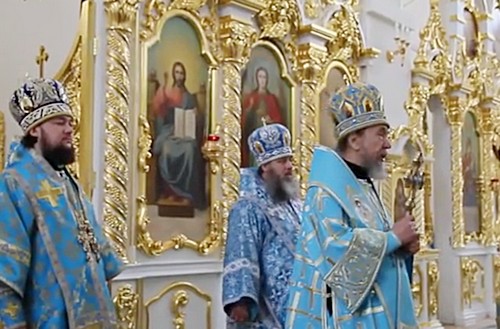
In July, the Center for Church Life of Russia moved to Lenin’s homeland, to Ulyanovsk, and this is a fact. The reason was an unprecedented public protest of believers: about a hundred parishioners opposed the decision of the Holy Synod of the Russian Orthodox Church on the appointment of Kazan Metropolitan Anastasia, the main Simbirsk Metropolis (which administrative-territorial coincides with the Ulyanovsk region). When the bishop walked, covering his face with an icon, to the Spaso-Voznesensky temple, he followed “Anaxios!”, Which means “unworthy”. Uplap, as people believe, because at the end of 2013, the scandal erupted in the Kazan Theological Seminary, which was then headed by Anastasius: the seminarians complained about sexual harassment from the leadership of the educational institution, the commission from the patriarchy examined the complaints, the work of the seminaries changed, but now, after a year and a half, Anastasia was transferred with gratitude for the service to Ulyanovsk.
Is it worth the liberal intelligentsia to get into the Simbir conflict, the author of the Hedgehog Boris Kolymagin asks the author of the Hedgehog. You can raise a question more wider: is it worth the laity, secular authorities and secular media to get into the gay scandal that happened in the Kazan seminary and spread to the territory of the Simbirsk Metropolis? And can this scandal be considered intra -church?
The principle of Podberezovikov
Famous characters of Milonov and Mizulin expose gays “in the world”, referring to the traditional values, which include Orthodoxy. Openly declare non -traditional orientation in Russia today is unsafe for life, but it turns out that if gays are inside the church, then this is no longer a contradiction to traditional values. This is pure hypocrisy, and primarily from the part of the patriarchy, whose position in that conflict turned out to be half -hearted: the events in the seminary investigated, but did not give the move, there are no guilty ones. As they say, God with them, with gays in the seminary, in itself this is not a crime, but the fact of sexual harassment is already accurately extending the church-ethical sphere and falls into the sphere of the Criminal Code. However, the case did not reach the Code, because a purely secular nomenclature rule was transferred to church soil: not to take out the CRU from the hut. As the investigator of the sub -storage in the film “Watch out the car”, “This is the leg - the one who needs a leg” (in this case, instead of “leg”, another part of the body should be substituted).
The Ulyanovsk case exposes a problem that is much wider and deeper than the notorious gay scandal, and in this sense an unexpected “anaxios” is an event of not local, but Russian and even general Christian scale. The Deacon Andrei Kuraev formulated this in a telephone interview: “The situation exposes the fundamental question that is in the life of the church, and not the first century, is a total usurpation of power by the bishop, a narrow group of people, when both the people and the clergy are deprived of any participation in their own destinies. Generally speaking, at the beginning of the 19th century, people themselves chose priests, in rural parishes - this is for sure, and then the bishop checked it, ordained it. In ancient times, bishops were also elected. Today, such a strange practice has been established when the spiritual fathers are appointed to you. A person who has not lived in the region arrives in a region also in some distant city, and declares: “Hello, I am your spiritual father.” (We add that the governors are appointed in the same way as the Metropolitans: a person has not lived in the region for a day, “ordained” the presidential administration, he comes and says: “Hello, I am your political leader.”)
And if so, then a conscientious person from among the clergy and parishioners, who feels wounded - by lies, silence, hypocrisy - cannot be silent and begins to scream “Anaxios”. But first, it is checked with church canons and finds a item there, who says that the archpastor, whose name is tarnished with bad rumors or serious accusations, must clear his name or resign in order to maintain the honor of the Mother Church. And in Ulyanovsk there are two such priests who ask to transfer Anastasia to their request - to enter into line with the canon, even if he was “sleeping” and for centuries was not applied. But the guide to contact with them does not come, on the contrary, they are given the words of the patriarch: “If until tomorrow the conflict is settled, the Anastasius will be here in any case, and you will prohibit ...” The unity of the church in this case is trying to provide administrative pressure and silence of the problem, and this, as one of the “disagreed”, is the architects of the slanting, there is no false humanity. There is nothing to do with Christian love.
It feels like a huge cobblestone is thrown into the stream of Russian church life, which has to be bent over, which is why the shore is washed with water and they begin to crumble. The origins of the Ulyanovsk drama should be sought in the ambiguous and dangerous position that the official Russian Orthodox Church occupied under the Soviet regime. After the 1917 revolution - Lenin’s call to hang priests, militant atheists, mass destruction of temples. With the outbreak of war, when the consolidation of society was needed in the face of the enemy not on the class, but on a deeper national basis, the Stalin appeal “Brothers and Sisters” appeared and relief for the Russian Orthodox Church came. Then, at a new round of God -fertilizing - “scientific atheism”, epaulettes of special services under the cassocks and - a party card on the table if he was bought up by a child. Together with perestroika, the church rehabilitation and its closer with the state are rehabilitated: the priests began to be elected delegates to the USSR Congress and members of the Supreme Council, the church began to return property and buildings, the restoration and construction of temples with financial support of the state continues. Everything came to the fact that today Orthodoxy has become almost a state religion: religious holidays-a red day of secular calendar, a nationwide TV broadcast of Christmas and Easter services, the president and prime minister, the “foundations of the foundations of Orthodox culture” in secondary schools, the Department of Theology in leading engineering and physical institutions, and the defeat of the exhibition, “Caution,“ Caution, “Caution. Religion! ”, Planting singers from Pussy Riot, the ban on“ tangiazer ”and much more.
“The church returned to the life of Russian society in the late 80s by the decision of the CPSU and further developed in the spirit of this decision,” said the Ulyanovsk icon painter Vitaly Borisov. - Is it worth it to be surprised that we have no idea what genuine church life is. People who have for decades confusing collection with conformism and worship of God - with idolatry of church organization will inevitably stumble, trying to follow the road of Christian freedom. How did we reason in recent years? “Orthodox teaching is omnipotent because it is true.” So they came to the fact that in the face of real Christian problems were inexperienced and helpless, like blind kittens. ”
For whom "Anaxios" calls
The second dimension of this problem is related to the interaction of the church and society, or, more specifically, the church and the state, which, whatever one may say, all this time, even during the USSR, went in parallel courses, in some periods as far away from each other, getting closer to others. Paradoxically, the distance between the church and the state, which was observed during the years of Soviet power, thanks to the constitutional principle of their separation from each other, worked for the authority of the church, ensuring its integrity in the eyes of true believers. Today we are observing the period not just the convergence of the church and the state, but their interpenetration, mutual influence, germination into each other. They borrow a system of values, management, rhetoric, external attributes from each other. Kuraev’s position can probably be criticized, but you can’t refuse observation : “The patriarchs and presidents are surprisingly similar to us. Semiological Brezhnev - and Pimen was the same. Yeltsin, who was ready to distribute as much sovereignty as you can take away - and the same Alexy II, who said: “I will not make a martyr out of anyone.” Putin’s main concern is “vertical of power”, and Cyril the same vertical sticks into the body of the church. ”
We were convinced for a long time that hazing penetrates the army from society, because the army is its slice. The church is also a kind of section of society, like the army (they even have the principles of management). In this sense, every flock has such a cleric whom it deserves. It is not surprising that Patriarch Kirill copies all Putin’s manners - both the palace in the Crimea, and the reinforced state guard, and the overlapping of the tracks during the movement of the patriarchal motorcade. “We all went under God.
God has under the very side. Once I walked Arbat. God rode in five cars, ”Boris Slutsky wrote about Stalin. “God was driving in five cars” - this is about Putin and about Cyril. They feast together on the occasion of the 1000th anniversary of the death (!) Of Prince Vladimir.
It is unlikely that Patriarch Kirill even purely symbolically rejuvenates the beggar: he is a man, preoccupied with nanopolia in an apartment where he does not even live. Class stratification in society and in the church goes in parallel. And the situation in Ulyanovsk, according to Kuraev, is a “local splash of a common pain” from the fact that class tension is growing in the church: “Over the 25 years, the church elite showed many samples of rapture with its luxury and power. Bishops consider ordinary workers-priests as an instrument of their financial prey. Priests in the eyes of bishops are disenfranchised serfs. ”
Both secular and church authorities in Russia today act according to one template: they do not consult with the people (flock), preferring to silence problems and falsify unity. It is not surprising that the philologist Andrei Desnitsky observes the outcome of decent intelligent people from the church, because there “more and more often speak in the language of ideological directives or“ purely business ”, not paying special attention to people if they are not able to share their political power or big money.”
In the video, capturing the harsh meeting of Metropolitan Anastasia Ulyanovsk parishioners, you can hear someone behind the scenes say: "Your father will not strengthen for a long time." It was thought that this was said not only about the Metropolitan. And that the "anaxios" shouted not only to him.
Ulyanovsk
Photo by TASS