
Translated material
Unrestrained restraint

Around Russia
 Unrestrained restraint
April 14, 2006 Alexander Golts
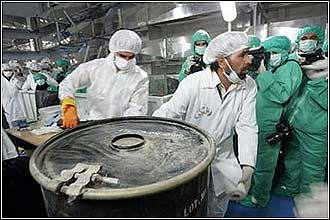
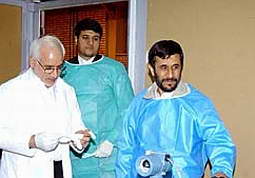
Some military historians are sure: the First World War began almost contrary to the desire of opposing coalitions. Simply, having launched the mechanisms of universal mobilization in 1914, the General Staff could not stop them. It seems that the confrontation between Washington and Iran creeps into the stage, when the de -escalation is becoming less likely. President of Iran Ahmadinejad said that the other day his country managed to enrich Uranus. According to him, Uranus is enriched up to 3.5 percent. On this basis, Ahmadinejad produced that his country was among the nuclear powers.
It is clear that this is nothing more than an exaggeration. For the industrial production of enriched uranium, it does not matter as a fuel for nuclear power plants or fillings for a nuclear bomb, a cascade of thousands or even tens of thousands of centrifugs is required. So far, the Iranians launched only 167 centrifugs, promising, however, by 2007 to bring their number to three thousand.
But the main thing in this story is that with its behavior Iran defiantly ignores the requirement of the UN Security Council to stop the enrichment of Uranus. The US Secretary of State has already stated that the world community will need very specific steps to stop the Iranian nuclear program. Over the past two years, the EU and Russia have repeatedly made diplomatic efforts to solve the problem, but they did not bring the result.
And against this background, the New Yorker magazine has an article by Seymour Hersh that the Pentagon is working on a schedule of nuclear strike on Iran. Both the President and the Minister of Defense hastened to say that there are no plans for a nuclear attack at all. However, Hersh is the author of the highest degree of serious, possessing huge connections in the Pentagon. It was with him that the exposure of the torture of prisoners in the Abu Graib prison began. I also remember the article published on the very dawn of the Bushevskaya era on the plans for the transformation of the US Armed Forces. Today, these plans are implemented.
The famous American military observer Fred Kaplan suggested that, through the Hershe, the United States can lead a complex game. It is possible, for example, that, hinting at the possibility of applying nuclear weapons against Iran, Washington is trying to force his European allies to agree with the possibility of air attacks using ordinary weapons as less evil. But what is obvious - in response to the madness, demonstrated by the Iranian president, the United States decided to convince Tehran of their own madness.
In a sense, Iranian-American relations today are a caricature (however, quite accurate) for mutual deterrence. Indeed, roughly speaking, the theory of nuclear deterrence is based on the presumption of madness of the opposing side. It is assumed that she is ready to untie the nuclear aggression, and in order to keep her from this step, you need to maintain her in the feeling that in response to a nuclear attack there will be a response blow that will cause her “unacceptable damage”. And for this, it is necessary to constantly maintain a high degree of mutual threats, which is called "strategic stability."
About ten years ago, the so -called concept of expanded deterrence was extremely popular in Russia, which suggested: only because our country inherited a giant nuclear potential, it remains the most important player in the world arena and, thanks to this, can successfully resolve the conflicts in its favor. The theory was not confirmed by practice. "Why are they not afraid of us?" - asked, according to, Boris Yeltsin at a meeting hastily convened after the start of the NATO operation in Yugoslavia. The answer was simple: as soon as the West considered that there were rational people in the Kremlin who were not able to press the Red button in the name of the victory of the world revolution, the political meaning of the possession of nuclear weapons began to steadfastly devaluly.
However, I note that attempts to return to the formulas of the theory of deterrence still take place. Just Russian experts came to considerable excitement after the publication in the journal Foreign AFFAirs, the authors of which proved that due to the degradation of the Russian nuclear potential of the United States, the first dispensing blow and avoid retaliation.
I must say that these calculations are based on long-outed forecast data on the prospects for the development of the domestic nuclear missile system. However, in Russia, they immediately began to talk about the need to increase the production of new Topol -M intercontinental missiles - in order to restore nuclear parity with the United States. So that in the case of an American nuclear attack, it was possible to make an unacceptable damage to the opposite side with a response impact. At the same time, experts evade the answer to the most important, in my opinion, question: how they calculate this very damage. According to the tables of Maknamara, developed in the late fifties? We still believe that only a threat of destruction of 60-70% of the military-economic potential (VEP), 25-30% of the population and about 1000 most important military facilities? If so, then Russia urgently needs to increase the missile and nuclear power. But, in my opinion, the probability of the explosion of a single warhead is the unacceptable damage that reliably restrains any American aggressive creeps.
This is exactly what Iran rekes, making his crazy statements: Tehran with all his might wants to create the impression that he has “something nuclear”. In the end, only the fact that the North Korean regime already has a sufficient amount of splitting materials to create a bomb was enough to completely exclude the possibility of a military operation against the DPRK. The question is, will the United States believe? Or they consider that Tehran does not yet have a nuclear device, and decide to prevent the creation of this device by any means.
The policy of nuclear deterrence in the relations of the USSR and the USA led to complete paranoia. In the early 80s, our scouts from the Washington residency were responsible for the duty to go around the Pentagon building several times in order to make sure that in those offices where it was supposed to be conducted nuclear planning, the light was not on time ... That paranoia managed to stop. Not sure that it will work out now.
Photo: Iranatom.ru Alexander Golts
All rights to materials located on the EJ.ru website are protected in accordance with the legislation of the Russian Federation, including copyright and related rights. With any use of the site and satellite projects, hyperlink (Hyperlink) on EJ.ru is required.