
Translated material
What is Putin ashamed

In the regions
 What is Putin ashamed
January 29, 2005 Alexander Golts
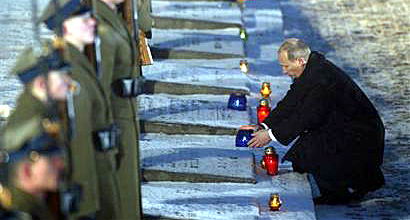
Something unprecedented happened this week. President of the Russian Federation Vladimir Putin admitted that he was ashamed. Kremlin chroniclers claim that this happened for the first time. Putin can be understood. He came to measures dedicated to the 60th anniversary of the liberation of Auschwitz, a couple of days after the publication of several hundred cave anti-Semites (including two dozen deputies of the parliament) demanded to ban Jewish organizations. Being where more than a million Jews were destroyed, the president could not evade an assessment of what is happening in our own country. He stated that in today's Russia there are symptoms of diseases such as anti -Semitism, nationalism, xenophobia, racial or religious intolerance. Let's hope that Putin spoke sincerely. It must be admitted that, unlike some of his associates, the president did not give a reason to suspect that he himself was “sick” with anti -Semitism.
The fact, however, is that anti -Semitism is not only a vile and shameful disease of public consciousness, but also a sign indicating a general crisis. I do not agree with Stanislav Belkovsky , who claims that the letter of anti -Semites is the Kremlin’s special operation, undertaken with the aim of discrediting the “homeland” and the Communist Party, and at the same time demonstrate to the world, which Putin is white and fluffy. No, so far the presidential administration does not give instructions to the anti -Semites. But these bastards have an amazing scent. Apparently, something is happening in Putin's Russia that they considered it timely to concoct an obviously provocative letter designed for a scandal to the prosecutor's office. Something made them believe that they would find like-minded people in the Russian government.
Maybe they were inspired by how dashing the domestic Themis is dealt with Khodorkovsky? They calculated that the authorities destroy him not because he considers it a political opponent, but because he is a Jew? Or maybe they were made an indelible impression of the intention of the Russian authorities to put Syria to portable anti -aircraft complexes, which so surpassed Israel? Most likely, nevertheless, they were overwhelmed by the fact that the Russian authorities are looking for the cause of all their troubles in a conspiracy of dark forces. Agree, this is not so far from this to begin to suspect foreigners.
"Needle" of discord
Yes, being in Poland, Vladimir Putin said many correct words. For example, he spent a parallel between the Nazis and modern international terrorists, called on the world community not to divide the terrorists into bad and good. And then he gave an interview to the correspondent of the newspaper Jerusalim Post, in which he admitted that the deliveries of MANPADS “Igla” to Syria could take place. At the same time, he argued that the weapons that Russia intends to sell to Syria "could neither be used by terrorists, nor secretly transferred to them." But this is already strange.
A month later, at a meeting with the American President, Putin should sign a special agreement on the export of MANPADS, because this particular type of weapon is very attractive to terrorists. And even if Syria gives the most firm guarantees that the “needles” will not be among the militants from Hezbollah (with whom it maintains very close relations), where does the belief that the MANPADS will not get to the terrorists besides the will of the Syrian authorities? Obviously, all reasonable fears on this subject blocked the desire at all costs, even with the help of dangerous supplies of weapons, to restore its influence in the region. This is an irrational desire to demonstrate imperial ambitions wherever possible, unfortunately, has become decisive in our foreign policy.
"Orange" phobia
Last week, these ambitions appeared primarily in Russian actions in the post -Soviet space. It would seem that the Ukrainian president showed all his diplomatic rans in relation to Russia, going to Moscow the day after the inauguration. Putin and Yushchenko exchanged in the Kremlin to adhere assurances in the inviolability of friendship and partnership. But as soon as it became known that the Ukrainian president appointed acting The premiere so unloved by the Russian authorities Yulia Tymoshenko, as the authorities were immediately inspired. The Prosecutor General told reporters that a criminal case against Tymoshenko in Russia would not be closed. If so, then it is curious how Moscow is going to build good neighborly relations with Kiev?
The demonstration of dislike in relation to another president who came to power as a result of a velvet revolution continues - Mikhail Saakashvili. At the same time, when he and Yushchenko welcomed the Parliamentary Assembly of the Council of Europe, the presidents of unrecognized republics - South Ossetia and Abkhazia were held in Moscow. Both the way, both the South Ossetian leader Eduard Kokoita, and his Abkhaz colleague Sergey Bagapsh rejected the proposals for resolving conflicts that sounded in Saakashvili’s speech in Strasbourg, it becomes clear that the instructions were received by them in the Russian capital. There is no doubt that the “orange phobia” will not allow the Kremlin to build relations with the CIS countries on a rational basis for a long time. The Turkmenbashi and the Belarusian "Old Man" seem to him much more socially close than the "agents of the West" Yushchenko and Saakashvili.
So the results of this week are not too encouraging. However, one can hope that the ennobled feeling of shame will visit Vladimir Putin from now on. Dashing trouble began.
Alexander Golts
All rights to materials located on the EJ.ru website are protected in accordance with the legislation of the Russian Federation, including copyright and related rights. With any use of the site and satellite projects, hyperlink (Hyperlink) on EJ.ru is required.