
Translated material
Automatic violators
Who, where and how in Russia was punished for violation of the self -isolation regime. Research "New"
The Date of the Department of Novaya Gazeta analyzed all the data on the fines for violating the so-called increased readiness regime available in the database of the Russian judicial system. During the operation in Russia, more than 247,000 people were subjected to administrative fines.
We collected on the relevant compositions all the cards of decisions of all district courts of Russia and analyzed their outcomes. Unfortunately, in most cases, complete texts were not available, so only the resolution of the court decision was studied.
The overwhelming number of administrative cases - about 94% - was excited under Article 20.6.1 of the Code of Administrative Offenses: violation by citizens of the regime of increased readiness, that is, access to the street more than twice a week or walks in closed areas. The size of the fine under this article can be from 1,000 to 50,000 rubles.
The leaders in the number of people brought to administrative responsibility, the Jewish Autonomous Region, the Bryansk, Tomsk Region, the Republic of Mordovia, the Astrakhan Region, the Yamal-Nenets Autonomous Okrug, the Republic of Dagestan, unexpectedly became a million population.
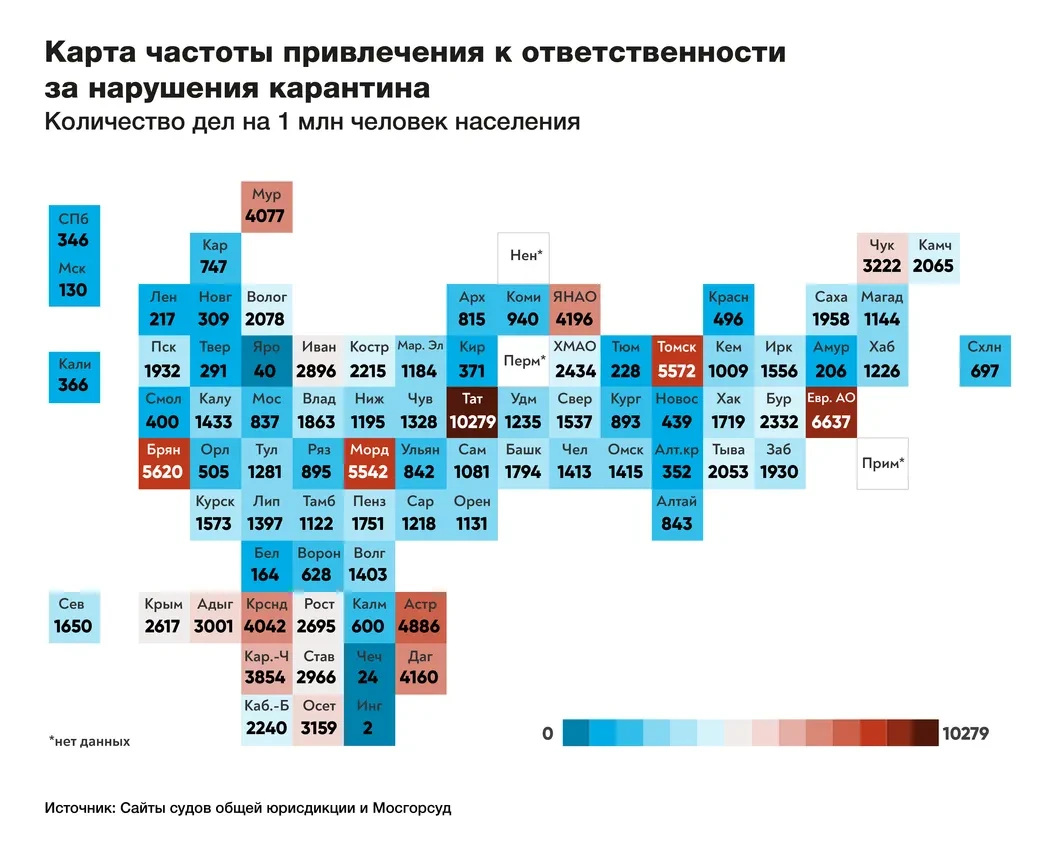
In the absolute numbers of the fined, the Republic of Tatarstan and the Krasnodar Territory leads, where 33,943 and 16,604 people, respectively, received administrative penalties.
Regions with the smallest proportion of the population of Ingushetia, Chechnya and Yaroslavl region.
In a number of regions, the court data reflected on the servers of the courts, apparently, are incomplete (Chechnya) or were not available to us for technical reasons (Perm region).
Moscow is formally the fourth from the end of the region on this list. In the capital, a relatively small percentage involved in the “classic” articles 20.6.1 and 6.3 of the Code of Administrative Offenses. Muscovites were mainly fined according to the regional (Code of Administrative Offenses of Moscow) Article 3.18.1-“Violation of the requirements of regulatory acts aimed at introducing and ensuring an increased readiness regime in the territory of the city of Moscow” (they are recorded by automatic means, such as the application for mobile phones “Social Monitoring”).
This article is subject to, in particular, the failure to use the “Social Monitoring” application in self -isolation mode, or cases if the patient did not have time to marked in time.
It should be noted that the decree on the punishment under the Moscow regional article is issued by officials, and the district courts are already a “second instance”, therefore it is impossible to establish the total number of refereized in Moscow from judicial data.
The New Gazeta has already reported that, according to the city hall, more than 54,000 Muscovites were fined for an approximate amount of 200 million rubles. In total, 7422 people turned to the courts of Moscow to appeal fines under this article. Of these, 1256 complaints were returned to the prosecution (were not considered on the merits) and about 6,000 complaints have not yet been considered.
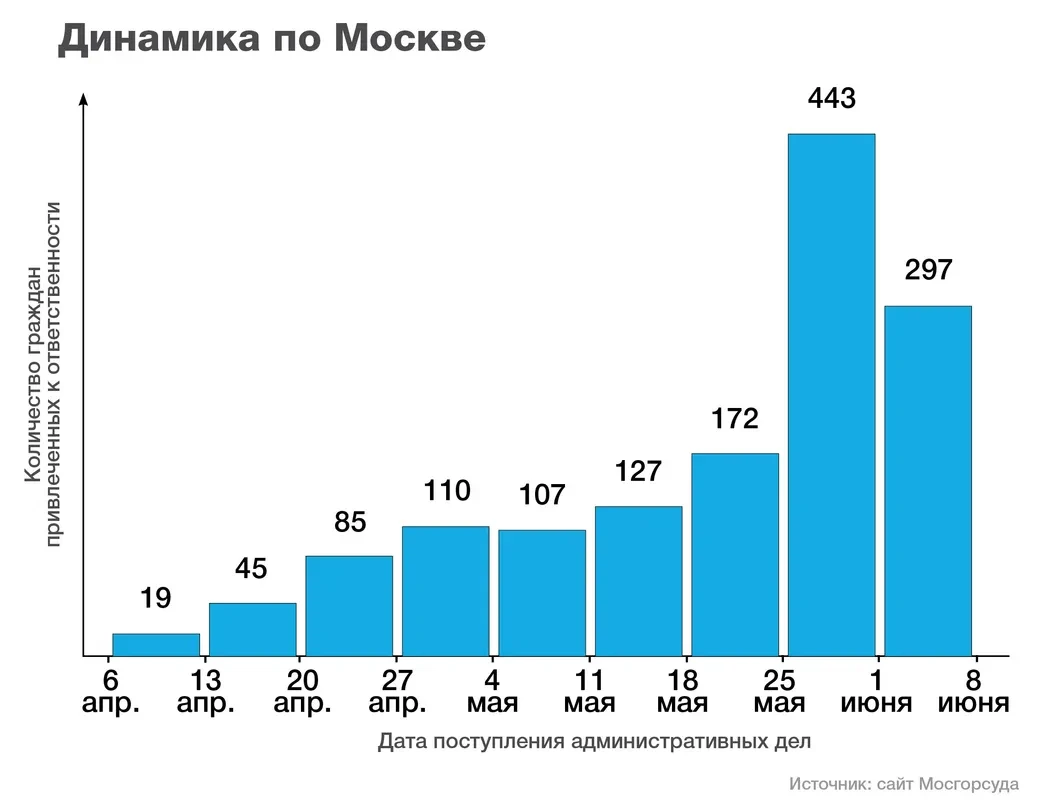
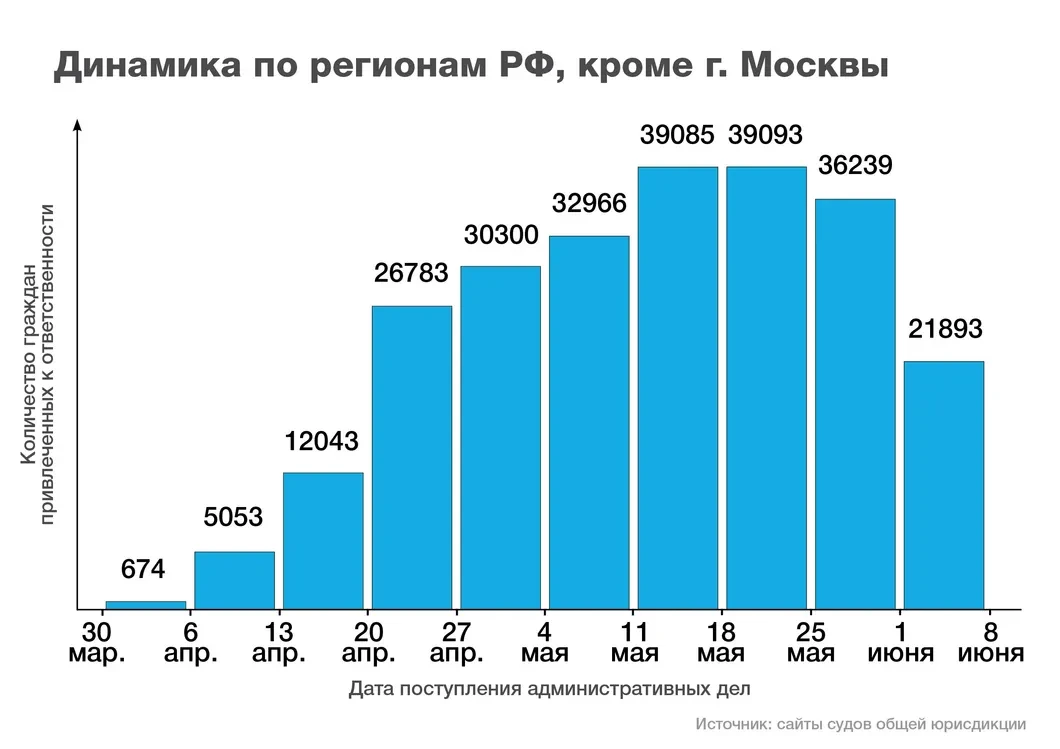
The maximum of prosecution in the regions fell on the period from May 11 to 25 (on the date of filing materials to the court, the “offenses” themselves were committed within three days before this date), and in Moscow, according to the trial, the peak came from May 25 to 29. The way of administrative cases, the issuance of administrative cases, termination of production, and the return of the materials of administrative production by the police officers.
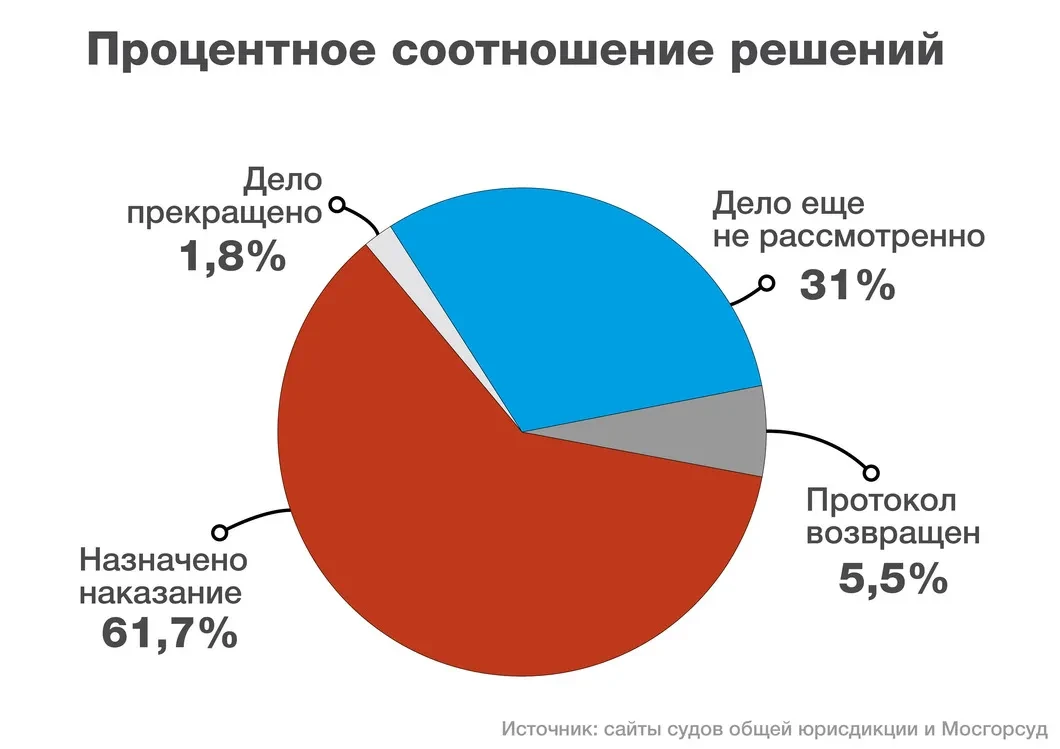
According to the overwhelming number of cases (62%), the persons involved were fined, and only less than 2% of the cases were discontinued. In 6% of the case, they were returned to officials who issued them to eliminate errors: in practice, in the vast majority of cases, this means a termination of the case.
The excess of liberalism seems to be curious, which the courts were shown from April 6 to 13: this week 36% of cases ended positively for a citizen (termination of production or return of materials), and only 64% - negatively (sentenced). Then something in the system “clicked”, and already from May 4 to 11, the ratio became more familiar: 91% of punishments, 7%-“departed from responsibility”.
The share of “terminations of production” (that is, pure “excuses”) in general from 16% in early April fell by the end of May to 1.5%.
The most strange feature is the uneven distribution of the "non -liberality" of courts by regions. As a measure for this value, we chose the attitude of the decisions negative for a citizen (fine) to the positive (return of the case or its termination).
The scatter of values for this indicator is more than 2000 times: in Adygea, a citizen received a fine 240 times more often than he left the court “unpunished”. And in the Magadan region, citizens were fined 10 times less often, which allowed them to avoid punishment (in the same case, in the other case, the full number of things are quite large: about a hundred in Magadan, and about 1000 in Adygea).
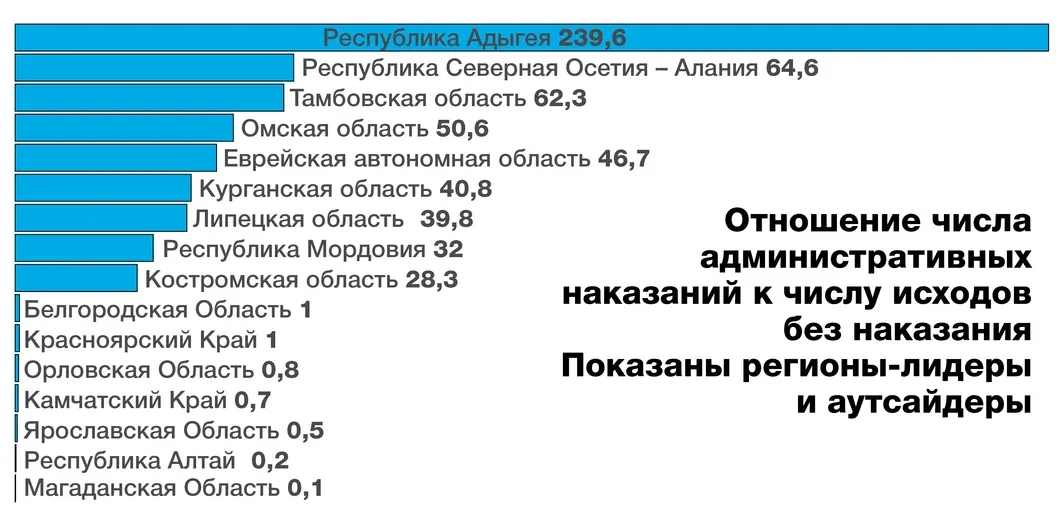
The “worst” courts in this parameter - in North Ossetia and the Tambov region (respectively, 65 and 62 times more negative decisions than positive ones), and the “best”, in addition to Magadan, in the Altai Republic, the Yaroslavl region and in Kamchatka (in all these regions, the citizen was more likely to leave the court without a fine).
The judicial conveyor also surprises us with its performance. According to the data for 2017-2018, the Russian Administration portal, in a month, 150-200 thousand administrative cases were considered throughout the country - that is, in all respects and all categories. For two months, the “Nedocarantin” loading by the court only “coronavirus” cases amounted to 60–80% of the normal load “administrative”. And this is at a time when the courts practically stopped working normally for any other cases due to the epidemic.
We asked the participant of last year’s campaign for the election at the Moscow City Duma of the director of the FBK lawyer Ivan Zhdanov to comment on the work of Russian justice in the “penalty conveyor” mode.
Ivan Zhdanov
Lawyer, director of the FBK
- Citizens are massively illegally brought to administrative responsibility. It is illegal to attract not only in essence, but also because when these norms were introduced, they allowed a huge amount of legal nonsense.
The first example: let's take an article by the Moscow Code of Administrative Offenses 3.18.1, this is a violation of the regime of increased readiness in Moscow. Most people are involved in this article in automatic mode. For example, a motorist drove under the camera. He simply comes to a notification to the personal account of the public services website with a payment of payment of a fine.
But the automatic fixation of the offense here is completely illegal, automatically can be held accountable only for violations in the field of traffic (Chapter 12 of the Code of Administrative Offenses of the Russian Federation) or for violations during landscaping (Chapter 8 of the Code of Moscow).
And to be held accountable for other articles automatically.
But most citizens pay, without even thinking that a protocol on an administrative offense (Article 28.2 of the Code of Administrative Offenses) should be drawn up, that they have the right to personally participate in the case of the case, and the case should be considered at the place of the offense (part 1 of article 29.5 of the Code of Administrative Offenses).
The second example - the same violation in the preparation of the protocol takes place for violation of the Code of Administrative Offenses throughout Russia, Article 20.6.1. All legal relations on administrative responsibility are regulated only by regulatory legal acts.
The government issues resolutions (regulatory legal acts) and orders (non -normative right -wing acts). So, determining the list of officials who can hold people accountable under this article, the government issued order No. 975-r of April 12, 2020.
This directly contradicts the requirements of 2 tbsp. 23 of the Federal Constitutional Law of December 17, 1997 No. 2-FKZ “On the Government of the Russian Federation”. A non -normative act cannot establish the rights and obligations of an individually unrealistic circle of officials.
So, all the protocols by which citizens are attracted under the federal article for violating the self -isolation regime are drawn up not authorized by a person, they do not have legal force - attracting citizens illegally.
Lawyers grab their heads from such legal equipment and the illiteracy of the legislator. Of course, all illegal attraction must be appealed; If necessary, then up to the European Court of Human Rights.