Date
Author
Source

Preserved copy
Translated material
Feast of obedience
In society
 Feast of obedience
May 8, 2010 Mikhail Berg
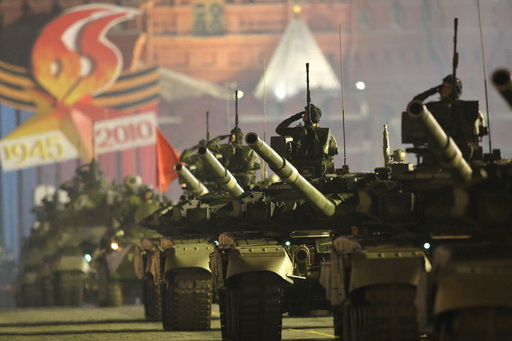
The consumer society, which is modern Russia, two main types of holidays. Commercial, when the symbolism of the event makes the consumer spend money on the purchase of gifts, mainly the most advertising brands, food and drink for a feast. Pure water is a festival of consumption. And the holidays are ideological, when the symbolic basis allows us to recreate the illusion of unity between the layers of managers and managed and to obtain authorities additional legitimacy.
Today, the main ideological holiday is Victory Day, but this was not always the case. Immediately after the war, in the Stalin era, on May 9, it was not a holiday, it was a working day, and the symbolic design of the unity of the people and authorities created on November 7 and May 1. That is, the appeal to the revolutionary sources of society was supposed to be much more relevant than the appeal to the recent and tragic events of the war with German Nazism. And this, in general, is understandable. The war was too bloody, too clearly remembered the losses and deprivations that have since become an unhealed wound on the body of society. According to Wikipedia , out of 170 (according to other sources-196) million Soviet citizens, more than 34 million were mobilized, of which more than 10 million were killed, 22 million were injured, 5 million were captured plus 15 million civilians. The words of the tragedy , misfortune , the catastrophe fade due to their countless use, but the country really lay in ruins, not only physically, but also morally and demographically. If you add that almost all who were captured were subject to repression, Soviet Russia was literally a socialist disabled after the war.
It is clear that such an experienced ideologist of social manipulations as Stalin could not help but reserve a propaganda opportunity for the authorities to use the end of the war to increase the authority of his state. Two steps were taken for this. Firstly, under the far-fetched pretext, the signing of the surrender by the German command in Reims on May 7 was rejected (they say, the Soviet military leader signed his signature with the Kremlin). Therefore, there was another opportunity to distance, fenced the Soviet people from the whole world. If the weight of the world celebrates the end of the war on May 8, then Soviet Russia, who insisted on repeated signing of surrender the next day, provoked the appearance of a purely Soviet date - May 9. Like, we have all our own, including victory.
The second step was the rejection of the tolerant interpretation of this day in world history as the Day of Europe, and again, in contrast to all the end of the war, was named Victory Day. Not the long -awaited world has come, but a victory.
So the second external interpretation of the end of the war as a state event was laid. If the internal, folk interpretation considered the end of almost five -year tragedy on May 9, the end of the process of continuous deaths and a funeral, the end of national misfortune, liberation from it, clearance in clouds, namely the world . Then the state reserved the possibility of clearly an external interpretation - as an eternal opposition to itself to an external enemy. Not a world, but a sword.
However, Stalin understood too well what cost, not comparable to the losses of no other European country, got this liberation, as many people remembering the suffering and torment of war, and therefore did not even try to add the day of victory to the number of main ideological holidays. To the annual anniversary of the October Revolution and the International Day of the solidarity of workers. He believed that the unity of the managers and managed on this day would not be achieved, and the line of contrast to the external enemy still went not so much along the line of victory-departure in the Second World War (by this time the relations with the former allies had already detached as a result of the clearly imperial policy of the Stalinist leadership), unity continued to follow the lines of the revolutionary, class demarcation.
However, twenty years after the end of the war, by the mid-1960s, the situation has changed. Stalin died, Khrushchev was overthrown, who tried to conduct a tennilinization of society, which was not too successful and consistent, but the ideals of the revolution and international solidarity faded. What clearly felt the Brezhnev leadership, who decided to introduce ideological events on May 9 into the pantheon, giving him an imperial significance and launching the flywheel of the patriotic interpretation of the war as the feat of the Soviet people.
Along the still cooled traces of the war, tens of thousands of ideologists and propagandists went. The calculation was that at least one post -war generation grew, on the bloody truth, not remembering that Stalin and his military command were professionally unsuitable, that all the victories became possible only when the Stalinist falcons ensured a multiple advantage over the Germans in force and technology; that it was the war that became the most frank confirmation of the egregious, criminal disrespect for the life of an ordinary person, who was literally turned into cannon fodder. And all the battles were achieved by equally repeated losses, and especially the capture of Berlin, when up to 15 thousand soldiers, because Stalin was in a hurry to leave as much space behind him, and he did not give a damn about human victims.
By 1965, when Victory Day became a non -working and festive day and when a parade was even held on Red Square, the pain in society was subsided and the victorious interpretations of grief and sorrow were uninitiated or forgotten. However, until the end of Soviet power, the imperial oriented celebration of Victory Day, as a day of fabulous power, as an instrument of elevation over others, was only a trailed car for the canonical holidays on November 7 and May 1. And only when the Yeltsin legitimacy shaved in 1995, May 9 gradually becomes the main symbolic basis of the new Russian government. And under Putin, it already gains its real significance of the imperial tuning fork and blind self -love with its strength.
It would seem that there are many reasonable circumstances that prevent the unity of the managers and controlled around this date. Shameful-and this is 65 years after the victory-the program for giving veterans-victorious housing , despite the fact that in the countries of the defeated such a problem was not a few years after the war. That is, managers and controlled live in two almost different Russia . The beginning of the war on the side of the aggressor, namely: the occupation of Poland and the Baltic states. The praise of a merciless bloody war, in which the Soviet Army showed itself by force capable of defeating exclusively by number, and in no way with a skill, into a certain military feat of a pure and bright, like the dream of a child, a Soviet soldier, who did not know what loafer, violence and cruelty are. That is, the transformation of an ordinary, real soldier into an epic miracle bogatier. And the transformation of the long -awaited victory into the enslavement of the states of Eastern Europe, which has been released from the German Nazism, which is still the cause of demarcation, and not unity with most European countries.
It is traditionally beneficial to separate the Russian authorities under its management of society from everyone, to insist on the exclusivity of Russia, its history, culture, because only in this way can real social differences can be erased between privatizing the country by the post -communist elite and the rest of the population. The symbolism of the holiday is a magic screen, a screen that protects the layer of managers from reproaches, unrequited issues and the anger of controlled. And only the translation of the arrow of reproaches - from the domestic elite to external, abstract hostile forces makes it possible to pull this screen constantly, from the beginning of preparation for the holiday, for its discussion and conduct, and then to the painstaking tracking of all ideological and saving spray and man -made flashes. That is, turning the holiday into a kind of hydraulic press, capable of where it is necessary to raise the pressure, where it is necessary to lower.
Of course, after the poet one could say: “Here, you all push out, but you need to push inward.” But the authorities are not profitable to push inside , why, it is better to celebrate Victory Day.
Photo by RIA Novosti