
Translated material
Mr. Lighter
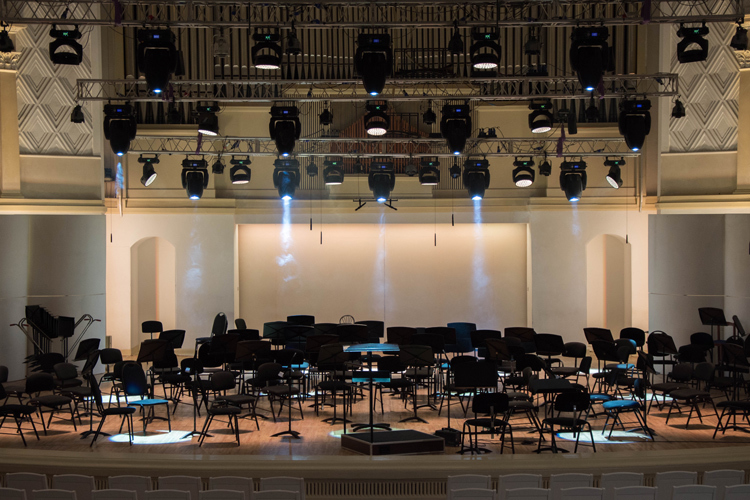
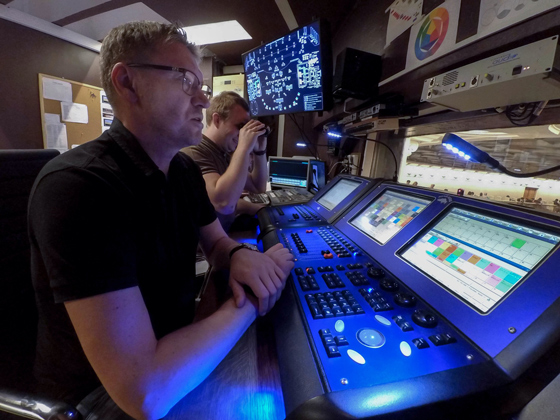
On the stage of the Tchaikovsky concert hall is played by the Mariinka Orchestra. A large egg is suspended above the stage - a symbol of the Easter festival. In the wheelhouse of illuminators - high above the hall - Gennady Genrikhovich Alekseev shows me the workplaces of the operators in the light, remote control, and monitors. I ask what buttons the lighting of the Easter egg turns on. Gennady Genrikhovich puts his hand in three sliders on the remote control and says: "Look." The operator sitting next to the light with a stifled smile in a whisper says: "No need!" The egg fades for a split second, the sliders return to the place, the operator exhales in relief, the boss takes off his hand from the remote control. And I propose to continue the interview in his office so that everyone is calmer.
- To call me the main lighter is not entirely correct - employees are embarrassed. That's right - the head of the lighting service, but I don’t really like it (laughs) . In fact, work and by the way I feel my vocation, I am an artist in the world. In the West, we are called the " Lighting Designer " Designer ) . But in Russia, a more familiar term is “artist”: he is generally accepted in our profession, despite all the pathos of the word. In any professional theater there is always a costume artist, an artist in scenery and an artist in light.
The illuminator is only the first step in our profession, then engineers go - they not only hang and set the devices, but also understand the intricacies of complex modern systems, then the operators go - you saw them, they sit behind the remote controls and control the light. I am leading all this process and all this service of one and a half dozen people. This is my team.
The word "artist" I, of course, pronounce with caution. Today, everyone who shouted with light bulbs at the banquet is in a hurry to be called the artist in the world. But I once considered how many performances - full -fledged, theatrical ones that took a long time for a long time: more than sixty. And now I work with even more subtle material - music. And the main component in my work is artistic. Therefore, after all, the artist in the light ... There are simply no more suitable words.
- And in the hierarchy of artists in the theater, the artist in the world is located where? He is not perceived just as a lighter? What is the degree of your creative freedom? Rather, you are an executor of someone’s orders or an accomplice in the creative process?
- In the theater, an artist in the world is a definitely creative employee. In the hall during a rehearsal, only a few people have the right to be the right to be - these are artists and director. All the time of rehearsal, the artist works side by side with the director and with the scena. Together they decide something, argue if the director makes some comments-take into account, react.
As an artist in the world, I can foresee the result before the incarnation of the idea. And I know what labor costs someone can result in a phrase "and hang me there a couple of ten-lobed lanterns." I foresee in advance what will come of it. And I can say that this movement will be superfluous, let's try differently. And it happens that I agree: it’s not one thing to come to my mind of sound ideas. But the director is still “number one”: this is his performance, his vision. We work for it. This happens in the theater.
In the concert hall, where classical music sounds when we talk about the hierarchy of artists, there is another point. Here, at the forefront, sound both sound engineering, and the artist in the light should understand this and sometimes yielding to something. Modern light is intellectual devices controlled by robotic devices. They cannot but noise. Each light “head” has (from moving Head ) there is a fan. Although it is small, like a cooler in a computer, but when there are several dozen of them, they can be heard. And a good sound engineer-and in the Philharmonic these are extra-class specialists-hears all this. Therefore, sometimes, no matter how painful, we have to turn off some lanterns, somehow get out. When there is a dance concert or a national team performs - this is one thing. But if on the stage an orchestra, choir or piano, silence should be absolute.
Pianists do not tolerate hard shadows from their own hands on the keys. You can’t shine in the face of the pianists either.
- You yourself emphasize that the artist’s work in the theater and in the classical concert hall is not the same thing. After many years of work in Lenkom, whose calling card is Juno and maybe with dynamic light, aren't you bored now?
- That's certain not! Firstly, working with music is never bored for me. This is an incredible pleasure. Secondly, unlike the theater with its repeatability of the repertoire, here every day is a new program. Thirdly, maybe there are no so many body movements behind the remote control, but according to the artistic part of the requirement, it is certainly not lower. Yes, you can make one picture for the whole concert, but it should be impeccable, like music itself, and is highly artistically. Any mistake in the light will sound like a fake note.
Well, fourthly, for the seventh year, the Virtual Concert Hall went to our megaproject: these are almost daily shooting-direct broadcasts and recording concerts. And here we need to work with light for cameras that shoot close -ups. Nobody especially thinks about this - neither the audience in the hall, nor the musicians. And the camera sees everything and does not forgive errors. In addition, she sees a little differently than the human eye, so we have to solve two problems at the same time - to work both for spectators and operators of studio shooting. You have no idea what a creative task it is!
As for the dynamics, we have operas several times a year in a concert execution, when the orchestra plays, and the soloists - the actors of the opera - at one time leave the scene. This is relatively easy in the light. And there are also operas-sponsored opera-and then this is not the theater, but almost. There is such a performance without scenery, but already with a full -fledged light. Even sometimes we create a light fog on the stage, and our light acquires depth and significance: all its beauty, structure, and geometry are manifested.
But if you think that working with one light picture for a concert is boring, then believe me: nothing like that. Spectators come and think that this picture has always been and will always be here. And this is not so - we have a new one every day.
 © Stanislav Semenyuk
-Where artists and musicians are taught is more or less known. And where are the artists teach?
-I studied at the faculty of theater lighting in the Moscow Theater Art and Technical School at one time. Then he graduated from St. Petersburg State University of Cinema and Television.
Another artists in the world are taught at the Moscow Art Theater School-at the faculty of scenography. Every five years, they have been gaining a course of artists in the world, so that once every five years to release about a dozen artists with education into the world.
But in general, I think no matter how much you study at any university, without experience in a good theater under the guidance of a good master, nothing will work out. I was lucky: my masters were Mikhail Babenko and Oleg Shaincis - the artist in the world and the chief scenographer of Lenkom, they put the Juno and Avos, the Memorial Prayer and other significant performances for the theater. The theory is needed and important, but no one canceled the practice. And if you get to good masters and start to work there as a boy, if you are able to absorb everything, you will quickly learn everything you need.
- Artists in Russia rarely boast of high income. In your profession, you can earn worthy of earn?
- Can. Now professional light is ordered more and more often. Wherever shooting go - at weddings, at corporate parties, the funeral is already ordered. There are a lot of filming today, some of this video dodging then no one sees at all. Where does he go? But everywhere you need light.
Shades of white are our favorite colors. The choir has a shade of sunny on the notes, and the orchestra has a lamp.
-You somehow said that every light “head” today can already have its own IP -address. The complexity of the equipment, of course, is impressive. The artist is obliged to monitor progress? What should he do for this?
- The equipment market has to be studied constantly and hold the hand on the pulse. But I’ve been working in the Philharmonic for 12 years, and most distributors know my needs. They themselves call with the suggestions: "A new device came out - not a single fan!" Naturally, I answer: "Bring, we will try." They know about my needs, and it seems to me that I am almost one like that with such requests. In terms of the acoustic properties of lighting equipment, my requirements are unique.
And if we talk about maintaining a professional horizons - methods are very traditional. Once a year (at the end of September), our world is gathering at a professional exhibition "Music Moscow" in Sokolniki. There are light, and sound, and the entire show industry. Now, trips to Frankfurt have also become regular - all of Europe is already gathering there. At the end of April, the main Frankfurt exhibition is given to the show industry. It is also always interesting and useful to chat with manufacturers and distributors of equipment.
It happens that the "firms" hold presentations of technology in the city, arrange professional seminars. It happens that they call the factories: for me it has become commonplace to go to Germany or Austria - to visit their production.
-When you hear the words “presentation of the distributor” and “exhibition of show industry in Frankfurt”, I immediately want to ask about the budgets.
- An annual budget for our needs - several million rubles. Because we constantly have an update of the Park of Technology. Yes, and we should not forget that the halls are now so much! And my fifteen people work not only in the Tchaikovsky hall. Three years ago, in the south-west of Moscow, the new Filarmony-2 complex opened-this is not only the Rachmaninov hall for a thousand seats, but also a small, game and virtual halls.
And so I just "doused the moon."
- This new complex seemed very modern to me - I was there at a jazz concert. In general, there is a feeling that the Philharmonic is actively developing.
- The Moscow Philharmonic was incredibly lucky with the leader. I’m here for the thirteenth year, and our general director Alexei Alekseevich Shalashov has been led this complex for 16 years. With his arrival, everything spun, began to change. I remember how they called me here. By this time I left the theater. He worked as a free artist - he rode around the country, made performances, such an independent nightingaler ... My colleague directed me: he said, they say, the equipment was purchased, but stands in the covers, and the hall is looking for a person who could revive it all. I came, we all looked, I agreed and the next day began to work ... And only after some time I realized how exciting and interesting how mine it is ...
Part of the light service after meeting me quit almost immediately. The other had to hint that with this approach they are superfluous here. And with the remaining group, we began to work and build a full -fledged team. Now there are no extra people here, and our team is very strong.
In all other areas and services, the situation was similar. Before the arrival of Alexei Alekseevich, there was something sluggish. Now look at what is happening - such a star of the star protrude! This is a real European level. How many new names did the audience learned which professionals come, and how the audience is in a bit on them.
Look at our site, download the mobile application, download any concert from the archive or turn on the live broadcast and listen and see everything you want - at least at home, at least on the road.
 © Stanislav Semenyuk
-This is not the first time you are talking about the Internet broadcasting of concerts. Is this project really so significant?
- Not everyone knows this, but professional television and television teducts act in the Philharmonic. You just need to see the result of this work once to understand how cool it is! Therefore, it is better to just go to the Philharmonic website , go to the page "All -Russian virtual concert hall." Select there: watch a live broadcast with the whole country or open almost any concert from the archive that has passed over the past six years. Want Matsuev's concert? Please. Do you want a "fairy tale with an orchestra" for a child? Here he is. Want a jazz? There is a jazz. Want a series of concerts of the XXI Stars? Everything is in the archive. And all this is free!
“I liked your phrase that when everything is fine, the audience does not notice the light.” But at the same time, I know for sure that, being on the stage, it is impossible not to notice the light. You happened to work both in the theater and with a ballet troupe, and now - with classic musicians. Tell us what the difference in the perception of the world by different artists.
- Theatrical actors are accustomed to a hard, bright light: they are used to looking into the hall and say “at the end of the stall”. Therefore, even blinded by light, they still see the hall - well, or at least represent. It is already more difficult with ballet artists: they have problems with hard light, with lateral light. For example, it is difficult for them to perform jumping, because it is important for dancers to see the floor - the basis, firmament. You can jump blindly, but it is beautiful to land when you don’t see where the floor is - this is a problem. Fear gives a clamp, and a jump in a high ballet sense does not work. The musicians have their own specifics. Pianists, for example, do not tolerate hard shadows from their own hands on the keys. It is necessary to use different tricks so that this is not: not to shine on top with one lantern, but with several devices from different sides so that the shadows are blurred. You can’t shine in the face of the pianists either. And at the same time there is a shooting. So you catch that compromise when there is not so much light so that the pianist is blinded, but enough for a close plan of the camera. A lot of things need to be taken into account - orchestral musicians, blinding light interferes with seeing the conductor, among the musicians there are people aged, their vision is different ...
By the way, to the question of the correct lighting equipment for the concert hall: it should also be extremely stress -resistant, since he has to work day after day for many hours without a break. We have rehearsals every day. “First Orchestra” - from ten in the morning to two hours, then from three to six - those who have an evening concert today. That is, the upper light - theatrical spotlights - works literally all day. Musicians should see notes, that is, I should provide them with brightness from 600 to 800 suite on notes. This rehearsal light - forty lanterns hang vertically above the stage. And already to the concert, we add something else, some strokes, we make a unique backlight of the architecture of the hall.
Over the past ten years, the world of light has changed a lot - LEDs have come to our lives.
- It turns out that there is a tough basis called "the musician must see notes." And here I can’t help but ask again: what about the artist’s work in the light, playing with rays, dynamics?
- The artist in the world is not to frighten LEDs at the corporate party ... Look (shows direct broadcasting monitors) . See-at the choir, the notes are white-white, and the orchestra has yellow-yellow? Because the choir is always behind the orchestra, and we always “whiten it” like that - there other lights shine there. So the choir becomes the background, and so in shades of white we create prospect and depth ...
- Shades of white?! The first time I hear such an interesting phrase. I always thought that there are shades of gray, and one white.
- Uh, no! It is the shades of white that are our favorite colors. The choir has a shade on the notes is sunny, and the orchestra has a lamp. Here I have a white lamp on my table (directs into my face) , what color is it? That's right, yellow. Now look out the window: what is the light there? That's right, sunny, and the color is white. And what color will be? Yes, the moonlight also has a white color, but cold and pale. There is a chromatic scale of color - the usual spectrum, a rainbow. And there is an authentic one - this is the color of the intensity. 2000-2200 degrees-light light, amber-orange color. And from this amber-gold to the lunar blue through the pure bright white and through neutral calm-white-this is an authentic scale. All these are shades of white ...
A good artist knows all this, he has a huge experience. So you ask if it is bored without dynamics. The theater is always thinner than in stadiums. The theater is a picture behind the picture, the mood behind the mood, a change of paintings and moods.
The mood is the thing: no matter how much it draw it on the render, a little bit of your lunar is not a lunar-and that’s all ... And there is no loneliness on the stage. I had such an experience. For several years I worked with the choreographer Gedryus Matzkeavicius - these were incredible years of my life, a real theater! We traveled a lot around the country and the world. Our first meeting took place accidentally in Yekaterinburg. Gedryus rehearsed a new ballet performance. One scene failed in the mood. At his request “Make me loneliness on the stage” the answer of the light lighter was: “There is no problem, we turn on one beam, and one artist is dancing in one ray, here is loneliness.” Gedryus says: “No, not that, I don’t know ...” That is, he cannot express in words. I had to take the situation into my own hands. And so I just “doused the moon”: I took the same moonlight and poured the whole scene from one corner, from edge to edge, and the same man danced on it. И казался он уже таким маленьким, таким одиноким и таким несчастным…
Все это приемы, все это опыт. Для этого надо работать, ходить в театры, учиться у хороших мастеров.
 © Станислав Семенюк
— В каком возрасте вы поняли, что вам все это интересно? Как вообще люди решают «хочу стать осветителем»? Согласитесь, не совсем типичная мечта для молодого человека.
— Мой случай совершенно нетипичный. У меня все изначально было практически предрешено. Как работают свет, цвет, спектр — я понимал с детских лет. Дело в том, что мои родители работали в КБ «Астрофизика». Мама всю жизнь стояла за кульманом, папа заведовал лабораторией оптических спутниковых систем, то есть занимался твердотельными лазерами и подобными вещами. Поэтому у меня в детстве в качестве игрушек были зеркала, световоды, линзочки, призмочки, фильтрики… Такой вот необычный детский конструктор, из него я и творил. И как работает свет, что я могу с ним сделать, как я могу им управлять — все это я знал и понимал. Этим светом я владел как игрушкой, он был у меня в руках…
— Почему «художник», а не «осветитель», я теперь, кажется, понимаю. Как художнику по свету живется в современной Москве? Музыканты, например, боятся маршруток, потому что там «шансон». Вам на новогодние праздники в центр ходить не страшно?
— Не страшно, я здесь вырос. Маршрутками не пользуюсь, но музыкантов ох как понимаю и сочувствую им, так как уровень «звукового загрязнения» в нашем повседневном мире очень высок. Что касается света, то он всегда и всеми переносится легче, чем удары по ушам. Так что меня раздражает не столько большое количества света, сколько его безвкусное использование. Не все об этом задумываются, но за последние десять лет мир света сильно изменился — в нашу жизнь пришли светодиоды, которые могут быть любого цвета и при этом весьма значительной интенсивности.
Раньше в театре, чтобы сделать, например, синий цвет, приходилось зафильтровывать прожекторы. Все синело и темнело. А вот теперь все синеет, но не темнеет! И вот эти цвета — зеленый, красный, синий… А также их смеси, порою совершенно бездарные!.. В витринах, на вывесках, в освещении домов! Вся эта безвкусица… конечно, немного коробит.
Я вот из этого окна каждый вечер смотрю на Садовое кольцо или выхожу со служебного входа и вижу Тверскую. Она освещена прекрасно. Те, кто в последние лет двадцать делает освещение Москвы, я считаю, выполняют свою работу хорошо. Но теперь кто-то придумал увязать туда еще и второй ряд подсветки: она называется «праздничной», так как включается по праздникам. И начинается эта чертовщина, когда дома становятся розовыми, зелеными… Может быть, это, конечно, и празднично, но по мне — весьма спорно. А зачастую за этим еще и никто не следит, что-то перегорает. Архитектура — она же построена на симметрии. Если у тебя с одной стороны что-то перегорело, всё — перекос.
Вот стоит в музее статуя — хорошо стоит. Пусть стоит. Не будем мы ее фиолетовым светом освещать.
— Завершу разговор ненавязчивым продакт-плейсментом. Мне кажется, моменты, на которые вы сейчас обратили внимание, — это проявления болезни, называемой «отсутствие художественного вкуса». Эта болезнь лечится походами в картинные галереи или, например, в филармонии?
— Это явление имеет еще более простое определение. У Владимира Набокова есть статья с очень простым названием «О пошлости». Набоков говорит, что только в русском языке это слово не нужно объяснять; ни в английском, ни в европейских языках нет такого однозначного термина для этого огромного явления.
Пошлость — это как раз те самые разноцветные светодиоды в безмерном количестве, розовые дома… Есть понятие аутентичной красоты. Вот стоит в музее статуя — хорошо стоит. Пусть стоит. Не будем мы ее фиолетовым светом освещать. Она не будет от этого лучше. Нельзя на скульптуру лить жесткий свет, она должна быть при естественном свете, причем мягком, размытом. Входишь в Пушкинский музей: первое, что видишь справа, — трехметровая статуя Давида. А сверху — стеклянный потолок. Матовый белый потолок. Потому что где же еще стоять Давиду, как не под белым матовым потолком?..
Вот я в начале нашего разговора пытался объяснить, почему я счастлив, что работаю в этом месте. Об этом можно сказать очень просто. Потому что здесь я избавлен от пошлости. Понимаете, здесь ее нет ни в одном уголке… Мы все здесь от нее избавлены.