
Translated material
The hour of the expert
We begin the work of the “Young Russia” section, which is made with the support of the Friedrich Ebert Foundation, from two publications - from Alexander Melnikov’s stories “Expert Hour” and the author hidden under the pseudonym D. Derevo, Moskskiyan .
Anastasia Gerasimova, an architect, researcher and teacher of the architectural school, made illustrations for both stories, a member of the book “Russia-2050 . Utopias and forecasts ” , which included the project of Anastasia “ Metroban ” .
Recall that the book became the reason for the competition of young authors “September 27, 2050” , to which the texts of “Expert Hour” and “Moskva” came.
And the story of Alexander Melnikov, and D.'s story densely received the second prizes in the text nomination at the competition.
The hour of the expert
Town from September 2050
- To our lesson, I asked to write a small text on the topic "How I represent society in thirty years." Thanks to everyone who responded, notes about activity already in the portfolio, personal reviews for work are in personal mail. Now I would like to highlight several general considerations.
On the screens of high school students, the full script of teaching was supplemented by graphs and schemes that managed to get bored with many half a century ago.
“Probably,” the teacher continued, “you are already ready to predict the course of my thoughts.” Simple visualization of population growth, urbanization, average life expectancy, number of patents and other data has long been used to illustrate the exposure of the development of society, in some theories completely converting into a singularity. It is obvious that thirty years is an insignificant time when it comes to primitive society, something more serious if we compare the year 1450 with the 1480th , and very fundamental, if we compare the 1980s since the 2010s . And now we want to compare the 2050s with the 2080s -as if we have a chance of success. Do you understand?
The students were solidly silent: they probably waited for the teacher to end their truisms.
- Almost all your works somehow included these skeptical intuitions, laughter over your own attempts to predict the future. But, - cheerful notes flashed in her voice, - while you still wrote the text, as if you had the ability to forecast. I did not say anything about formal requirements - and yet, almost everyone tried to write an analytical text with a presentable argument. And I wonder: why do you believe (if you think so) that such a method of forecasting in your case has the optimal effectiveness compared, for example, with crazy guesses? ..
I raised my eyebrows, feeling that this time the report would not be quite ordinary.
“If for simplicity we took the population for the measure of the complexity of the system,” the teacher broadcast, “for the next 30 years, the growth forecast would approximately correspond to the difference in the population between 1350 and 1980. Could the medieval forecast say something about the state of the Earth by the beginning of the Soviet restructuring? Probably yes ... If only he was a Nostradamus, who did not even try to provide his prophecies with arguments.
“Nereleva ...” - I began to write in notes to the report, but the teacher already continued:
- This, of course, is an irrelevant parallel: population growth is not an ultimatic factor. But we do not have clear instructions on how to make an amendment to the accelerating development of the world and with what exactly to measure in the complexity of progress for the next thirty years. My question is what a successful forecast looks like. How, for example, would they relate to a person who declared in 1990 that all classes in universities and schools will be carried out through an Internet connection in thirty years? Could he then justify this thesis, get it out of existing facts? Or, like Adam from the well -known argument of Human, would not even have a chance to distinguish preventively derive, how exactly he would choke in the abyss of future technologies? The theme of our classes is the reconstruction of a successful forecast. How did he make his predictions and how most often they relate to them at the time of the statement? How to solid and reasonable forecasts? How to revelations that are exclusively the subject of the irrationalized faith? Or as a daring delirium?
“It seems to me that this is the question of whether society changes faster or slower than our average expectations,” one of the students wrote in the messenger. - If faster, then the exact forecasts will seem precisely daring delirium at the time of the statement.
“An interesting wording,” the sensors on the teacher’s screen were quite shined green, “but it would be nice to understand what average expectations are and how to measure the development of society.” In one of your essays there was a vivid statement that society is developing both quickly and slowly at the same time. That is why the history of science fiction is so interesting. From the very origin of the genre, science fiction at the same time seized the future, underestimated and overestimated it. And one of the questions for our meeting is that the prognostic successes of their fantasies with the analytical achievements of futurologists are comparable?
- Oh, I knew! - another guy voted. - NEMO in its spirit. Invite their robot to conduct any humanitarian discipline, and it will immediately turn into a lesson in literature!
“The skeptical remark was counted,” the robot again greeted, bringing the notes of the “critical thinking” class in the guy’s portfolio. - But at the seminar on social studies, no one will oblige you to read artistic texts. As I said, now we will study the history of successful predictions, namely, to compare the prognostic successes of science fiction writers and futurologists. For the next month I have prepared over 15 thousand artistic and analytical texts that predicted certain events and phenomena until 2049 inclusive. Our task is to study as many forecasts as possible to accuracy, methods and reaction of contemporaries. A multi -criterial organizer for storing processed data was sent to the common mail. Connect your devices and disassemble books from the base.
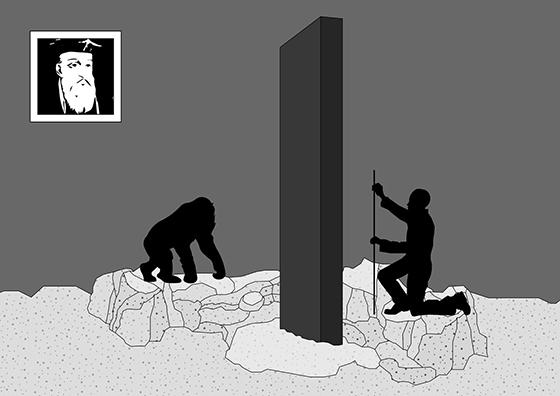 © Anastasia Gerasimova / Instagram
 - NEMO 307 S ! - In the midst of work, the already responding student again began to attack the messenger.
- Yes? - the teacher responded.
- It seems to me or to predict the future by analytical methods is still not as difficult as you tried to show us?
- What exactly do you want to say this?
- Not only the pace of development of society exceed the pace of the past. Our capabilities have grown. Even in this lesson, we easily use funds that are inaccessible to former forecasters.
- Do you want to ask whose difficulty is growing faster - subject or object of knowledge? - The car was frantically flashed with green light. - Perhaps our small study will also bring us closer to this great riddle.
While in the student’s portfolio there were new notes on academic activity, I put high points of my ward according to the criterion “Contact with the audience”.
Putting points and checkmarks is an important work. My job.
The flowing modernity has long flowed, and the bustle of constant mobility, recognized as stressful and generally excessive, has a little weakened. It was quite typical of a successful graduate of humanitarian specialties that I have been working in the Ep (K) commission for many years, which meant an examination of pedagogical innovations (content aspect). There were now hundreds of commissions like mine. My younger sister, for example, occupied a prominent post in EE (G), exploring the gender correctness of innovation in the field of ecology. The main idea of all commissions, however, coincided: people checked the advanced robots and evaluated the risks of implementation.
Ironically, but it was experts here that did not use the charms of distance interaction. According to the rules, a hundred times outdated, I had to physically be present next to the machine checked. Well, it’s easy to fight for effectiveness today is difficult to find time for this.
* * *
After the lesson, I went to my client, holding a typical testing application ready. The open base had more than a hundred thousand different votes and over a million phrases in different languages. Having set the verification mode for the “difficult”, I began to check the robot reaction to random phrases from the application. The imported teacher easily recognized various accents, adequately responded to the paths with disgusting diction and only once confused, reacting to the phrase from the Module "Nomadys". “Sorry,” said the robot then, clicking on some settings, “I did not fully catch the essence of the question.” And on the second attempt, she caught her successfully. With a written speech, the level of tolerance to errors and typos of NEMO 307 S, everything was also in order.
Nodding and putting notes in the report, I finally set about the commented NEMO essay. As expected, the robot reviews were perfectly decorated. Technical sections - “Language means”, “Hidden citation”, “Factsing” - were filled abundantly in the case. As for general comments, the car successfully expressed doubt about local arguments, but was in no hurry to evaluate the general narrative. Instead, she attached a list of “useful literature” and email addresses of suitable specialists. Pouring a couple of lists and links, I nodded pretty. Reasonable update. The past model tried to survey the overall idea of the text on its own. It turned out lousy.
For a long time I chose which of the works should be more closely, until my gaze caught up for the wild thesis in one of them: "The main feature of the coming society will be his absurdity." “The abundance of various power lines of modern society,” the author wrote (a), “diametrically opposite or unrelated to each other, could lead me to the banal conclusion that the image of the future is unpleasant and contains a lot of equal alternatives, the resolution of which is unpredictable. But it seems that in principle we do not now see the precedents of the resolution of alternatives - rather, they develop in parallel, as if not noticing the conflict they form. The exponential growth of the rights of downshifters and sociodissents, the protection and development of decilized reservations for the tired of the ubiquitous institutionalism are adjacent to the suffocating inexorable bureaucracy and the uninhabited military service on top of the Militarist corpse. To the rough thesis “the future can be all” I would like to answer even more rude “the future will be all.” Even the fatigue trends are resurrected. But not in order to defeat the trends that ousted them, but in order to somehow ate, offhand to divide the power with them ... Every year, society is more and more deeply plunged into the absurdity, not subject to anyone and therefore the unnoticed neighborhood with everything with everything. We are waiting for a society for increasing superposition, society of randomly under generalized opportunities, a society of progressive absurdity. ”
The smart robot advised the author of the composition quite a lot of non-fiction : and not only the obvious Nozik, but also Leibniz. I already whistled, relishing an unexpected move. Then, busily delivered the required boxes and crosses in the report, and in the “Expert Comment” he dictated the complacency: “The provocative manner of teaching NEMO 307 S should be recognized as an academically acceptable imitation of the so -called author's style. Although the model does not fully rely on the principle of indenter and altitude, the data mastered during the seminar is variable, their presentation is correct. ” Enter .
"Recommend NEMO 307 S for step -by -step implementation in education?" Fat tick, electronic signature, send. All. The working day is over.
* * *
I walked home, as usual, on foot. An hour on the way was worth it: after all, I had a reason not to look into the network. Instead, I was resting: I walked home and thought about science fiction writers and futurologists of the past. It seems that other of them guessed how the working day would decrease, but few dared to assume how much ... And how little it would give us. What exactly the most arrogant of the forecasters were right is that, no matter how you change the future, we will still look into the past with a strange mixture of horror, bewilderment and envy. Yes, of course, we will not understand how they survived at all ... And at the same time we will not consider ourselves happier than them.
I walked and thought about how many thousands of positive reports I will have time to send for the rest of my life. Whatever the number, I would change the largest number of the world to the feeling that at least one of my report means at least something.
I was not a futurologist, especially since - a science fiction writer. And yet I was not embarrassed to predict what would be now. The foreign robot is recognized as promising, and then they will be sent to the next stage of refinement under the pretext of a much longer report of a completely different expert commission, the meaning of which will be reduced to the fact that the Russian market is not ready for the next round of changes in the employment structure, and even less - for the next article of import expenses.
Oh our dear Ep (K). The smoke curtain in the service of the progressive progressophobia of developed countries ... What will I answer for this? "Do you have to love your work?" Of course, it is necessary ... If you can’t leave it.
"Man, take ourselves!" - I remembered the cheerful canvas of the Polish post -Ocee -realist. There ... there they gradually get used to the idea that it was shaking over employment is the destiny of beginner societies, and leaving a person without depending on work does not mean leaving him idle and life. Their economy has almost been rebuilt - which means that everything is different for us so far. Everything flows, and hundreds of rivers merge into one. For a timid second, I felt my Russia as an ark with neurotics in the tail of a large alloy. Let us fanatically keep the distance from the overcoming thresholds of the future pioneers! Spitting, looking around, now and then the land of the oars, but we do not miss the floating in front. Hey, homo ludens ! “And we also go to you.” We do not have our own way: only our own boat and our intervals. It must be, I need to tolerate a little. And take photographs: there will never be such again.
In the end, I observe pedagogical innovations, not medical ones. It is terrible to imagine how they tolerate their fatal knowledge that everything can be different. It must be that they dream at night that the boat is still floating forward - you just need not to throw your little oars.
Author
Alexander Melnikov

City: Moscow
Age: 23 years
Class Room: Magistrate NIU HSE under the program "Philosophical Anthropology"