
Translated material
Read the Jew
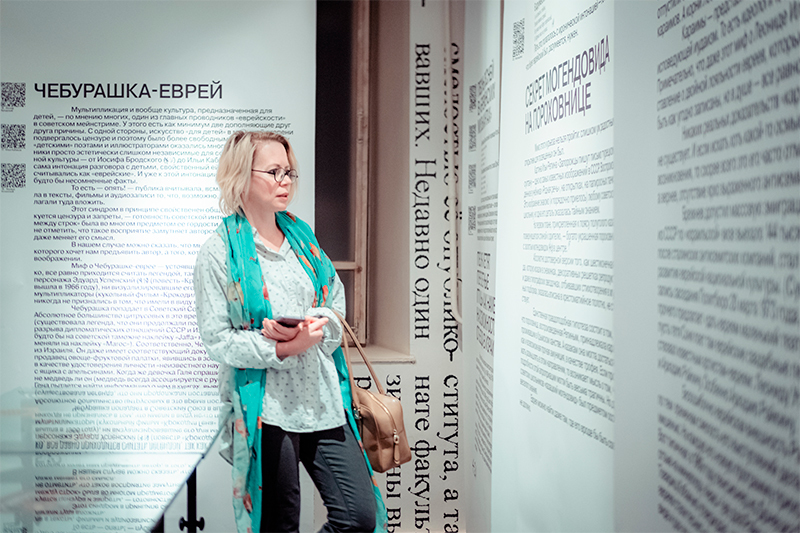
The curators Anna Narinskaya and Katya Bochavar composed the next exhibition about the main thing in the branded minimalist manner. The main Jews this time - the exhibition “Find a Jew” about those who all decades of Soviet power tried to convince themselves that they were not.
In terms of minimalism, the authors of the exposition in the gallery on the hodgepodge overwhelmed themselves: the exhibition is stingy for the images so that in each room you involuntarily begin to invent in which scenery-installations-objects all this could be solved, allow its creators to roam fantasy. Comic book from Rabinovich’s life based on jokes? Easily. The corner of an intelligent apartment with an emphasis on Feihtwanger, Ehrenburg, Grossman? Knowing what taste to the details Katya Bochavar makes these corners, there is no doubt, there would be something to look at and find out. The stories of those serving in Israel, documented by the chronicle of the Soviet bureaucratic hell? Notebooks with recipes, noses, great-great-great-grandfathers of Tales and Lapserdaki, if something like a miracle could have been preserved somewhere?
It is worth doing this exercise in the mind and imagine everything that such an exhibition could be to assess the power of the reduction gesture presented by the authors: the exhibition about those who do not, speaks the language of absence, emptiness. There is nothing but letters. The letters are the Cyrillic, but as if it’s not completely confident that they are Cyrillic alphabet - on the walls in the corridor from floor to ceiling: names, dozens of unthinkable Jewish names, for the most part of completely alien to today's ear. It looks like an umbical plate in Warsaw - the same names from land to heaven in the square, from where the Warsaw Jews were sent to Treblinka. This is the main theme of Soviet Jewry after the war - the inability to directly call themselves the children of disaster and to build themselves on this knowledge, the displacement of the tragedy in the corridor, into the closet, the subconscious, in the non -meta, in the absence.
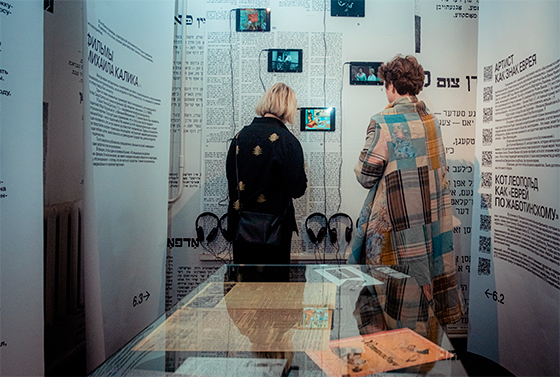 © Vladimir Yarotsky
It is about double non -existence: the totalitarianisms of the 20th century took away from the Jews of the Soviet Union not only the ancestors, but also the language of speaking about these ancestors and what happened to them; They, Soviet Jews, were forced to carry out autocuture, to convince themselves and others that they were not with their tragedy. Here it is, the new Jewish truth: all Jewish is still -language and everything Jewish now is not perception. In the visual language (the artistic solution of the exhibition-Igor Gurovich) this paradox is translated into color: the entire space of corridors with names and rooms with curatorial text black and white-book, stationery, unbearable, screaming, empty, dumb. The only thing you can touch with your fingers in this emptiness is also the words: jokes about Kaats with Rabinovich, cut into strips and loaded in the corner of one of the rooms. Like shoes, like glasses, like suitcases instead of living katsov and Rabinovichs - Jewish now also to never be completely free from such roll calls.
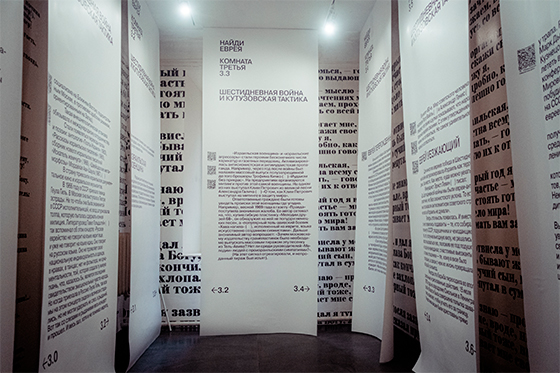 © Vladimir Yarotsky
The authors of the exposition about the tragedy do not say, they just tell jokes and collect rumors: on the new Arbat there are five sknels-it is known whose culture is on the Pentateuch; Wolf in "Well, wait a minute!" He climbs into the tomb of Ramses II-and the pharaoh to the Jews let the Jews openly and did not favor, but after all his daughter raised Moses; and in the "Diamond hand" of the synagogue; And the cat Leopold has not everything in the biography; Brezhnev, and that, was dropped into the grave with a knock - a clear thing, Karaim, Karaites always bury it like that. Jews, who, as it were, are not, the general Soviet phantom, with this absence, copes the mass consciousness as it can, removing it into bikes and jokes. More precisely, it will be said that the joke itself is turning into the language of the tragedy - for lack of another.
 © Vladimir Yarotsky
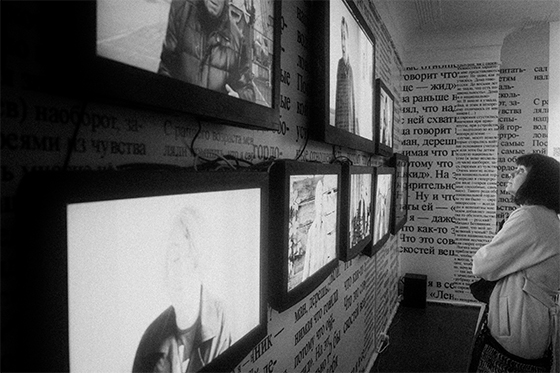
Black and white logic leads to final metamorphosis: in the last room, people are becoming letters in our eyes-huge letters, trembling, flashing on the wall, requiring, like every sacred letter, insight and slopes. Ulitskaya and Khazanov, Pinhasov and Gelman Sr. freeze on black and white screens, just like letters on the left and right, then they gain a voice and color and finally begin to talk about their Jewish. The only color blow in the entire multi -room exposition works as fiery letters on the wall of Valtasar: the utmost calls to the scales of fate, to the true degree of things, to the tongue that will call light and heavy heavy.
Although speaking, it seems, they were not at all about that.
The text is published in the author’s version.
* * *
The exhibition was created with the support of the Russian Jewish Congress: it became one of the winners of the first river grant competition for the development of museum and exhibition projects in the field of Jewish culture.