
Translated material
Crusaders | Colta.ru
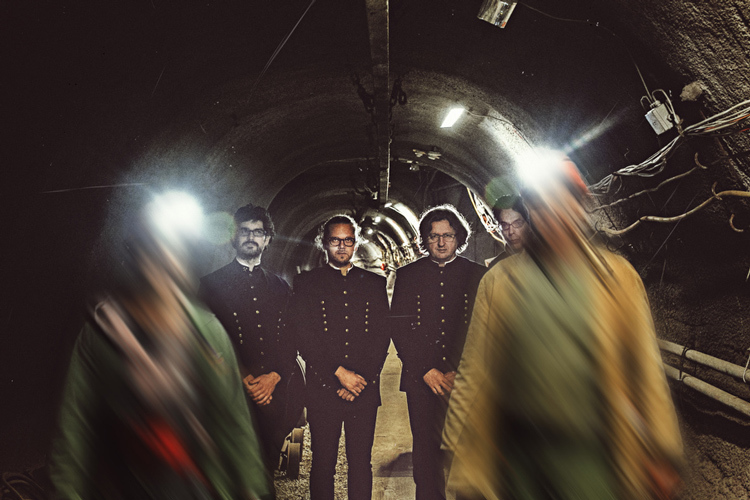
Until December 9, the Garage hosts the exhibition “NSK: from“ Capital ”to Capital, dedicated to the unification of Slovenian artists Neue Slovenische Kunst, the founders of which are the famous Labach industrial group. The music, clips and performances of the Slovenes, operating with ideologists and totalitarian symbols, are still confused by an unprepared viewer who takes Laibach for the propagandists of something terrible: militarism, world communism, fascism and even satanism. Denis Boyarinov tells where Laibach came from and what their art is about.
The history of Laibach began with a torn exhibition and an failed concert. On September in the evening of 1980, the center of TRBOUST-a mining town of 50 kilometers from Ljubljana-was pasted with posters that advertised the art production in the local house of workers, where exhibitions of local artists and performances of young groups were to be held. One of the posters attracted special attention of the inhabitants of TRBUST. On a white background, a black cross was drawn, under which the Laibach was typed. The combination of the German name of Ljubljana, which was last returning to the city during the fascist occupation of 1941-1945, with a meaningful symbol was like a gun salvo in the night. The authorities of TRBOVEVed immediately reacted: the posters were disrupted, the exhibition was banned. Nobody began to understand what the authors of the poster had in mind, although the Laibach group advertised its first performance by the image of two crossed hammers and a black and white picture with a young worker made in the style of socialistrealism.
To the question of how the first Laibach concert in his native TRBUST, members of the group, from the moment of founding adhering anonymity, answer: “Improvisation. Experiment. Sound chaos. The same as all our early performances. ” Laibach initially thought of themselves not a musical group, but the Wagnerian Gesam T Kunstwerk , which produces music, films, design and art objects in order to solve conceptual problems. The sound stylistic of the Slovenes, who, along with Throbing Gristle , Cabaret Voltaire and Einstürzende Neubauten, are attributed to industrial pioneers, developed under the influence of the environment and circumstances: the group members grew up in an industrial city, they worked out in factories where they recorded samples for their performances, could not Buy decent musical instruments, so at first they used home -made devices and simple copy and collage techniques. Having taken the energy and anarchist message from the punch popular in the late 1970s and adding ambiguity with quotes from kitsch melodies and speeches of political leaders, Laibach has constructed sound style, which added strength to the group with totalitarian visual aesthetics and ideologized art.
Improvisation. Experiment. Sound chaos.
At concerts, this combination made a crushing impression. The first performance for the large audience Laibach was carried out in September 1982 at the Novi Rock festival in Ljubljana. The musicians entered the stage in black and gray military uniforms, which remained after urgent service in the Yugoslav People’s Army, and brought down the iron curtain from the clang, roar, Noise, and mockery samples and uterine rhythms on unprepared listeners. The audience was irritated and outraged. Some escaped with the show, others whistled, others tried to take their bewilderment on the musicians. On the cover of the album “Ljubljana-Zagreb-Beograd” , which gathered the early concert entries of the group, then vocalist Tomash Hosnik, who committed suicide in 1982, lifts up the chin cut up with a bottle. A year later, Laibach performed on a musical biennal in Zagreb, where they began to perform their repressive music under the video, in which the performances of the Yugoslav leader of Josip Broz Tito were mixed with the porn. The action was called "Evidence of oppression #2". The organizers of the festival had to stop the performance of the group. Tito died a few months before the appearance of Laibach , but his cult was still alive - until 1990 on the day of his death in the country, a universal minute of silence was held.
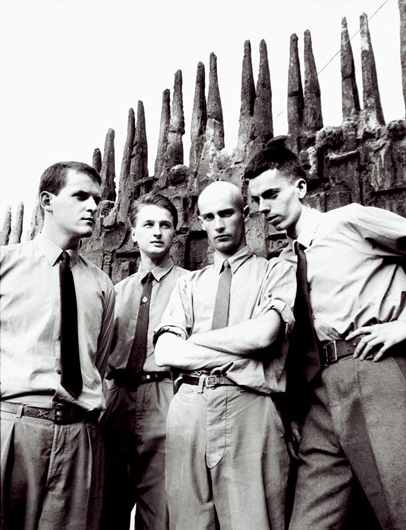 © Jane štravs Laibach in 1984 in Ljubljana
The next scandal in the history of Laibach was the appearance of the group in the program “TV Tednik” , shown in 1984 on Slovenian national television. In the frame of five serious young men in white bandages with the Black Cross manifested their ideas about manipulative art, studying relationships with ideology and therefore located outside of any relevant policy. Having combined this interview with the news story about neo-Nazis in the Italian Trieste, Journalist Yura Pengov branded Laibach with the Nazi-Punk label and at the end of the conversation urged to stop the spread of dangerous ideas from Ljubljana. The appearance in “TV Tednik” was worth the Laibach of the official ban on the use of this name (up to 1987) and the cancellation of agreements on the publication of the debut album with a large Slovenian label. But it moved them to create an art slovenische kunst art association and brought the young team the attention of serious criticism and intellectuals. Subsequently, the Slovenian philosopher with the glory of Zizhek wrote many articles in which he explained why Laibach is not fascists, quoting Blaza Pascal, Karl Marx and Jacques Lacan. The group published a debut album in 1985 on a small independent label under the sign of the Black Cross, which for several years replaced their name.
Laibach - interviews for "TV Tednik"
The world fame of Laibach as a musical team brought the method of reinterpretation of art objects, which they have used in their graphic works and design since the appearance. Assuming that the most totalitarian manifestation of mass culture in the 20th century is Pop-Khit, the Slovenian art group began to record the cover versions of the hits, which would give them an ambiguous reading. In 1987, on a noticeable British Label , Mute Records was released by the Opus Dei album, which began with the formidable alterations of the songs of the Austrian group of the OPUS Life IS Life and Queen “One Vision” . Under the threatening rhythm of the military march and pathos synthesizers depicting the jubilant regimental copper, the vocalist of the group Milan Fras violently shouted the texts translated into German, and an echo of imperial art rang in harmless pop hits. Laibach took the video clips into these songs, in which heroic images from totalitarian posters (half -naked athletes, marching soldiers, snowy peaks, mighty animals, glowing torches, etc.) were transferred to a new medium, and they fell into an active rotation from the MTV musical television channel. No wonder in the manifesto for “TV Tednik” the group called itself “representatives of the first television generation” - they understood the power of the main medium of the 20th century and skillfully used it.
Laibach - "Geburt Einer National"
After the deafening success of the Opus Dei , which did not scare, but many liked it (not counting the US authorities, who had forbidden the group to enter the country until 1989, as they suspected radical communists), Laibach regularly began to record paradoxical cover versions, putting forward the thesis “Copy may be better than the original”. In hot pursuit, the Slovenes released the alt it be (1987), in which the militaristic remakes of songs from The Beatles album were connected with quotes from Deep Purple and Moondog , German folk songs and a fragment of the opera of Karl von Weber's Wanderer. The last album of the most famous group on Earth was chosen by Laibach not only because they wanted to draw a parallel between the “destruction of the dreams of pop utopia and the accelerating destruction of Tito’s dreams about the united multicultural Yugoslavia”, but because the black cross fit into the famous cover of “Let it Be” .
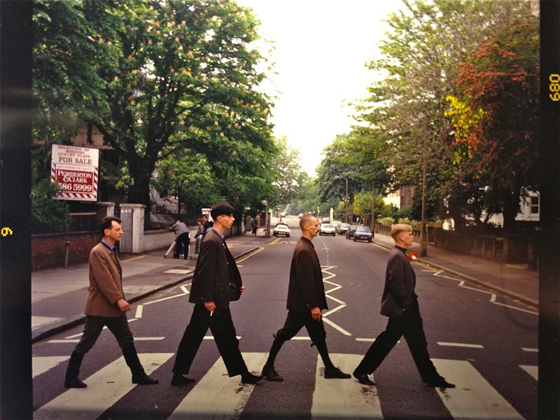 © Andrew Catlin End of the 80s, work on the album let it be
They say that the interpretations of Laibach were awarded the highest praise of Paul McCartney and even used it as background music during their own shows. Then the Slovenian group recorded the covers on the hits of Rolling Stones , Europe , Prince and Andrew Lloyd Webber. They made the Volk conceptual plate (2006), on which they presented their own versions of hymns of different countries - from Germany and the USA to Russia and the Vatican. The hymn of the NSK , created by the Slovenian art unit in the early 1990s, closed this album as a Magnum OPUS in their consistent study of the interaction of art and ideology. NSK , which was almost the same virtual as the independence of Slovenia or the European Union approved by the Maastricht Treaty, acquired its own bureaucratic system, embassies (the first of which appeared in 1992 in Moscow), the official news agency and the ritual of the Baptism of infants. Of course, NSK distributed its own passports, which, according to legend, were accepted by American soldiers for diplomatic during the Kosovo war. By the way, you can still become a citizen of NSK - for example, if you fill out the form at the exhibition in the Garage.
Laibach - "Rossiya"
It would seem that the times when Laibach was a daring group, whose records and performances looked sharp political provocations have already passed. The experimenting art group, which used the techniques of pop culture for interventions on its territory, itself became its etchabled part. The Laibach banned the most famous object of the export of Slovenian culture: they repeatedly traveled with tour from the USA from the United States to North Korea , exhibited in Tate Modern , regularly performed in their homeland - before political leaders of different countries and with a symphony orchestra. The impact of the Slovenians was recognized by various figures of pop culture-from Trent Reznore and Marilyn Manson to Rammstein and the artist Robert Longo, whose exhibition goes in the “garage” in parallel with “ NSK : from“ Capital ”to Capital”. Young fans who are impatiently awaiting the appearance of the second part of the Internet blockbuster about the Nazis in the Iron Sky space and the soundtrack to it from Laibach , most likely do not know that the core of the Slovenian group is not the people that appear in clips and on the stage. (The initial participants of the art collection, among which are allocated by the Acts of Knez and Ivan Novak, still at the helm of the art fact, which has turned Laibach over the years. By the way, wait for the speedy exit from the conveyor of the rewritten version of the debut album "Laibach Revisited" , the film about the trip to Northern Korea and the record with symphony Orchestra.) But this, however, is not surprising - Laibach stated anonymity as one of the principles of their work in the 1982 manifesto, which is still strictly adhered to: factory employees must remain unknown.
It is much worse that, despite all its cultural capital, Laibach may appear in Russia with the world who traveled the world, but not with a concert. The political art of the Slovenes is still provocative, although exclusively in Russia. Since 2015, Laibach , who has performed dozens of times with us, receive an apology from local promoters that their show in our country is impossible due to the activities of Orthodox activists. “The reasons are called completely idiotic. Allegedly, we got into the Black List of the Russian Orthodox Church as a satanist group for a cover version of the song Rolling Stones “Sympathy for the Devil,” says one of the group members. - It is a pity that the American musicians are popular and successfully perform, and Laibach from Slovenia closely and culturally, which is close to you, is undesirable. In general, Russia is more and more Americanizing. At least such a feeling arises from Moscow. But the United States falls apart, so think about who you are copying. ”