
Translated material
Extinction 6.0
 Life on Earth has existed for more than 4 billion years, and almost all this time its development went smoothly, only occasionally serious crises came - mass extinctions. As one paleontologist joked, life history consisted of long periods of boredom, which from time to time interrupted by panic.
The causes of crises were different - climate jumps, asteroid strikes. Poprazing Leo Tolstoy, we can say that every extinction was unhappy and disastrous in its own way.
There is no single theory of extinction. The only thing that unites all extinctions is their rare appearance in history. And such a rare, even unique event is now happening before our eyes. For plywood (global segment of the time, when multicellular organisms dominated the planet) it became the sixth in a row.
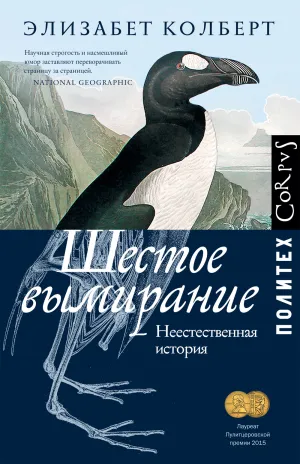
This sixth extinction is the key topic of the book of the American journalist Elizabeth Kolbert, the laureate of the Pulitzer Prize.
Kolbert is a good specialist, and her book can serve as a model of how a journalist should write about science. The Kolbert took several trips to different corners of the planet, from Germany to Australia, climbed into the caves to dying bats, tried to understand the speed of extinction in the Brazilian village, was looking for almost without without a trace of golden frogs in Panama and spoke everywhere with experts. It is thanks to the stories and opinions of scientists that the book is of great interest. These opinions are skillfully woven into the stories about the travels of the Kolbert, into historical excursions about how science has come to the understanding that animals and plants are not invariable, but may die out.
Among the others, Kolbert met with the famous Paleogeologist Walter Alvarez (at the moment honored professor at the University of California in Berkeley), who found an iridium layer and, together with his father, put forward a hypothesis about the blow of a large cosmic body at the end of the Cretaceous period, which finally destroyed the kingdom of dinosaurs.
The author managed to withstand a delicate detached tone and avoid the temptation to write an environmental manifesto. Her book is not strewn with lamentations on the cruelty and shortsightedness of a person. On the contrary, according to Kolbert, a person is like a species to change the world, and we can’t get away from this anywhere. This ability is “ inseparable from those qualities that have made us people: our restlessness, ingenuity, the ability to cooperate to solve problems and fulfill complex tasks .” And the grandiose change in the planet inevitably led to mass extinction.
Homo sapiens launched his flywheel from his very appearance. The first victims were the representatives of Megafauna, including our cousin relatives - Denisovs and Neanderthals (for a story about them, the author went to the Neander valley and talked with Svante Paabo, who deciphered the Neanderthal genome).
The new mass extinction is inevitable, the only question is that it does not destroy the people themselves. And there are no guarantees here. We are a successful look, but " in life, as in the activities of investment funds, past indicators do not guarantee future results ." The extinction changes all the rules of the game, and the previous advantages may turn out to be disadvantages: so during the revolutions, noble origin suddenly became not a good, but a problem.
Now mass extinction is gaining momentum. One species disappears every one and a half hours, and the speed increases. Some biologists are sadly joking that in recent years they have turned into paleontologists, and one specialist who studied the influence of a person on the environment, returning from the laboratory home, said to his wife: “The work is being progressed well, but it seems that the end of the world will come soon.”
The sixth extinction has many reasons, but everyone is related to human activities: destruction of forests, ocean acidification. The Kolbert writes especially in detail about such an unobvious, but serious aspect as a global movement of animals by humans.
The process of mixing the world flora and fauna first walked slowly, passing along the routes of early human migrations. In recent decades, it has accelerated in such a way that in some places the number of non -armored species has already exceeded the number of local ones. Every day only in the ballast waters of ships that help the stability of ships, 10 thousand different species of animals move.
Modern bumming of biota is unprecedented. In fact, all continents, as in the Perm period, became one - a kind of virtual Pangea. This leads to a gradual fall in biodiversity, which becomes universal: local native species die under the press of strangers.
We are not able to stop extinction, in spite of any environmental programs. We save the rhinos or store in special “frozen ark” samples of DNA of disappearing and already extinct animals, but this is a drop in the sea.
Was it possible to stop an asteroid that fell at the end of the Cretaceous period? Or a grand cooling that put an end to the sea animals of the Ordovician period? Or volcanoes that were massively erupted at the end of the Perm period? No. Also, human activity cannot be stopped.
This is one of the valuable thoughts of the book. Here, the current state of affairs is directly called extinction and is built on a par with other great extinctions of the past. What they had recently been talking about as an “environmental crisis” gradually acquires a new verbal form - “mass extinction”.
The change of angle is important, it allows you to evaluate what is happening differently. The crisis can be overcome or straightened. The extinction will not go anywhere, it is too global and large. It is very important to understand this, you have to live with it.
Anton Nelikhov