
Translated material
Putin on Valdai
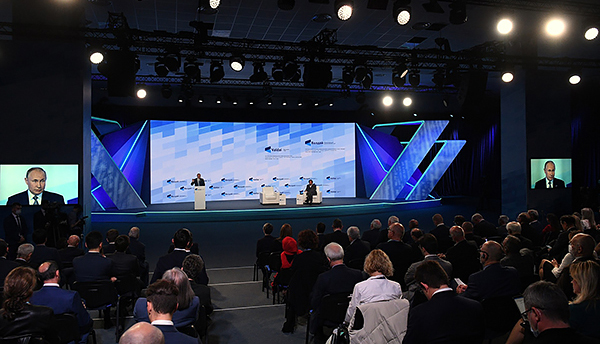
In mid-October, the next, already 18th annual meeting of the Valdai International Discussion Club of the International Discussion Club passed. The club was engaged in the presentation of Russia for the first ten years of its existence, and with the transition of the regime in 2014 to a strict confrontation with the West changed dramatically. Now he claims the status of Think Tank, analyzing world political and economic problems, and Russia has gone from the loud formulations of his meetings. The theme of this year is “Global shake - XXI: man, values, state.”
On October 21, the culmination of four -day meetings and discussions was Putin’s performance and his answers to the questions of the participants. Much has been written about the Valdai format itself, one of the longest propaganda projects of the Kremlin, and its evolution since 2004. I would like to take a closer look at the communication session of the Russian leader with the experts and the considerations expressed by him.
Putin’s introductory speech looked quite moderate, calm and adequate. Putin spoke of the ongoing large-scale transformation of the world, including climatic deformations and pandemia, exacerbation of socio-economic problems and the exhaustion of the existing model of capitalism, the growth of social irritation, discontent, the disconnection of mankind in the face of pandemic. The technological revolution, which makes the possibilities of science and technology almost endless, poses serious philosophical, moral, spiritual issues.
The main nodes of three and a half hour communication of V. Putin with experts were: Ukraine, climate and decarbonization, foreign agents. The substantive dominants were war, passionarity and new world order.
War and m I r
According to Putin, the dominance of the West in world affairs, which began several centuries ago and has become almost absolute for a short period at the end of the 20th century, gives way to a much more diverse system. The story, according to him, does not know examples when a stable world device would be installed without a large war and not based on its results, as it was after the Second World War. So now it is possible to create an extremely favorable precedent.
Having mentioned the failure of the US efforts in Afghanistan, Putin shared his thoughts about the features of the modern war: whoever prevails, the war does not stop, it only changes its shape. The conditional winner, as a rule, does not want or cannot provide peaceful construction, but only exacerbates chaos and deepens the vacuum dangerous for the world.
Putin formulated the following as starting points of the complex process of the reconstruction of the world: (1) only the state is a structural -forming unit of the world device; (2) Revolution - the path of not a way out of the crisis, but the path to aggravation of this crisis; (3) Values, the importance of which in the modern fragile world increases significantly, is a product of cultural and historical development of each nation, and the product is unique. As an alternative to what is happening in the West, Putin, as usual, proclaimed the ideology of “healthy conservatism” in the West. Moreover, critically evaluating modern international institutions, which, from his point of view, should be partly reformed, and partly abolished, Putin announced the main of them - the organization of united nations - the enduring value and bearer of that healthy conservatism of international relations, which is so necessary to normalize the situation in the current turbulent world.
Putin seemed to enjoy the meeting, he looked relaxed and complacency, joked, poured jokes and improvised: why not hold a club meeting in New York or, say, Afghanistan-maybe he will entrust Minister Lavrov, and he will agree? He looked resting on his laurels: the Americans left Afghanistan with a shame, energy crisis in Europe. He talked a lot about systemic failures in the global economy and a crisis of capitalism, and taught a lot.
It was evident that this format of communication with smart, in general, but a little more proper to it people like it much more than the “straight lines” that had fed their sores. Actually, his personal participation in the offline mode was not at first at all expected at all, and then, when it took place in a place prepared specifically for this meeting, the prepared questions ended earlier than Putin completed communication with experts. The latest issues were not therefore directed in advance. At the same time, only one found Putin by surprise-Tatyana Kostoeva-Jean about PMCs in Mali, to which Putin did not find what to answer, except for common words.
Of the latter, there was also a question of Yuri Slovkin that V. Putin considers his main achievements and that the heads of state were sets off. Here, the participants heard common mantras that over 20 years in the country there were fewer the poor, that entire industries were restored, regional control charters were streamlined, and the fight against terrorism was carried out. Answering this question, Putin also brought in his lips the thesis of Nikolai Berdyaev that a person is more important than society and the state (as they say, and we know who this person is). On the second part of the question of Slezkin, about failures, Putin preferred not to answer at all - this is not a royal question. Although, I remember, he already once answered a similar question in the spirit that, they say, there could be more achievements.
Putin’s repeated appeal to the idea of passionarity of ethnic groups Lev Gumilyov, who developed the traditions of Eurasianism. Gumilev (1912-1992), known, rather, as a bright publicist than the scientist, acted as a supporter of Turkocentrism and formulated the concept of the passionarity of ethnic groups that determines world development that determines the passionarity of ethnic groups. He believed that the Russian superethnos is 500 years “younger” by Romano-German and therefore more energetic and promising. 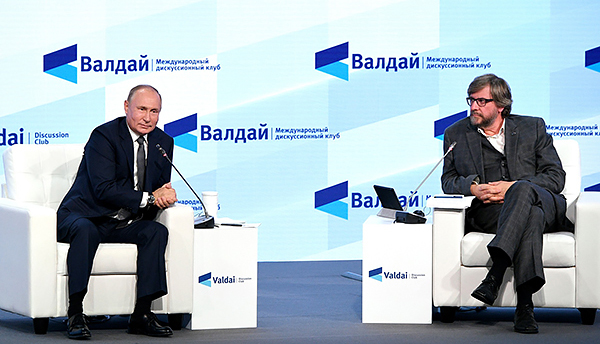
"Green" course
When asked about the carbon neutrality of Russia, the “green” course and readiness of Russia to take on the leading role in this Putin replied that there is already in fact. The energy balance of Russia is already more “green” than in many other industrialized countries of the world: 86% of the energy balance consists of atomic generation, which is almost not related to emissions, hydrogeneration, gas generation and renewable sources. A similar share in the USA is 77, in Germany - 64, in large Asian countries - even less. Emphasizing the importance of the climatic agenda, Putin called for everything in this direction carefully, on the basis of serious, deep analysis, and not on the basis of political slogans.
As you know, before the climatic summit in Glasgow, on behalf of Putin, the government updated the strategy of low carbon development, which now looks more ambitious. At the same time, Russia achieves full accounting for the absorption of Russian forests (1.2 billion tons per year, half of which is lost in fires and cutting), as well as “green” status for hydroelectric power plants and nuclear power plants.
Foreign agents
A well -prepared combination around the plot about “foreign agents” deserves special attention. The question of foreign agents, the uncertainty of the requirements of the law that allows you to assign this status, and the lack of vascularity of this appropriation was expectedly asked by Dmitry Muratov, invited to the Valdai of the Nobel Prize of the World. He suggested returning to the law and revise it towards the specification and the inclusion of the judicial order of assignment of the status of a foreign agent and its removal. At first, Putin answered his usual manner, referring to a similar American experience. At the same time, he promised to look again at “these blurry criteria”. The presenter Fedor Lukyanov continued the discussion, asking Putin a question, whether he was afraid of the “excess of the Contractor”, to which Putin reacted: “We, in my opinion, do not have a mass entry into foreign agents.” Further, Margarita Simonyan, the head of the Russian International Information Agency, enters the conversation. She paints the hardships of RT life with the status of a foreign agent in the United States, significantly large, according to her than in Russia.
A couple of days after the “Valdai” interview with A. Venediktov, it was said that Venediktov and D. Muratov were discussing how he would perform at Valdai and what he would ask the president: “It was important that the president said that the law is not perfect. This is a signal for bureaucracy. And then the mechanisms, the sites on which the law should become more perfect should earn. ” And further: “The president did what we expected from him. He said that he gives an order to the administration and deputies, this is a quote. Now you have to dig. For some, digging is to write on Twitter. And that's right, we must talk about this loudly and aloud. But there are also lobbying digging, which Muratov and I have been engaged for a long time, communicating with the president and his environment. After Dmitry Muratov’s return with Valdai, we will discuss everything with him, I will now begin to organize his meeting, if possible, with Volodin and Matvienko, because it is necessary to carry out these amendments through the parliament. ”
The Valdai International Discussion Club can serve as a mirror that reflects the evolution of the regime and demonstrates its flexibility and the ability to use in their interests a certain part of Western intellectuals, mainly from those who are engaged in Russia. At the same time, however, the peak of his “passionarity” has clearly passed the club, he is aging along with V. Putin and participants standing at the origins, and those who are more younger and already Russian come to replace Western experts.
In 2014, following the regime, the club changed his face and began to claim the formation of a global agenda. At the same time, however, there were practically no retired, and sometimes existing foreign politicians in his meetings. The stated turn to the east did not turn out, although Valdai was actively trying to attract Chinese, Indian, Japanese and other experts as opposed to the Western. Valdai, as before, remains a comfortable option for communication with the world on its site. At the same time, the addressee addressed by V. Putin, and the club as a whole, was and remains the West.
Photo: Kremlin.ru by license: Creative Commons Attribution 4.0 International