
Translated material
I am a woman and a man
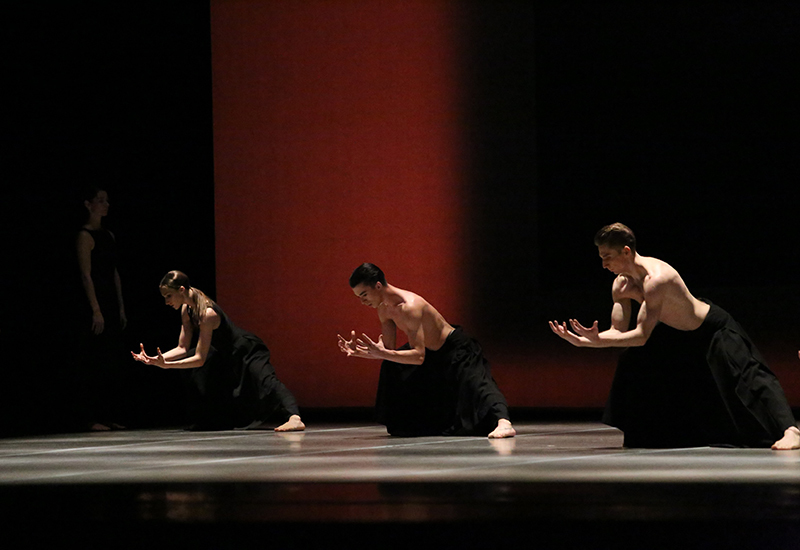
The famous Zurich choreographer Christian Shpuk released the new Ballet "Orlando" at the Bolshoi Theater. A week later, Mamt answered with two prime ministers : Sharon Eyal transferred the Autodance ballet to Moscow, the favorite of the Moscow public Akram Khan remoded his long work “Kaash”.
In the Bolshoi Theater
By watching Orlando, you might think that Virginia Wolf wrote the story of the success of a boy who, in four hundred years, became a happy single mother.
If we take the text like the novel Wolf for the ballet, then build a similar structure of action and look for the dance equivalent of the author’s irony. That is, leave only the name from the original and come up with something of your own. Andriy Zholdak and Susan Kennedy among the choreographers are not yet visible: “Putting a ballet according to the novel” still means retelling a plot that inevitably takes a stupid appearance, and the way the plot and content differ from each other. Is it possible to convey in the dance periods and parcellation of Wolf? Or passages like this: “The life of a decent woman all consisted of a chain of childbirth. Having married eighteen years, she had fifteen to eighteen children by thirty: twins were very often born. So the British Empire arose "?
Choreographer Christian Shpuk and Librettist Klaus Kopa decided not to answer the question of what the novel means - which means turning a man into a woman. They even pretended each scene with quotes from Orlando, but with texts based on the novel, which a female voice pronounces with the intonations of Google -translator. The audience perception immediately switches to the lower syntactic level: the actual choreographic pattern ceases to be significant - it is covered with a cap of a household situation, which needs to be accompanied by any set of body movements.
Choreography as the art of Rubato, the art of convergence and discrepancies with music, in Orlando.
Music always turns out to be more than required for such primitive illustrations. The choreographer, as well as the conductor, Alexei Bogorad, rightly decided not to cut her across: Elgar cell concert and Glass's violin concert are performed in whole parts. Standard set of "Gather a big ballet": late romanticism for the suffering of the hero, post -minimalism for the masses. It is well clear why choreographers have an unnatural passion for rehearsal music. Her motorcycle replaces the dance motor skills, and the fat orchestral texture, as in the concert of Glass, gives the feeling that the large mass of bodies is moving - the visual is imitated by the auditory. It is easy to reset responsibility for movement for such music and not bother about the hardly arranged choreography.
In Orlando, choreography is uninformative and non -functional, it does not move the action. Glissade , Renversé E and Port de Bras sets are mechanically and neatly laid out on strong shares - choreography as the art of Rubato , the art of convergence and discrepancy with music, there is no. The rhythmic landscape does not change. Illustrative episodes were broken by abstract ensembles, which were supposed to be “lyrical digressions” (the program numbers almost fifty artists “in other parties”), but in vocabulary and syntax do not differ from the exits of the characters.
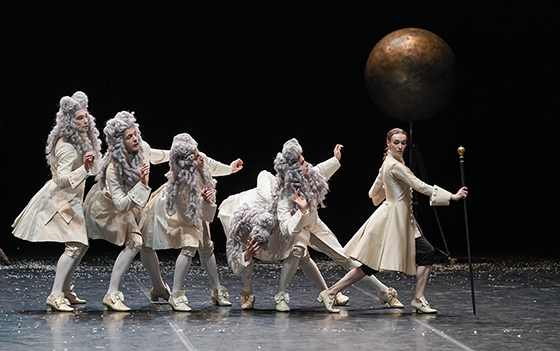 © Pavel Rychkov / Bolshoi Theater "Orlando" Christiana Shpuka. Orlando - Olga Smirnova
The high -class troupe of the large manage to give action the slightest connectivity and meaning. The heroes of the last performance of the premiere - Maria Vinogradova (Orlando) and Artemy Belyakov (Shelmerdin; he also walked in the Korolev Elizabeth party in a red -haired wig), Jacopo Tissy and David Mott Soares (abstract young men). In addition, congratulations to the prime minister of the theater Vladislav Lantratov (Nicholas Green) with a wonderful debut in the role of a grotesque.
At the same time, the performance looks stylish. It is possible to argue whether the scenography is two gray walls and the gray portal of Rufus Divishus, whether Martin Goebhardt’s light or artists who perform in the costumes of Emma Raitt are good at the semi -ducal. However, Orlando demonstrates the level of staging culture, still rare for Russian ballet. Only choreography and drops of absurdity are missing. Maybe for the next ballet to take Kysa Tolstoy or "Tellyuria" Sorokin ( Thème Russe , relevant)? Think about the texts of Erofeev one or Erofeev another? And not to cheer up the doomed Moscow intellectuals and order the Furtsev opera-ballet.
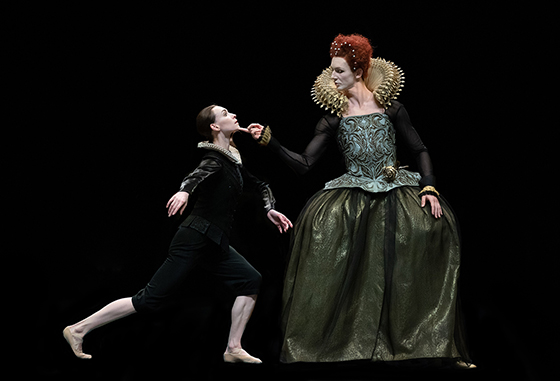 © Natalya Voronova / Bolshoi Theater "Orlando" Christiana Spuke. Orlando - Olga Smirnova, Elizabeth I - Semyon Chudin
In Mamt
“Autodance” begins with an energetic bat, blowing from the speakers, - what Bach - Balanchin, who danced and played as a herbarium, is needed after the “Baroque” Baroque. Along the perimeter of the scene, setting a plastic topic, someone walks for several minutes-if you look closely, you can see the ballerina Oksana Kardash, although it doesn’t matter who it is: the floor of the participants is leveled by bodily swimsuits, a dull light and a single type of movement.
The basis is the step on the high half -fans from which the dancers almost do not descend the entire half -hour ballet (during rehearsals, the chosen artists of Nehilo and the ankle joints and thekle joints). The step does not stop even in one place, only the amplitude changes. Plasticity can be roughly called the mannerist: a move with exaggerated extraction of legs through the knee, a discarded case, hands turned out in the shoulders, chematic changes in posings - imitation of softness at extreme tension. At the same time, the fourteen performers have a gap for artistic expression (it turns out to be something more complicated than the game familiar in the ballet with a face).
The Israeli choreography Sharon Eyal did not add anything new to her previous works (see the Half Life staged in Berlin). The same service technique for the Peni for the unchanged musical size is 4/4 - and retraining to each account, creating a monotonous pulsation. The same principle of increasing the body mass: begins one, the rest are connected, stick together in whom, stretch in a straight line. There is always a high -rise dominant (now Leonid Leontiev served it and danced excellently). Metamorphoses of mass cannot end: in " Half Life ” curtains them from the viewer, in the “ autodance ” artists gradually eat darkness.
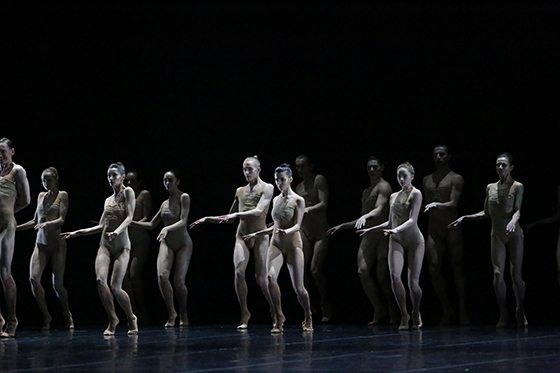 © Svetlana Avvakum "Autodance" Sharon Eyal
The work of the ejal does not lie in the planes of the “new”, “original”, “diverse”: the same amount of techniques rotates in the compositional versions to infinity. This variability consists of all interest. The composition " Autodance " sags exactly in the middle, with the beginning of a solo episode, and the final part dilutes the accumulated energy: not fun, not dreary, not scary. Nevertheless, the whole captures: the curtain for the bow had to be lifted four times. On this, the theme “Sharon Eyal in Russia” is quite exhausted.
Akram Khan “ Kaash ” remained losing: it was not worth it to give two ballets under the phonogram and in the twilight in a row. And the work itself, shown at the Diaghilev festival five years ago, faded after the author’s editing. The strict two -part structure collapsed, and the demonstration of the corporate alloy of the Indian cathac and the pan -European Contemporary Dance after numerous visits of the khan to Moscow is impressive. This is the fate of all “one of the best world choreographers”: thanks to festivals and broadcasts, the local viewer lost its artistic virginity, and it turned out that the theater performance cannot be built on some branded alloys or “bewitching work with the rhythm”. Exotic has become a routine, sometimes modest artistic qualities.
This does not cancel the powerful work of seven performers led by Dmitry Sobolevsky: in the series of impulsive Port de Bras , rotations and sharp departments to the floor, they were relaxed and accurately - and their dance was fired for eternal conversations about the "classics who try to dance modern." In the reader of the new dance, which was collected in the musical theater for the last four seasons, the artists showed a high class. More precisely, the class showed the vanguard of the troupe, two or three dozen artists out of one hundred four, and this is an internal problem. It is difficult to rehearse such programs (which was also noticeable at the premiere), and the validity periods are quickly expired. Following the big Dmitrovka comes a large, warm and roomy: Maxim Sevagin, which shone in the Autodance Solo , is already putting Romeo and Juliet. Konstantin Bogomolov was appointed to his partners.