
Translated material
"For two hares"
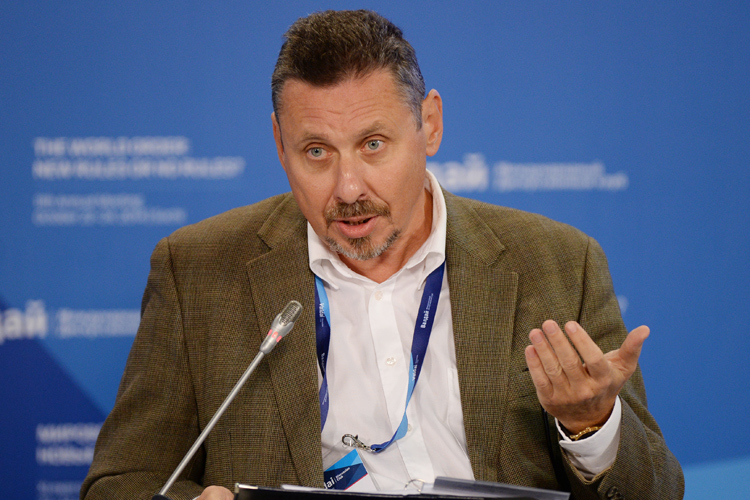
The reason for a conversation with the doctor of historical sciences, a professor at the European University in St. Petersburg , the head of the Center for the Study of Cultural Memory and Symbolic Policy, Alexei Miller, was the publication of an article by Russian President Vladimir Putin about the Second World War. To whom Putin wrote? Why can historians welcome the article by the Russian leader? And how does the Black Lives Matter movement affect the memory policy in Europe?
- The article by Vladimir Putin is actively discussed, historians from professional positions notes shortcomings and silence, but how should we evaluate this text?
- I think that not only historians notice shortcomings and silence. It is completely expected that people who do not like V.V. Putin, spoke out, what an article is bad and how much he lied and silent. And those people who “drown” for Putin talked about which article is wonderful. But I think that there is no need to pretend and think about this text as the text of a historian. Although for sure among the people who wrote this article, some historians were: we understand that this is the fruit of collective creativity. It is also clear that this is not a historical scientific text. We must evaluate the article as a step in memory policy, that is, from the point of view of political judgments and accents. And in this sense there is something to talk about. At the same time, in this text there is a call to ensure that the complex issues of European memory policy are the reason for organizing international scientific projects, where professionals-historians would study relevant issues. For me, as a historian, this is exactly what is important, but whether it will be possible to do something in this direction is another question.
- And another call to the opening of the archives.
- Yes, in the text it sounds through a comma. It is mentioned that the British have some parts of such archival funds closed, and then there is a very important call to open the opportunity to study the relevant documents and discuss difficult issues of the past. The historical workshop should definitely welcome this part of the article.
- The article was published in English, and then in Russian; For whom was she written? And how do you assess such an algorithm for publishing the text under discussion?
- In this part, we can talk about the obvious organizational failure. When I saw how this article was published, and looked at the text, I remembered the Russian proverb “Behind two hares”. Obviously, some fragments of the text and especially its beginning were written with the thought of a Russian -speaking reader. The most obvious proof of this is a link to the feat of the 6th company (the battle of a height of 776.-A.U. ) without additional explanations. It seems to me that even in Russia, not everyone will immediately understand what is being discussed, but many, of course, know. However, no one knows about this among the English -speaking public, except for single exceptions. This is the first. The second is that this text was first published in English , and then in Russian -this, from my point of view, is an extremely clumsy decision of those people who have been responsible for this. The choice of The National Interest as the publication sites also looks very strange: it, gently putting it on, is not the most authoritative. They could offer an article by Foreign Affairs , and I suspect that the magazine would not refuse. Well, the quality of the English text clearly indicates that the translator is not a native. This is generally inexplicable.
Another thing is also important - such a long text is strange to publish now in America, which is busy with its own problems: Black Lives Matter , monuments fly, the presidential campaign is in full swing. And here this is an appeal to the Americans. It is quite obvious that the article will not receive great resonance in the United States. Those who have such a job will unsubscribe on it - scold Putin. I would understand if this article was published in Germany, in which these questions of people are worried and talk about them. Recall the article by Haiko Maas (German Foreign Minister. - A.U. ), which he wrote in co -authorship with the historian. By the way, this form was more elegant in its own way , and the article itself is much shorter. From the point of view of P Ublic R Elats, the publication of Putin's article in a non -authoritative American magazine is an extremely unsuccessful entry. The large text should be published in Russian, but a compressed and focused option to be presented in English, but to publish it not in America, but in Europe - either in America and Europe at the same time. In its current form, from my point of view, all this turned out on a live thread, extremely unsuccessfully. The publication of the article was not announced, and this shows that everything was decided at the last moment. This allows us to talk about the obvious shortcomings of the apparatus that did this.
- Over the past few years, many Russian officials spoke about the events of World War II. How does the president’s new article correlate with these statements?
- There were many statements, and they were different, but I would note several important points. Firstly , over the past year or two, many, including prominent figures as Sergey Naryshkin and Sergey Ivanov, as well as representatives of the Russian Military Historical Society, spoke about the Pact Ribbentrop-Molotov as an outstanding victory of Soviet diplomacy. We know that a bill filed in the State Duma submitted by the hyperactive deputy Alexei Zhuravlev, on the cancellation of the decision of the Congress of People's Deputies of the USSR, which Putin refers in his article. In this sense, the article removes the possibility of adopting a law on the cancellation of the 1989 resolution. Thus, the assessment of the pact that Putin gave in 2009 was confirmed when he went to Poland. And that's good. Secondly , the article is convicted of Stalinist repressions. Yes, this is not Newton's bin, there is nothing new in this, but the fact that it was said is important. Thirdly , the article notes not only the victims of the confrontation with Nazism, but also the victims with which the people paid for Soviet political and military decisions. All this can be appreciated positively.
Whether the events in the Baltic states were shown well - no, not good. Is there any silence in the text - there is. Here we once again rest on a large topic: we still have not figured out how to tell us about the Soviet past. We have passed the indiscriminate condemnation, and it no longer works, but the indiscriminate excuse, to which many in today's Russia are rolling, also does not work. Why should we fight for the pure shirt of the Soviet Union, which has never been such, I do not understand.
If we look at these statements, namely, the discovery of archives and the invitation of historians to participate in international projects in order to create a new, less filled with inconsistencies, shaking the Second World War and the preceding period, we will see that this means a large -scale revision of those positions that have been formulated for a long time and no longer work. Moreover, these old installations do not work for either Americans, or for the British, or for us. This is very important, hence the path to the realization that all these cries about “we will not let the story” look just ridiculous. For historians, they always looked funny: after all, historians are only doing that what they rewrite history.
It is important to see another point in this message. There, of course, there are many strict words addressed to those who are trying to rehabilitate collaborators, but at the same time it is very clearly said about the need for a mutual insistent dialogue about the complex issues of the past. I repeatedly wrote that in the atmosphere of the Memory War, we rolled up to the antagonistic approach, when the space for dialogue was destroyed. We can study the reaction to this article by Putin as an exercise in memory wars. But the call to the dialogue contains it, and it is addressed to the great powers, so to speak, to participants in the anti -Hitler coalition. It is this item - a statement expressed in the first person about readiness for a mutual insinight dialogue - for me the main thing in this text and the only reason why Putin makes sense to speak out during these wars of memory. Putin has already talked about this in Jerusalem in January , now he repeats it, but whether such a meeting will be held in the format of the summit is a big question for me. The Americans are very busy with their own, but a lot is possible in the context of the presidential campaign. Now, for example, the United States decided to reconcile the Balkans . This is always a promising idea - to reconcile the Balkans. However, it seems to me that in modern conditions Putin’s proposal to enter into a dialogue will hang in the air - simply because people are not busy. But what will happen after November, after the US presidential election, is difficult to say. Maybe then the opportunity will open for such a dialogue. In any case, the invitation is again voiced.
-Can anyone else in addition to the United States enter into such a dialogue about the past? Perhaps strong European states?
- We must pay attention to some contradictions. The trigger was the resolution of the European Parliament of September 19, 2019 “On the importance of preserving historical memory for future Europe”, at which Putin specifically stops in the article. They talked about this resolution and its significance many times. It turns out that we must speak, first of all, with Europeans, and not with the Americans. And here Putin follows what he had to do. It takes a strict position in relation to Eastern Europe, especially Poland, and a position involving dialogue, the search, albeit consent, but understanding, in relation to “old” Europe, which has its own long tradition of building a policy of memory of the Second World War.
But today's situation is unlikely to contribute to concentration on such a dialogue. The anti -racist movement with very different manifestations and political consequences covered after the United States and Europe. The question arises: if this topic, in fact, is the topic of colonialism and colonial heritage - very important for Europe, there is no dispute - it comes to the fore, what happens, for example, with the theme of the Holocaust? Is it in the foreground or not? What happens to overcoming Eurocentrism in the history of World War II? After all, China suffered most in absolute numbers, but few people remember about it.
We are now observing the effect of a spoiled kaleidoscope. The tube rotates, the glasses change their position, but they do not add up to some orderly picture. The symbol of this situation may be a monument to Winston Churchill in London, which was closed with a box . Churchill can be presented a lot , but not presented to Bengal, but racism. Mahatma Gandhi was also accused of racism . Fierce battles flashed on other fronts of memory policies, there is a tough struggle, they do not take prisoners. All these circumstances must be taken into account. Therefore, the resonance from Putin’s article will not be very strong, the voices of those who received an occasion to say again which Putin is bad will be heard most.