
Translated material
There is contact
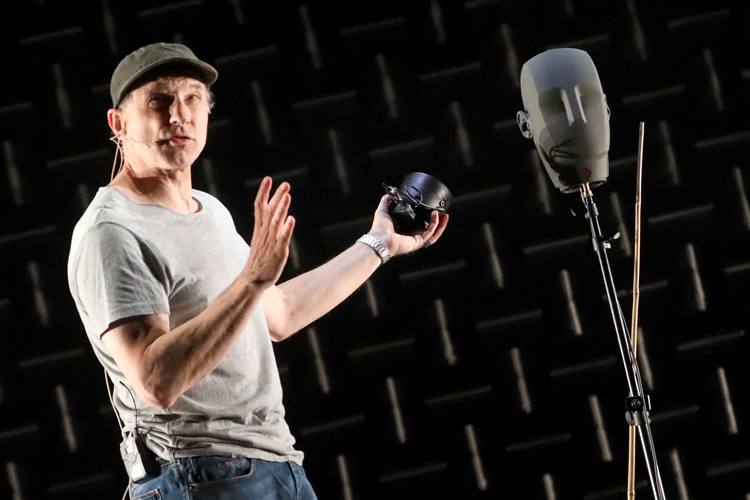
Festivals “Cherry Forest” and “Golden Mask” showed in Moscow one of the main hits of the European festival market in recent years - “Meeting” by Simon McBberny and the Complicité Theater. About the play of an outstanding British director and actor - Anton Khitrov.
In 1969, the American photographer Lauren Mcyntair alone traveled to the jungle of the Amazon to take the first pictures of the people of Mayorun - one of many dozens of non -contact tribes of the Amazon, living in isolation from the rest of humanity. The American returned without photographs, without a camera, but with an incredible story about the Telpat Indians traveling in time.
Makintire saw Mayorun near the camp, went to the village after them and forgot the road back. I had to wander through the forest with “cat people” (as they were nicknamed for the custom to decorate their face with spikes like a cat's mustache). Over time, the photographer allegedly established a telepathic connection with their leader - and realized where the tribe moves: back to the Stone Age, where white people do not threaten him. The traveler assured that he had been in the distant past with Mayorun, but managed to return along the river.
In 1991, the Romanian writer Peter Popescu told the story of Makintire in the book “Lucheznaya Amazon”. The monoscope “ The Encounter ” (“Meeting”, “Contact”), set and played a quarter of a century later, Simon McBberney, of course, should be attributed to the department of the immersive theater, although everything seems to be more than traditional: the artist on the stage, the audience in the hall, between them ramp. But the audience really fall into the thick of events - not physically, but with the help of a binary record - technology that allows you to hear in 3D, however, only in headphones. On the stage is a dummy of the head with microphones in the ears, to which McBberney arranges a real presentation: “Now I am pouring to you in the right ear and you will feel hot air. And now I move to my left ear - right through the brain. Hear, I'm in your skull! "
The sound is headed by Gareth Fry and Pete Malkin; “Meeting” without their fantastic sound design is like Robert Wilson's projects without hey Jay Weissbard and his magical light. For example, during the performance the storyteller’s voice changes: McBberney speaks with tenor, and Lauren Mcyntair - bass. High-tech is adjacent to emphasized by old-school tricks: a pack of chips depicts a crack of fire, a bottle of mineral water-a splash of a river.
We get too valid our past to let him go.
We see three times alternately: the present, where the director appears in front of the hall, the recent past, where he creates this project, and the past is more distant, where the Macrantire travels around the jungle. “Meeting” is one of those performances in which the authors become characters: McBberney is chatting with the audience in the manner of a stand-up comedian, he returns himself several years ago, when he spoke with an expert or a little daughter.
The director manipulates with space and time no worse than the Superhero-wizard Dr. Strange (by the way, Benedict Cumberbatch, playing Strandja in the Marvel Cinema, is a big fan of the Meeting). He communicates with people whose voices once wrote down: it turns out a phone between the present and the past. It allows you to be in two places at once, on the stage and in the hall, and even gives you a kind of out-of-you experience: after all, the binaural mannequin in front of you-in a sense your head. But there is no more magic here than on the set of Dr. Strange: these are just high -class special effects. Real magic is there, in the jungle.
It is from this that the narrator begins the performance: do not forget, they say, you are in the theater, you are being deceived here. First, he, as it were, accidentally breaks the invaluable cassette from the family archive and after a second admits: it was a fake, I deliberately dropped it. And some time later it interrupts itself with the words "actually I have been silent for a long time, and you are listening to the record."
Therefore, the “meeting” is more than the attraction. The task of McBberney is not that you are amazed at the achievements of modern recording. On the contrary, he wants to shake your faith in technology. It seems to you that the director’s voice sounds in your head, but it's just a focus, not a genuine telepathy. Or another example is a photograph that both the Macyntire and McBberney himself are talking about: we take pictures of fear of losing the past, but we do not control time - this is only an illusion. Even if the secret knowledge of Mayorun is just primitive magical beliefs, we differ little from them: after all, we attribute to ourselves supernatural opportunities that we do not have.
The “meeting” is echoing with the installation of Robert Lepage “Night in the Library” shown at the “Territory” festival last fall: the Canadian colleague of McBberney also exposed the technology with their help. Lepage created ten VR Video about the most amazing libraries of the world -from Alexandria to the cabinet of Captain Nemo. Visitors fell into a dark reading room, lit only by green table lamps - but instead of volumes and brochures they were expected by helmets of virtual reality. As a result, flanifying famous libraries, you could not get rid of the thought that the gadget that made this trip was possible - only a surrogate of the book.
Macyntire described how, on the way to the golden eyelid, Majorun lit a large bonfire and threw all his things into it: it was necessary to move on. Observing the ritual, he imagined how it would look at his homeland: families carry property onto the lawn in front of the house, watered gasoline and set fire to, cities are feeling in a flame, the White House, the Congress library - all the great American heritage turns into coals. In McBberney, this fantasy becomes an emotional peak of the performance - with the howl of a fire siren, red computer fire and the cries of an invisible crowd. The narrator revels in the spectacle of the fire, perfectly understanding that in fact, such joys are not available to people of civilization - they are too cherished by their past to let him go. Otherwise, a real family cassette would have broken on stage.